
Dual stage actuator suspension having a single microactuator and employing pseudo symmetry to achieve suspension balance
a microactuator and suspension technology, applied in the direction of maintaining head carrier alignment, recording information storage, instruments, etc., can solve the problem that dsa suspensions have only been available recently in the commercial mark
- Summary
- Abstract
- Description
- Claims
- Application Information
AI Technical Summary
Benefits of technology
Problems solved by technology
Method used
Image

Examples
first embodiment
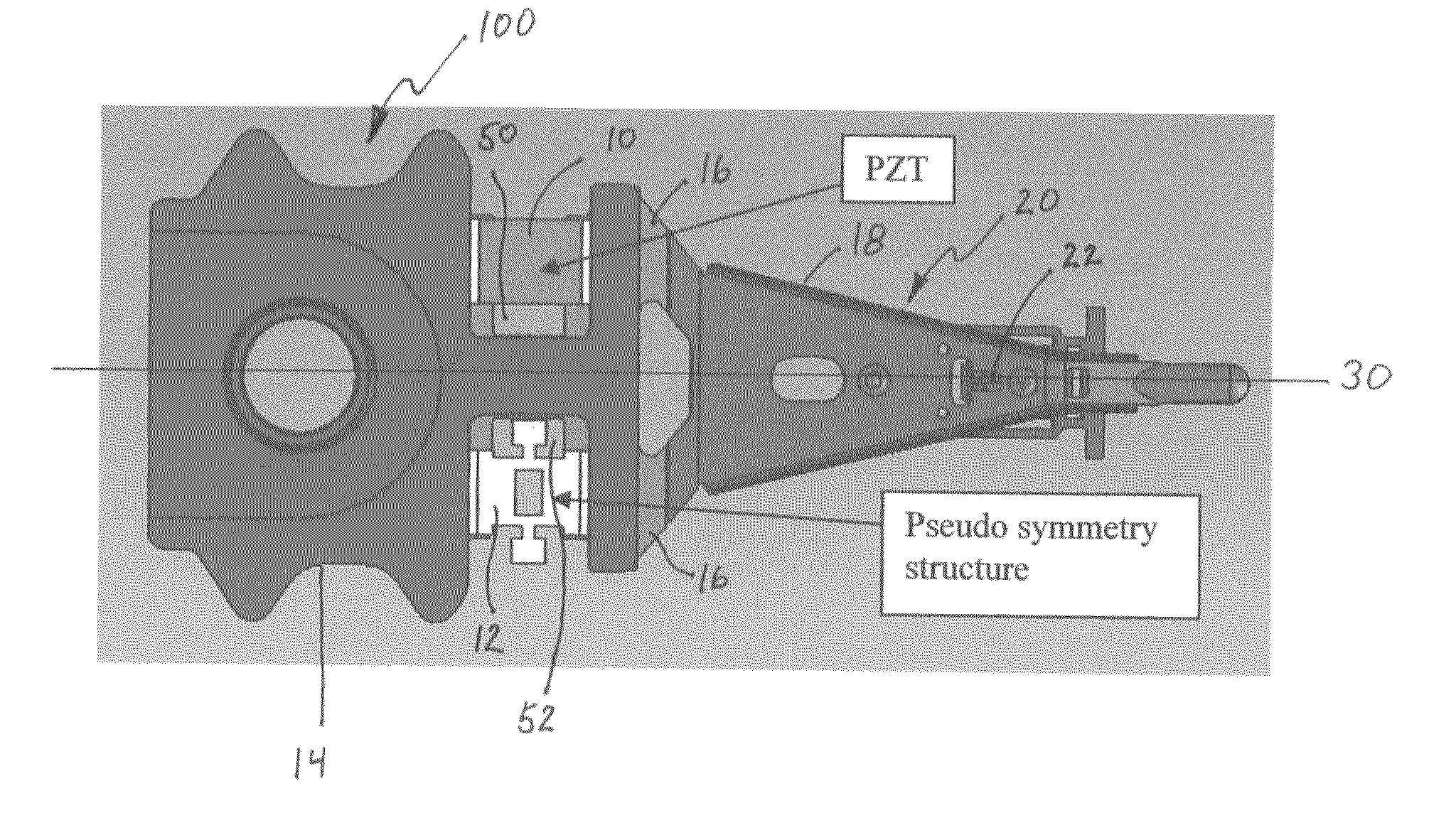
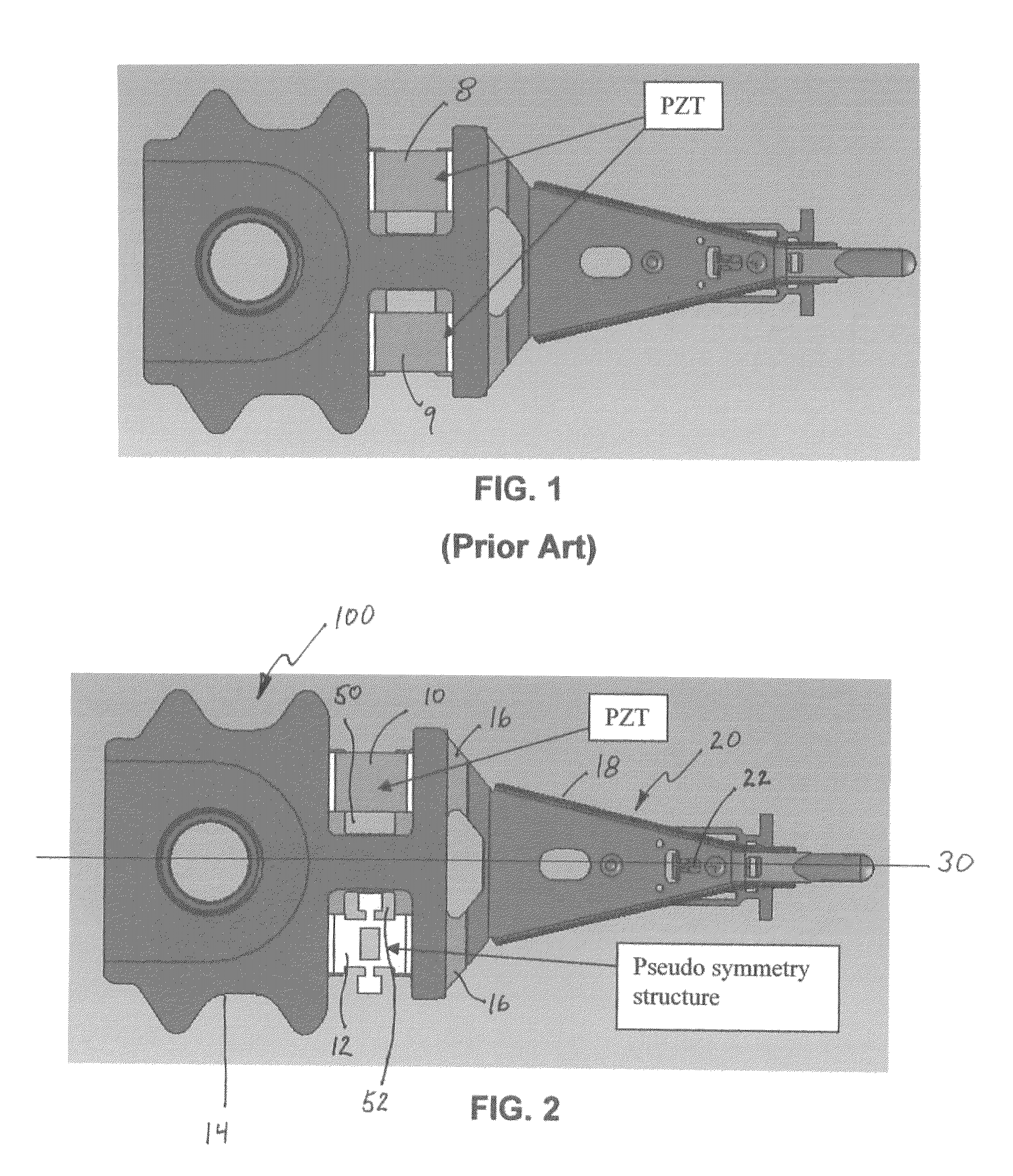
[0025]FIG. 2 is a top plan view of a DSA suspension 100 having PZT 10 and balancing structure or pseudo symmetry structure 12 according to the present invention. PZT 10 has convention electrical connections thereto (not shown) that will add somewhat to the weight and inertial characteristics of PZT 10. For purposes of the present discussion throughout this disclosure and the appended claims, what will be referred to as the PZT or other microactuator encompasses the electrical connections thereto and their weights. Pseudo symmetry structure 12 may be fabricated separately and thereafter affixed to suspension 100 such as by an adhesive such as epoxy, or by laser welding. It is currently anticipated that the preferred embodiment will include at least one added stainless steel component that is formed separately and later affixed to the suspension by welding. Accordingly, in the discussion that follows, although the pseudo symmetry structure component will be referred to for brevity as ...
second embodiment
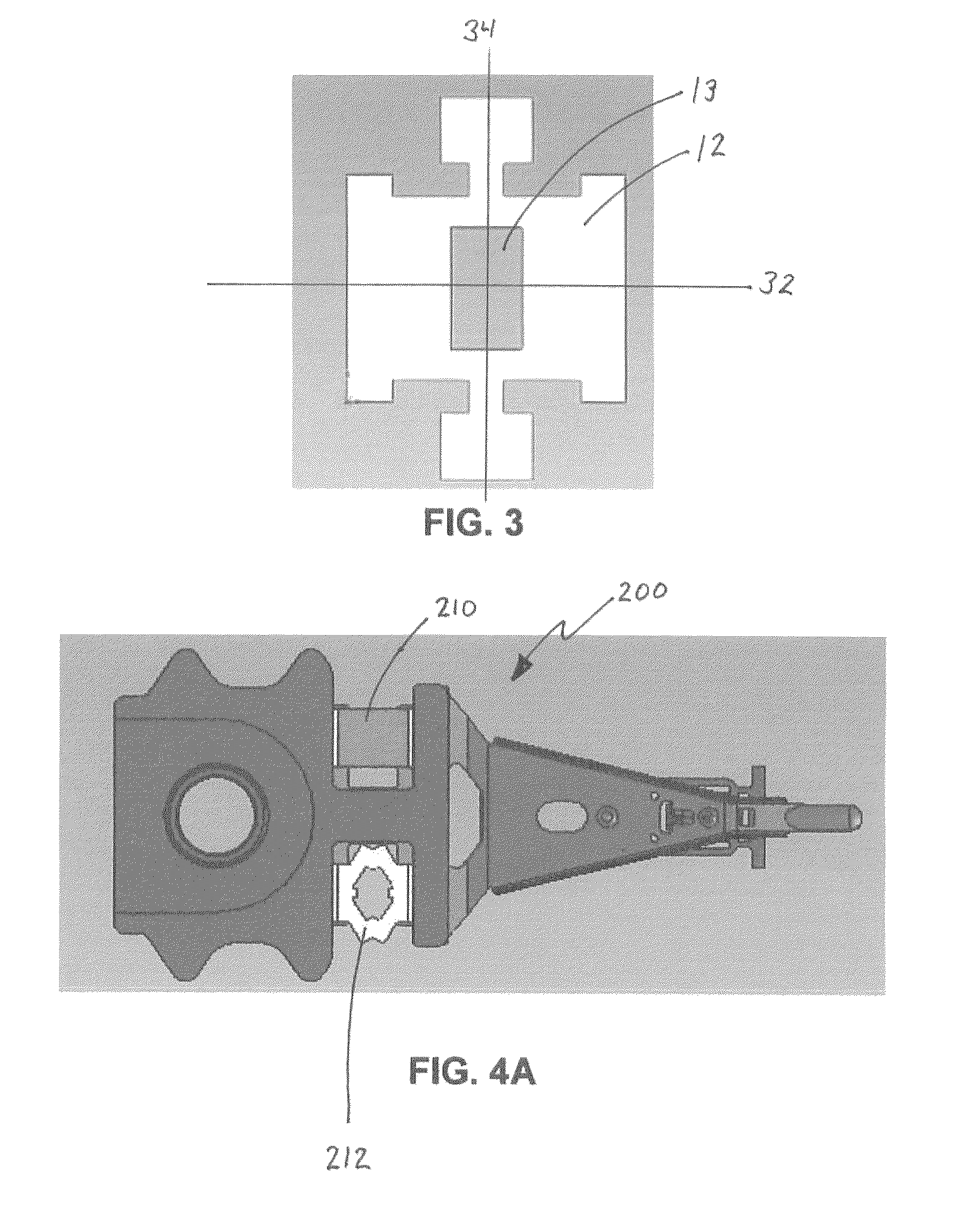
[0030]FIG. 4A is a top plan view of a DSA suspension 200 having a single non-split PZT 210 and a pseudo symmetry structure 212 according to the invention. This embodiment is similar to the embodiment of FIG. 2 except that the shape of pseudo symmetry structure 212 is different.
[0031]FIG. 4B is a bottom plan view of the suspension of FIG. 4A. This view shows magnetic head slider 260 which is a conventional head slider. In operation, PZT microactuator 210 expands or contracts in response to a microactuator driving voltage applied thereto causing the distal end of suspension 200 carrying head slider 260 to move slightly up or down as oriented in the figure, thus effecting microfine movements of head slider 260 in order to keep head slider 260 properly positioned over the desired data track on the magnetic disk surface (not shown). Pseudo symmetry element 212 counterbalances PZT both statically and inertially.
[0032]FIG. 5 is a top plan view of the pseudo symmetry structure 212 of the su...
PUM
| Property | Measurement | Unit |
|---|---|---|
| mass | aaaaa | aaaaa |
| stiffness | aaaaa | aaaaa |
| pseudo symmetry structure | aaaaa | aaaaa |
Abstract
Description
Claims
Application Information
 Login to View More