[0015]It has been found that the
algorithm according to the invention can be implemented in a particularly simple and effective manner in hardware, preferably in FPGA or ASIC modules. In particular, the required memory is also relatively small. Taken together, these lead to a very fast identification of corner points of objects between straight-line segments and a possible further segmentation using these points. In particular, it is then also possible to form quickly links between the corner points and to further process them.
[0018]When the conditions (i) to (iii) remain fulfilled for a large number of adjacent contour points, the computational effort for the determination of the minimal
aperture angle for the contour point p increases. Therefore, it is advantageous for the computational effort and the speed of the analysis of corner points when the device for the determination of corner points of contours is designed in such a way that, for a given contour point p on either side along a contour, at most 7 contour points are included for the tests of the conditions (i), (ii), and (iii). In other words, the test is terminated when the contour points p+, p+ are each separated by seven contour points from the point p.
[0023]The selection operation according to the invention, in which, in each case, contour points that have the lowest connection probability in relation to the central point are sorted out of a set offers the
advantage of requiring very little memory. In particular, the
processing can be conducted on the basis of continuous
list data. The small memory requirement needed for this even allows
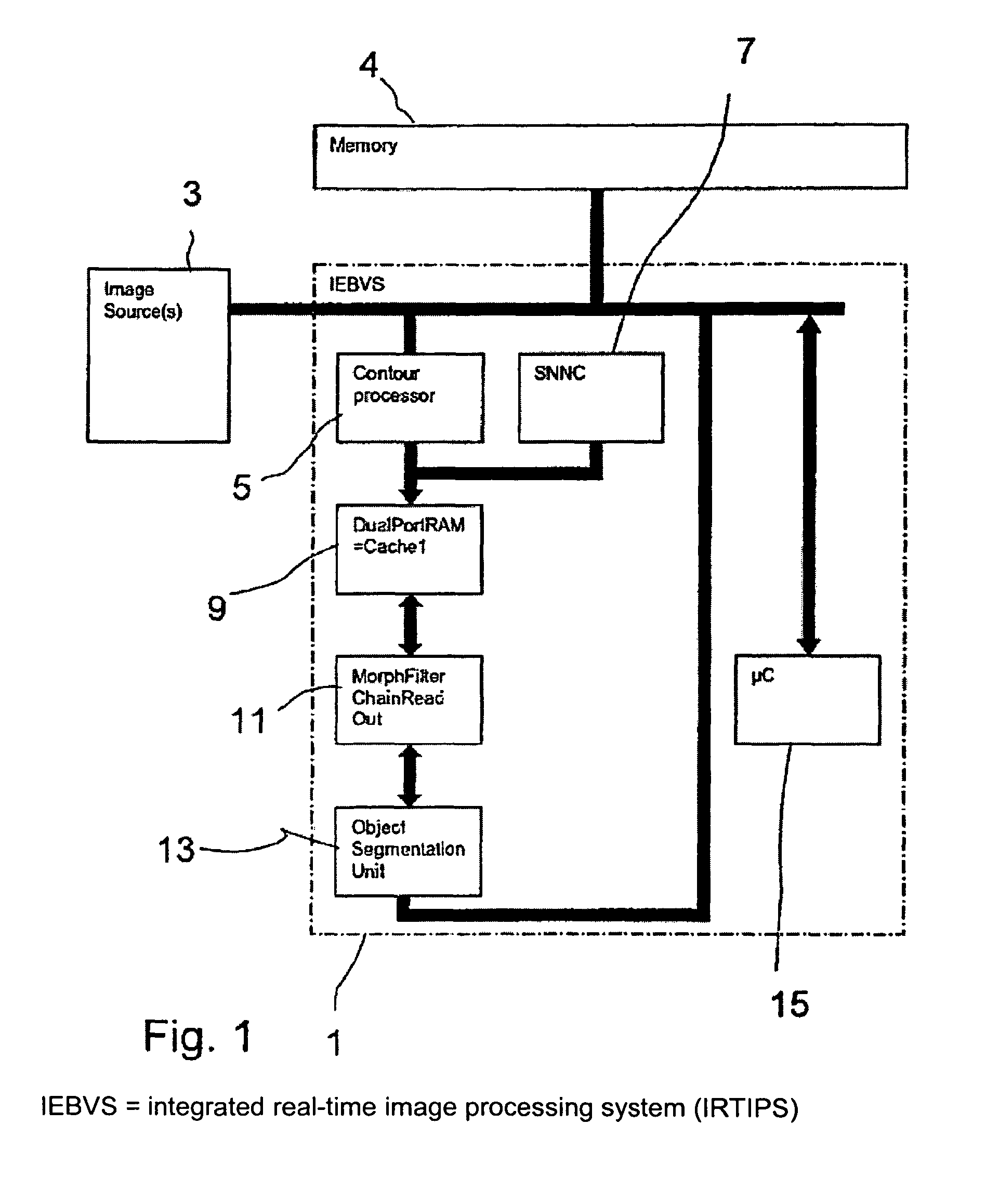
processing in real time with little demand in terms of the hardware to be used. In addition, on account of their simplicity, the processes described above can easily be implemented in
hardware modules without elaborate
software and
peripheral circuitry. The apparatus according to the invention can therefore be designed very simply as a very compact integrated hardware image processing apparatus. In order to reduce the required memory, the further processing of the contour points in the form of continuous
list data, in particular, is also especially advantageous. These list data preferably contain only the pixel coordinates of relevant contour points as well as attributes of the surrounding area and, accordingly, only the data that is relevant for the contour identification. Accordingly, in this way, the amount of data is reduced to a minimum in comparison to the
original data of the image. The sorting out has the purpose of determining those contour points that, together with the respectively considered central point, belong to the same contour.
[0037]In order to be able to process the image data quickly with only little required memory, in particular to determine contour points and connectors from the image data, it is further preferred that the image data is read out in several strips, each of which has a width of more than 1 pixel, preferably at least 16 pixels, and particularly preferred, 26 or 32 pixels. Preferably, in this case, the image data are read out successively in strips that overlap by more than one pixel, preferably by at least 4 pixels, particularly preferred by at least 8 pixels. Although, under certain circumstances, on account of this overlap, connectors will be calculated twice in the overlap region, this additional effort will be more than compensated for by the fact that the individual determined contours can be combined again more easily and with fewer errors.
[0038]The image processing apparatus is further preferably designed for real-time image processing. This means that, within the
image transfer, a complete determination is conducted for the objects that the contours describe. This real-
time processing is made possible, in particular, also by the very simple calculation of the connectors for the contour points.


 Login to View More
  Login to View More