
Spread-spectrum high-frequency heating device
a heating device and high-frequency technology, applied in the field of rf heating system, can solve the problems of easy damage of the semiconductor power amplifier, and achieve the effect of reducing the size and cost of the heating system, facilitating the heating process, and ensuring the optimal heating process conditions
- Summary
- Abstract
- Description
- Claims
- Application Information
AI Technical Summary
Benefits of technology
Problems solved by technology
Method used
Image

Examples
embodiment 1
[0066]Hereinafter, a first specific preferred embodiment of an RF heating system according to the present invention will be described.
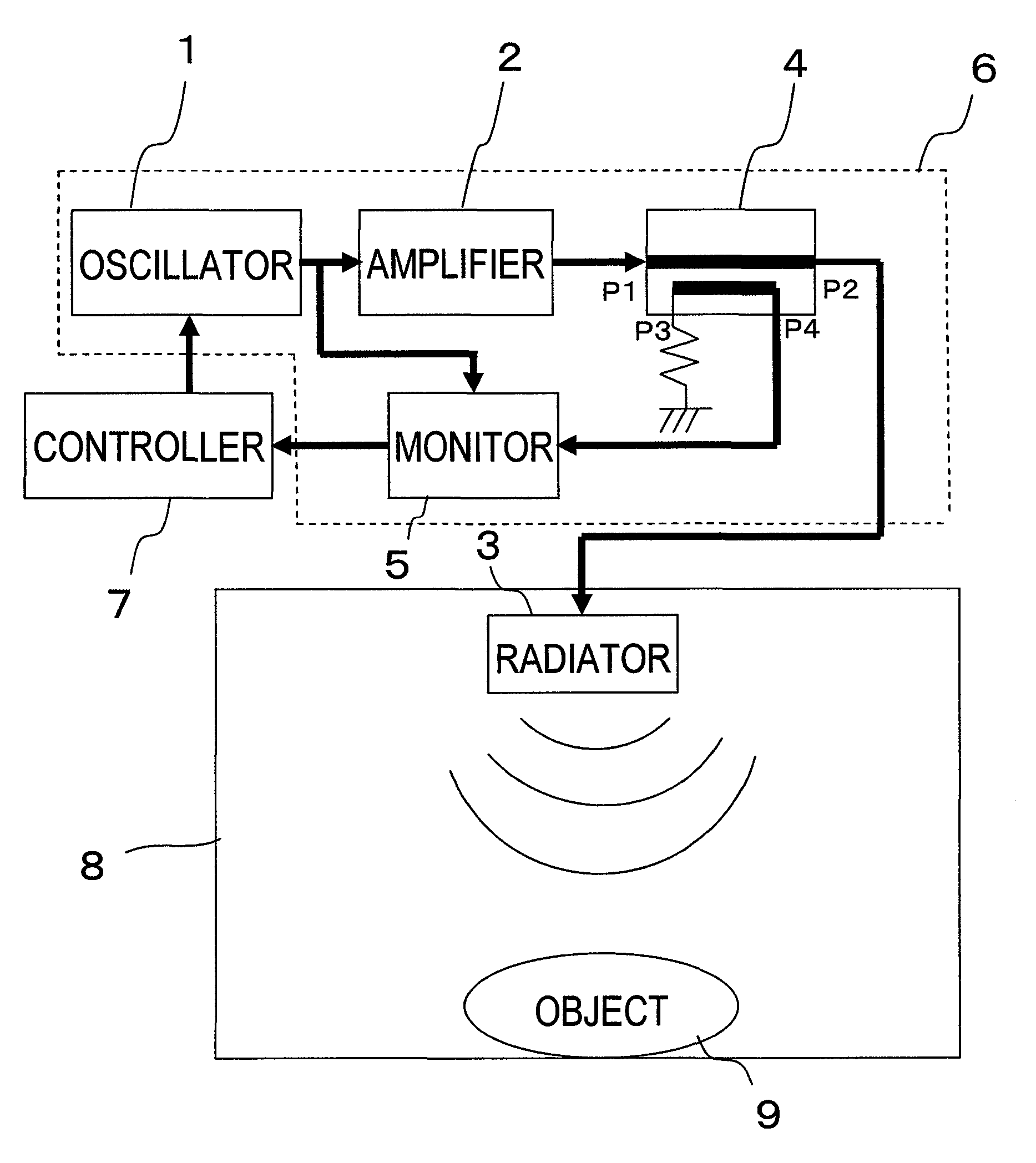
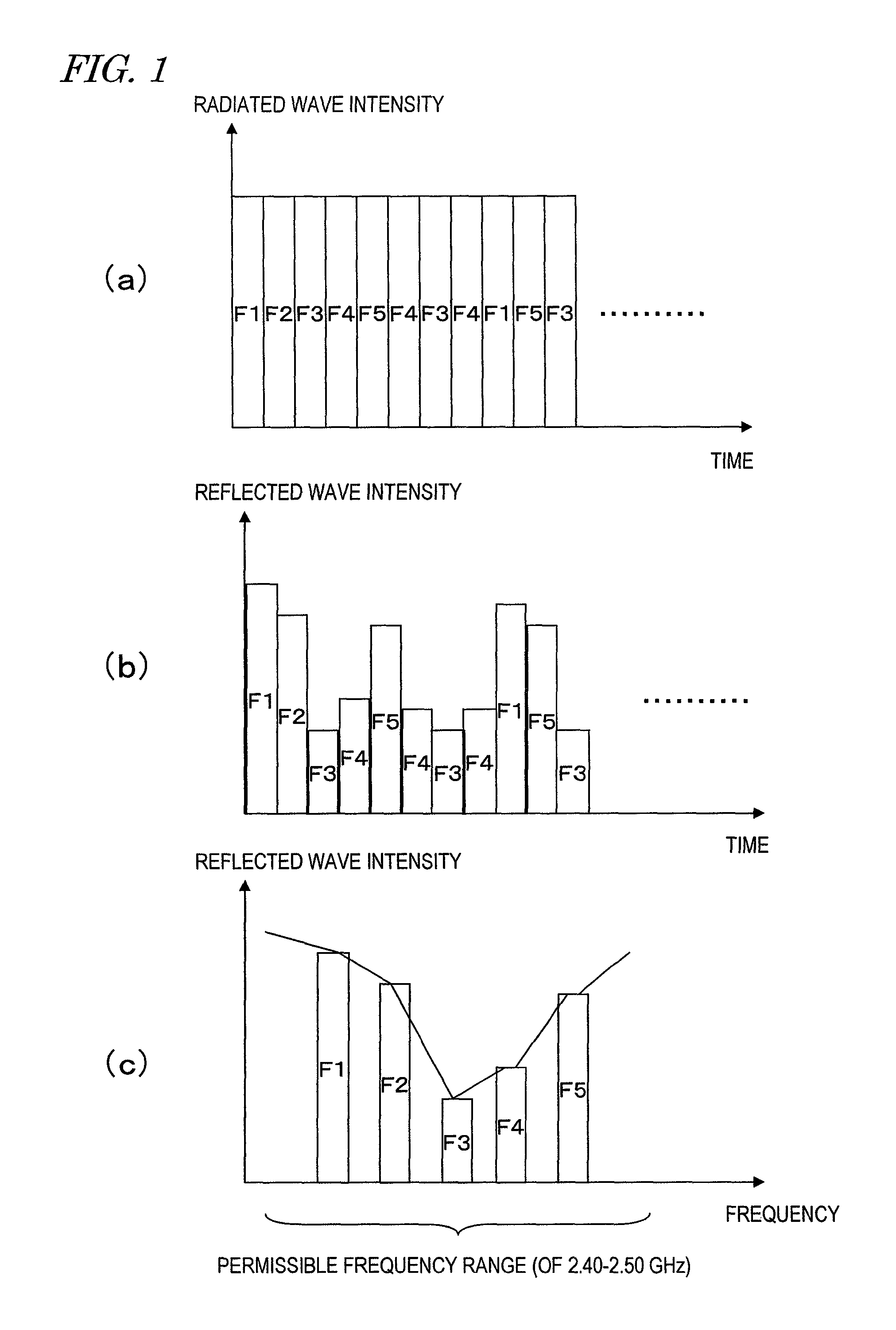
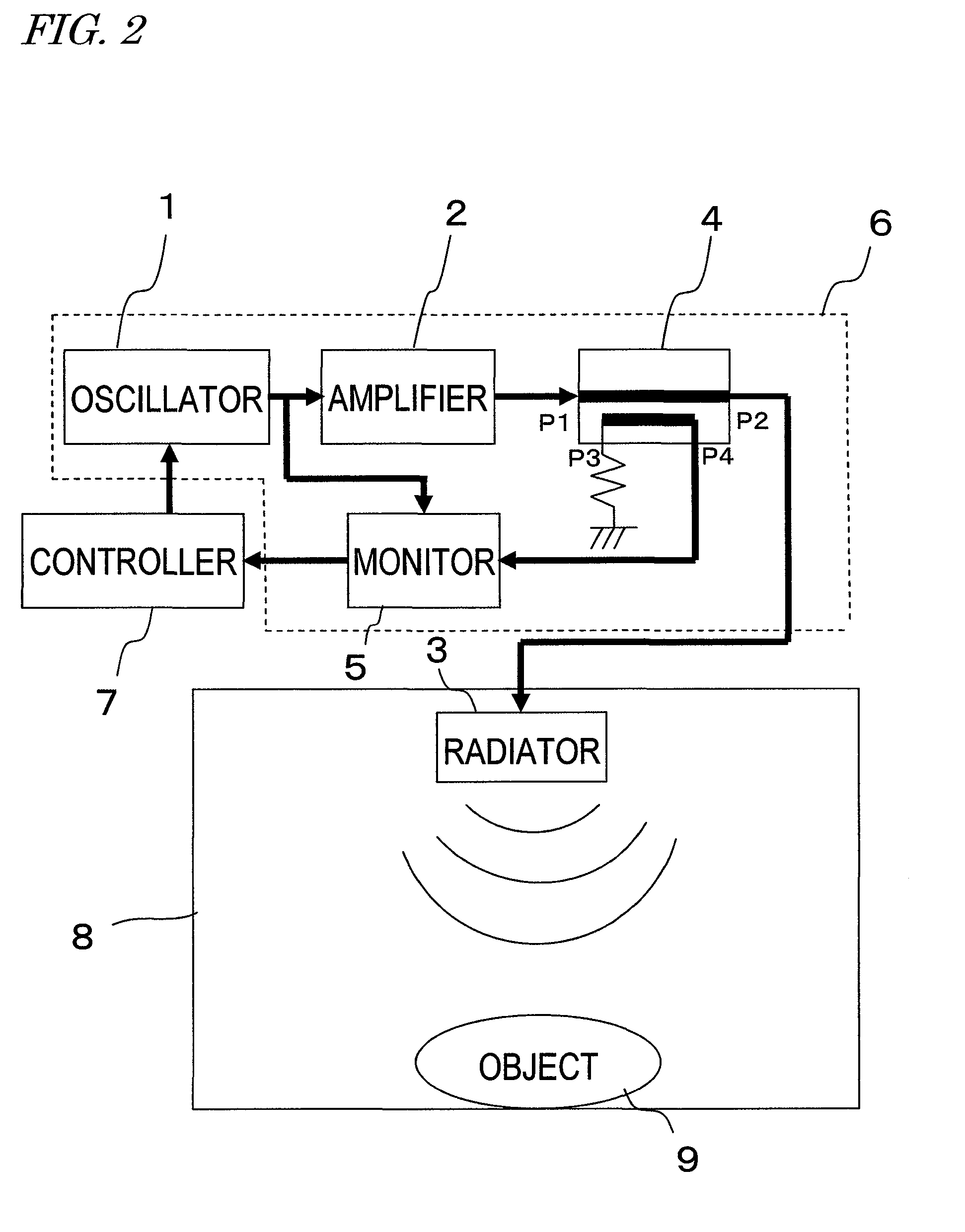
[0067]First of all, look at FIG. 2, which is a block diagram illustrating an RF heating system as a first preferred embodiment of the present invention. The RF heating system shown in FIG. 2 includes a variable-frequency oscillator 1, a semiconductor power amplifier 2 for amplifying the output of the variable-frequency oscillator 1, a radiator 3 for radiating an electromagnetic wave for heating based on the output of the semiconductor power amplifier 2, a reflected wave monitoring circuit 5 for detecting a reflected wave of the electromagnetic wave for heating, and a controller 7 for controlling the oscillation frequency of the variable-frequency oscillator 1. The controller 7 changes the oscillation frequencies of the variable-frequency oscillator 1 discontinuously, thereby getting frequency-hopping spread-spectrum radiation done by the radiator 3. T...
embodiment 2
[0108]Hereinafter, a second preferred embodiment of an RF heating system according to the present invention will be described with reference to FIG. 8, which is a block diagram illustrating a configuration for the RF heating system of the second preferred embodiment.
[0109]As shown in FIG. 8, the RF heating system of this preferred embodiment includes a number of radiating circuits 6, each including the variable-frequency oscillator 1, the semiconductor power amplifier 2, the directional coupler 4 and the reflected wave monitoring circuit 5. Also, each of those radiating circuits 6 is coupled to its associated radiator 3. Those radiators 3 are preferably arranged on mutually different wall surfaces of the same heating chamber 8 and preferably face the object 9 to be heated 9 in the heating chamber 8 at significantly different angles. Each of these components has basically the same structure, and operates in substantially the same way, as its counterpart of the first preferred embodim...
PUM
 Login to View More
 Abstract
Description
Claims
Application Information
 Login to View More