
Cone beam CT scanning
a computerized tomography and cone beam technology, applied in the field of cone beam computerized tomography, can solve the problems of increasing the reconstruction error with increasing the beam cone angle, the data sets (projections) associated with such a trajectory are theoretically insufficient for precise object reconstruction, and the estimation of object density values may not be adequate by approximation algorithms
- Summary
- Abstract
- Description
- Claims
- Application Information
AI Technical Summary
Benefits of technology
Problems solved by technology
Method used
Image

Examples
Embodiment Construction
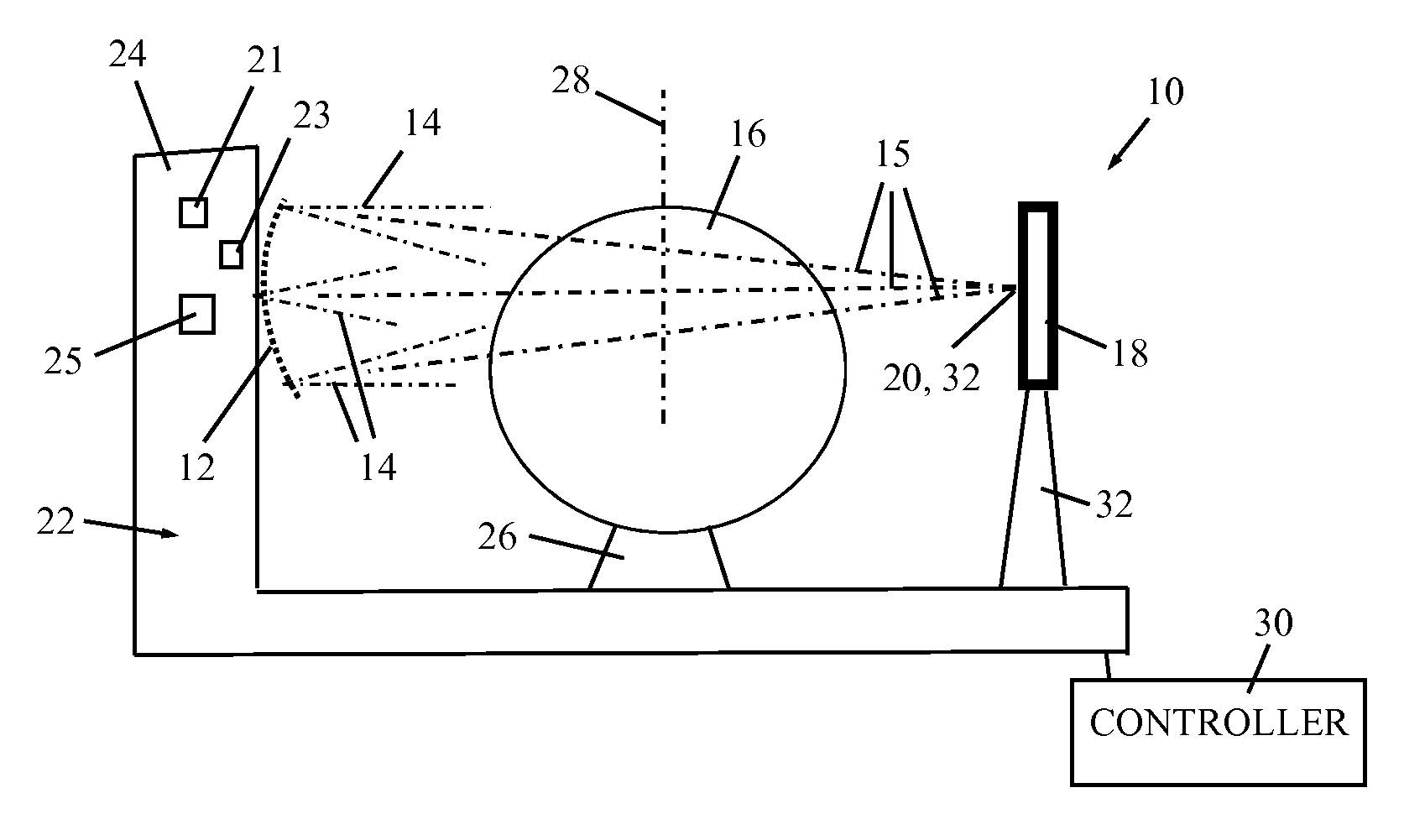
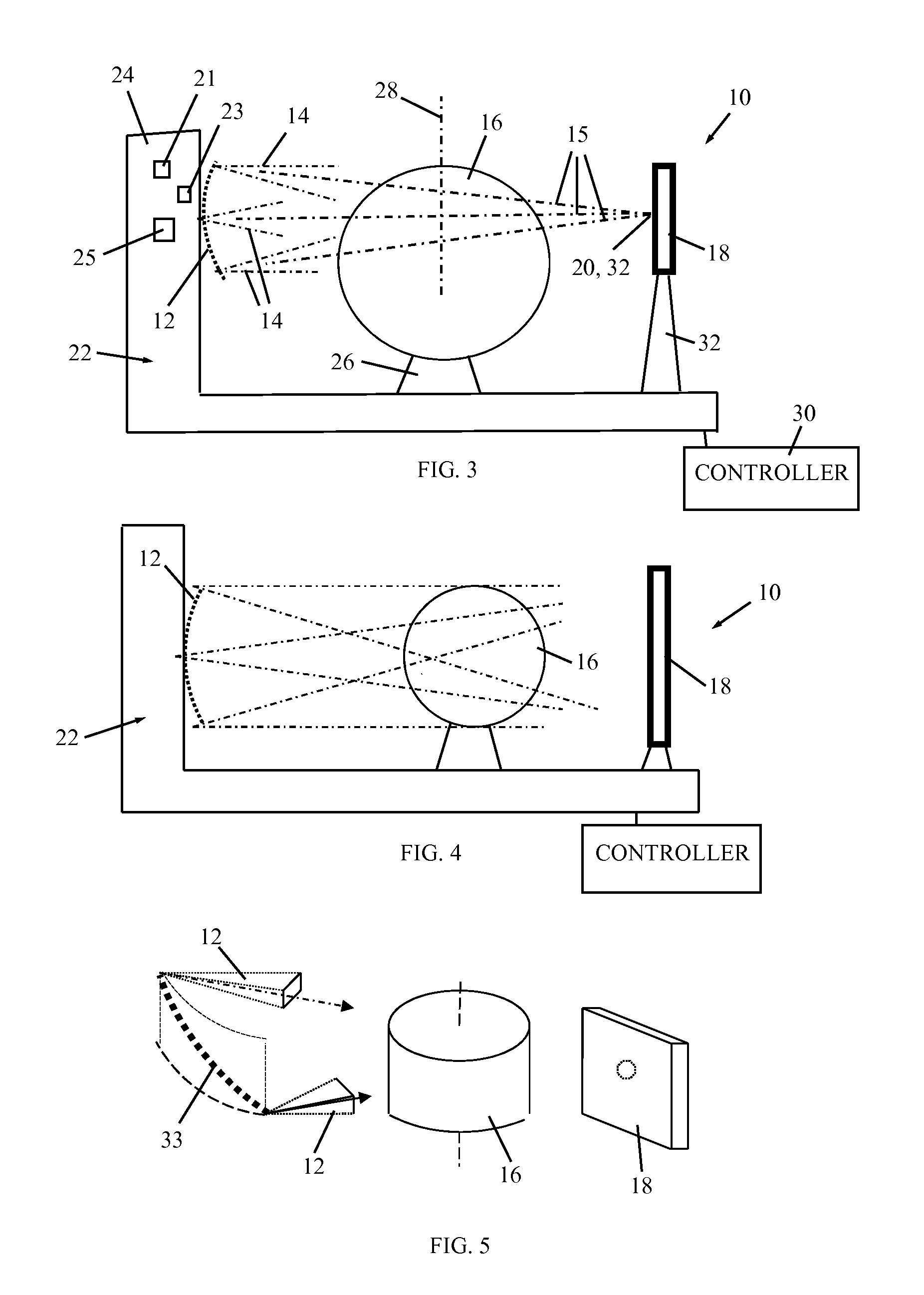
[0025]Reference is now made to FIG. 3, which illustrates a cone beam CT (CBCT) scanner system 10, constructed and operative in accordance with an embodiment of the present invention.
[0026]CBCT system 10 includes a radiation source 12 (such as, but not limited to, an X-ray source) that emits a cone beam 14 of radiation in a beam direction 15 towards an object 16, such as an animate object (e.g., human or animal) or an inanimate object. A detector 18 is provided on the other side of object 16 and has a detector center 20. Detector 18 detects the cone beam(s) 14 of radiation, which pass through, off, over or around object 16.
[0027]CBCT system 10 includes a positioner 22 that can move radiation source 12 and the object 16 according to a scanning trajectory. Without limitation, positioner 22 includes a gantry 24, which moves the housing which houses the radiation source 12. Motion of the source housing may be implemented by electronically moving the source position. To achieve that, gant...
PUM
| Property | Measurement | Unit |
|---|---|---|
| fan angles | aaaaa | aaaaa |
| speed | aaaaa | aaaaa |
| trajectory | aaaaa | aaaaa |
Abstract
Description
Claims
Application Information
 Login to View More