
Composite sheet and display substrate using same
a technology of composite sheets and substrates, applied in the field of composite sheets and display substrates, can solve the problems of polyimide-based resins not being suitable for substrate materials, deflection of products, disconnection of wiring, etc., and achieve the effects of low coefficient of thermal expansion, excellent flexibility, tensile strength, and bending resistan
Active Publication Date: 2015-05-19
KOREA INST OF IND TECH +1
View PDF3 Cites 0 Cited by
- Summary
- Abstract
- Description
- Claims
- Application Information
AI Technical Summary
Benefits of technology
The present invention is a composite sheet with excellent flexibility, transparency, and heat resistance. It also has good impact resistance, tensile strength, and bending resistance. The composite sheet has low coefficients of thermal expansion and good light transmittance. It has low viscosity, providing excellent processibility and wettability in preparing a glass fiber composite. Additionally, it exhibits Tg-less properties within a process temperature range, providing excellent heat resistance. The composite sheet allows for adjustment of curing rate. A display substrate made with the composite sheet allows for a reduction in size, thickness, weight, and cost.
Problems solved by technology
However, these materials can cause problems such as deflection of products and disconnection of wiring due to their considerably high coefficients of thermal expansion.
In addition, although polyimide resin has a relatively low coefficient of thermal expansion, it is pointed out that the polyimide-based resin is not suitable for substrate materials due to very low transparency, high birefringence and moisture absorption.
However, the composite sheets disclosed in these patents have a glass transition temperature (Tg) within the range of 145° C. to 160° C., which is lower than a process temperature employed during manufacture of the same, and thus have low heat resistance and deteriorated processibility.
However, in this case, the sheet has reduced flexibility and becomes rigid and thus may not be suitable for flexible substrates.
In addition, due to increased viscosity, the sheet is deteriorated in solubility and wettability, and becomes brittle.
Method used
the structure of the environmentally friendly knitted fabric provided by the present invention; figure 2 Flow chart of the yarn wrapping machine for environmentally friendly knitted fabrics and storage devices; image 3 Is the parameter map of the yarn covering machine
View moreImage
Smart Image Click on the blue labels to locate them in the text.
Smart ImageViewing Examples

Examples
Experimental program
Comparison scheme
Effect test
example 1
Preparation of Composite Sheet
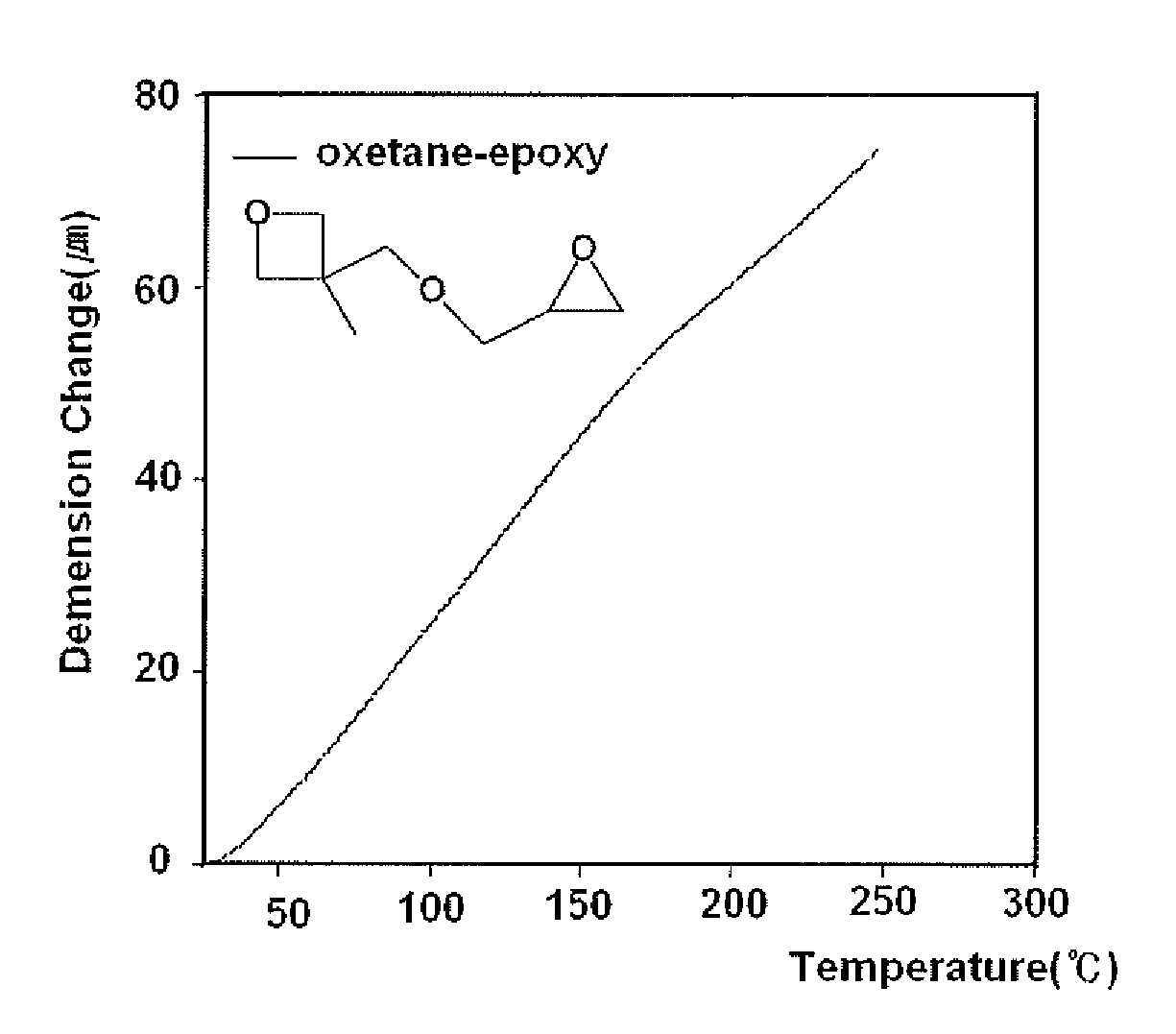
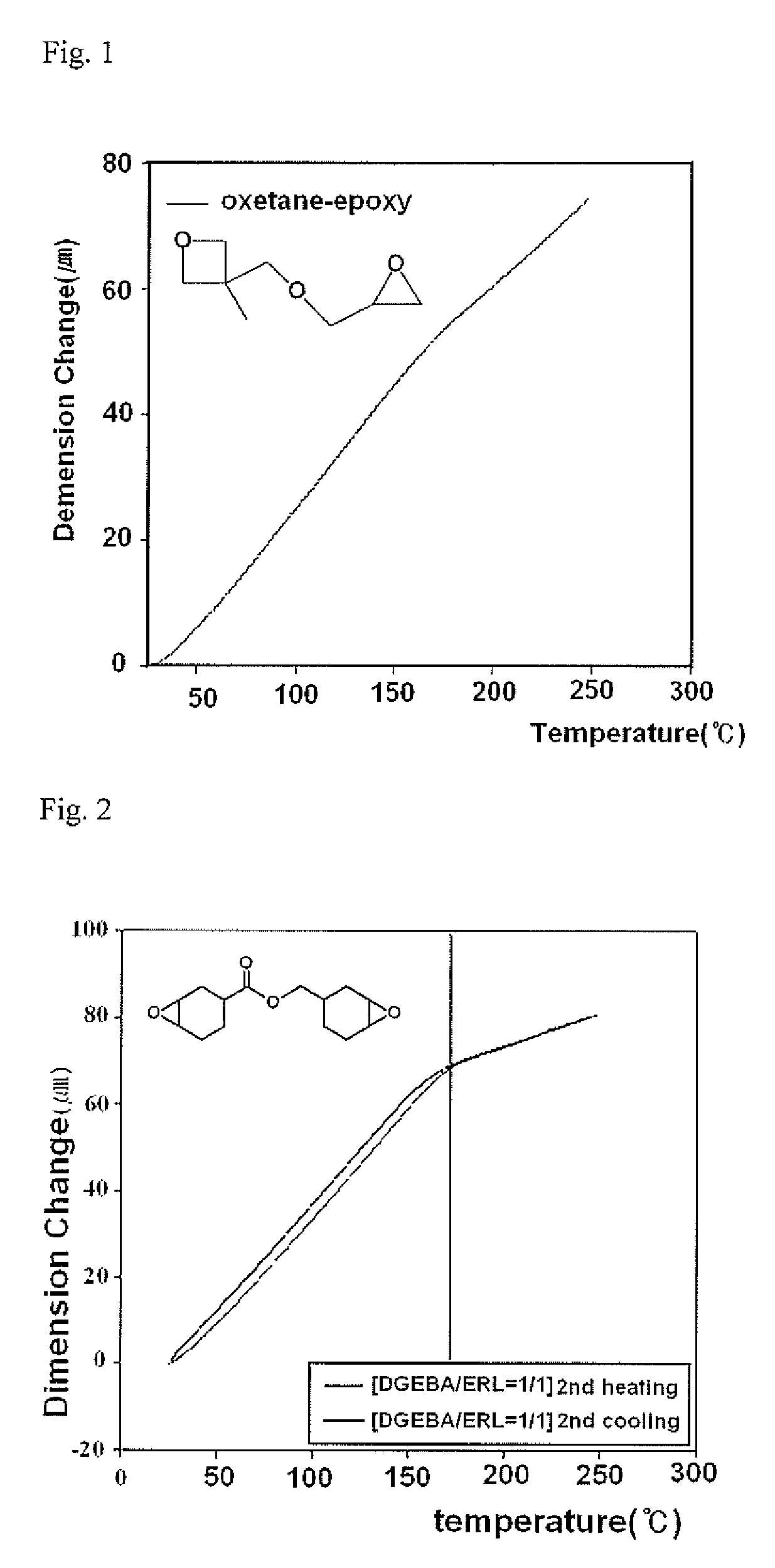
[0063]5 g of the oxetane-epoxy obtained in Preparative Example 1, 5 g of diglycidyl ether of bisphenol A, and 0.2 g of a triarylsulfonium hexafluoroantimonate salt were sufficiently mixed. After impregnating the mixture with 10 g of E-glass based glass fibers (Product 3313, Nittobo Co. Ltd.), the resultant was placed between release-treated glass substrates and both sides of the substrate were UV irradiated for 2 minutes, thereby producing a transparent composite sheet (resin content: 50 wt %) having a binder content of 50 wt %. FIG. 1 shows a TMA graph of the prepared composite sheet.
the structure of the environmentally friendly knitted fabric provided by the present invention; figure 2 Flow chart of the yarn wrapping machine for environmentally friendly knitted fabrics and storage devices; image 3 Is the parameter map of the yarn covering machine
Login to View More PUM
| Property | Measurement | Unit |
|---|---|---|
| refractive index | aaaaa | aaaaa |
| glass transition temperature | aaaaa | aaaaa |
| glass transition temperature | aaaaa | aaaaa |
Login to View More
Abstract
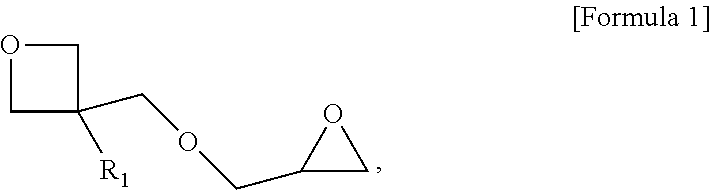
A composite sheet of the present invention comprises an oxetane-epoxy-based compound, represented by chemical formula 1, as a binder.
Description
CROSS-REFERENCE TO RELATED APPLICATIONS[0001]This application is a National Phase Patent Application and claims priority to and benefit of International Patent Application Number PCT / KR2012 / 003557, filed on May 7, 2012, which claims priority of Korean Patent Application Number 10-2011-0044646, filed on May 12, 2011, the entire contents of which are incorporated herein by reference.TECHNICAL FIELD[0002]The present invention relates to a composite sheet and a display substrate using the same. More particularly, the present invention relates to a composite sheet, which includes an oxetane-epoxy bifunctional compound having a specific structure as a binder to provide excellent flexibility while securing excellent properties in terms of heat resistance, crack resistance optical properties and processibility, and a display substrate using the same.BACKGROUND ART[0003]A glass substrate having excellent thermal resistance, transparency and a low coefficient of linear expansion has been wide...
Claims
the structure of the environmentally friendly knitted fabric provided by the present invention; figure 2 Flow chart of the yarn wrapping machine for environmentally friendly knitted fabrics and storage devices; image 3 Is the parameter map of the yarn covering machine
Login to View More Application Information
Patent Timeline
 Login to View More
 Patent Type & AuthorityPatents(United States)
IPC IPC(8): B60C1/00C07D407/12C08G65/18C08G65/22C08J5/24C08K7/14C08L63/00
CPCC08K7/14C08L63/00C08G65/18C08G65/22C07D407/12C08J5/24C08J2363/00C08G65/24C08J5/244C08J5/18C08L71/00G02F1/1335
InventorKIM, YOUNG KWONLEE, SANG KEOLIM, SUNG HANCHOI, SEOK WONKIM, SUNG KOOKJEON, HYUN AEKIM, YUN JOOTAK, SANG YONGPARK, SUK YEONKANG, KYUNG NAMKANG, SO YOUNG
OwnerKOREA INST OF IND TECH