
Water-in-oil type emulsified cosmetic
a water-in-oil type, emulsified cosmetic technology, applied in the field of water-in-oil type emulsified cosmetics, can solve the problems of uneven finish color, difficulty in affinity with skin, unfavorable oiliness after application, etc., and achieves no oily sheen, no creasing and/or make-up occurrence, good affinity to skin
- Summary
- Abstract
- Description
- Claims
- Application Information
AI Technical Summary
Benefits of technology
Problems solved by technology
Method used
Image

Examples
examples
[0056]Each component used in the Examples and Comparative Examples was as follows;
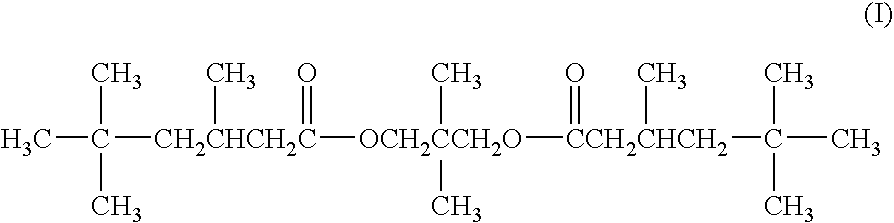
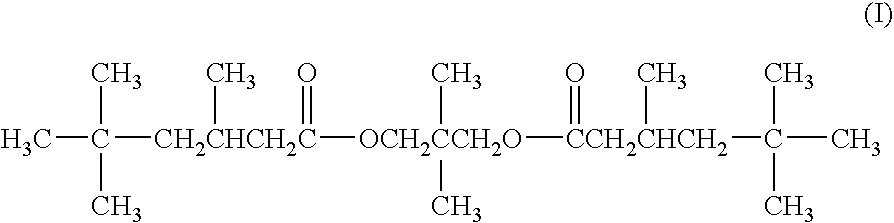
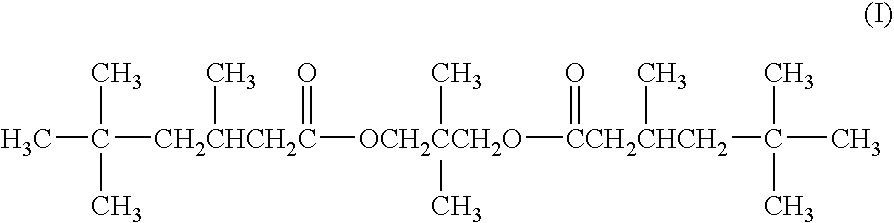
Component (A): the Compound Represented by the Formula (I), which May be Called “Neopentylglycol Diisononanoate”.
[0057]Use was made of one which was prepared as follows:
Synthesis of Neopentylglycol Diisononanoate
[0058]In a four-neck 2,000 mL glass flask equipped with a stirrer, a thermometer, a nitrogen gas inlet tube, and a Dean-Stark condenser with a water measuring trap were placed 208.2 g (2.0 mol) of neopentylglycol, 632.4 g (4.0 mol) of isononanoic acid, 100 mL of toluene as a solvent and 0.8 g of paratoluenesulfonic acid as a catalyst. Then, the reaction mixture was heated to 200 degrees C. under a flow of nitrogen gas in a rate of 10 mL / min. at atmospheric pressure. The reaction was carried out under reflux with heating at that temperature for 10 hours while distilling off the produced water with the solvent azeotropically. When the distillation-off water subsided, the temperature was raised to...
example 12
Milky Emulsion Type Sunscreen
[0130]Components (A), (B) and (C), and the optional components other than those which were water-soluble, indicated in Table 9 were dissolved homogenously at 100 degrees C. to obtain a mixture, to which Component (D) was added to make a dispersion. Then, Component (E) and the optional components which were water-soluble were added to the dispersion thus obtained to make an emulsion-dispersion. The emulsion-dispersion thus obtained was cooled to room temperature while stirring to prepare a milky emulsion type sunscreen.
PUM
| Property | Measurement | Unit |
|---|---|---|
| pressure | aaaaa | aaaaa |
| pressure | aaaaa | aaaaa |
| reduced pressure | aaaaa | aaaaa |
Abstract
Description
Claims
Application Information
 Login to View More