Pseudo-random code estimation method of direct sequence spread spectrum system
A direct sequence spread spectrum, pseudo-random code technology, applied in multi-frequency code systems, transmission systems, multiplexing code generation and other directions, can solve the problem of not meeting the estimation of cyclic shift characteristics, affecting the estimation accuracy of pseudo-random codes, and timing synchronization requirements Advanced problems, to achieve the effect of overcoming the influence of the time-frequency uncertainty principle, fast calculation speed, and overcoming the estimation error
- Summary
- Abstract
- Description
- Claims
- Application Information
AI Technical Summary
Problems solved by technology
Method used
Image



Examples
Embodiment Construction
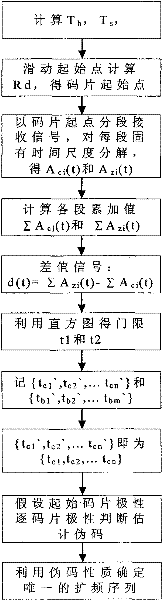
[0027] refer to figure 1 , the steps of the present invention are as follows:
[0028] Step 1, calculate the period T of the spread spectrum pseudo-random code in the received signal s and the symbol period T of the received signal b .
[0029] The period T of the spread spectrum pseudo-random code is obtained from the quadratic spectrum of the received signal r(t) s , its quadratic spectrum S r (e) calculation expression is: S r (e)=|DFT(S r (f))| 2 (1)
[0030] where S r (f) represents the power spectrum of the received signal, and DFT represents S r The power spectrum of (f) is Fourier transformed, and the secondary power spectrum of the received signal is defined as S r The square of the modulus after Fourier transform of the power spectrum of (f). Search for the adjacent local maximum of the quadratic spectrum within a certain range, determine the frequency of the quadratic power spectrum corresponding to the local maximum, a...
PUM
 Login to View More
 Abstract
Description
Claims
Application Information
 Login to View More