Cubic copper oxide nano particle and synthesizing method and application thereof

A nanoparticle, copper oxide technology, applied in copper oxide/copper hydroxide, nanotechnology, nanotechnology, etc., can solve the problems of harsh synthesis conditions, difficulty in synthesizing copper oxide nanoparticles with clear shapes, and high temperature requirements. The effect of the simple and easy synthesis process

A nanoparticle, copper oxide technology, applied in copper oxide/copper hydroxide, nanotechnology, nanotechnology, etc., can solve the problems of harsh synthesis conditions, difficulty in synthesizing copper oxide nanoparticles with clear shapes, and high temperature requirements. The effect of the simple and easy synthesis process

CN101696027AInactive Publication Date: 2010-04-21SOUTH CENTRAL UNIVERSITY FOR NATIONALITIES

Image

Smart Image Click on the blue labels to locate them in the text.
Viewing Examples
Smart Image
  • Cubic copper oxide nano particle and synthesizing method and application thereof
  • Cubic copper oxide nano particle and synthesizing method and application thereof
  • Cubic copper oxide nano particle and synthesizing method and application thereof

Examples

Experimental program
Comparison scheme
Effect test

specific Embodiment

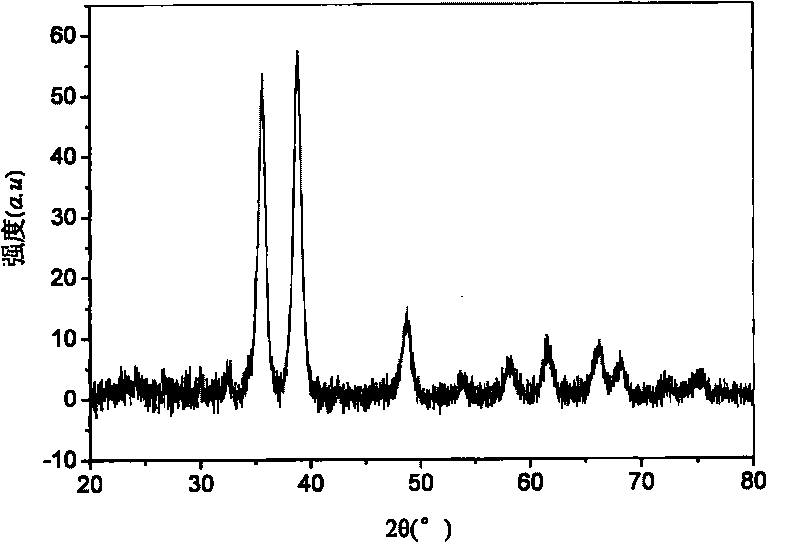
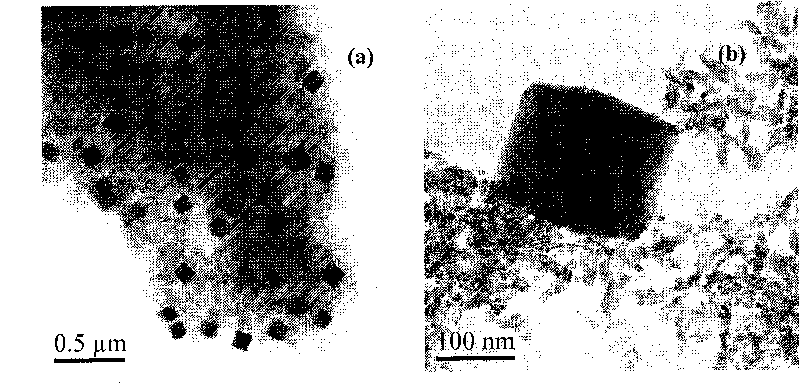
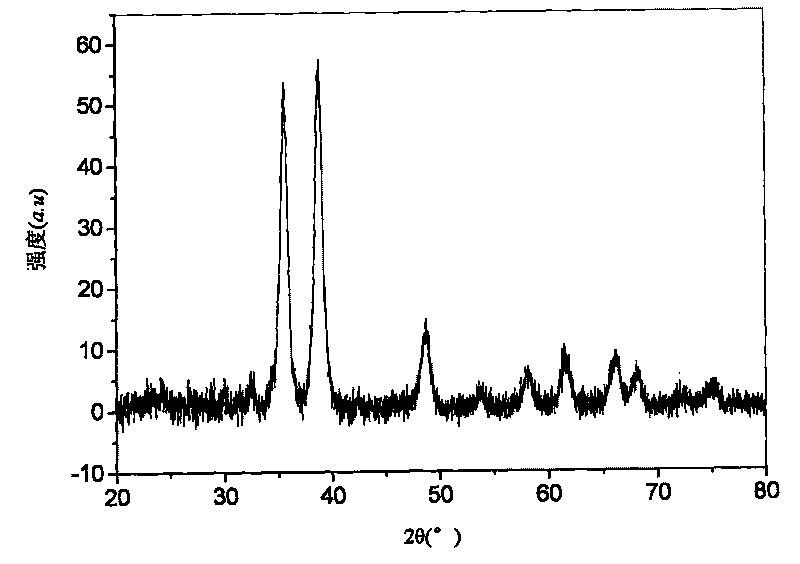
[0017] Example 1. In a 50ml round bottom flask, according to the molar ratio Cu(CH 3 COO) 2 : NaOH:PVP ratio of 1:2:10, add copper acetate aqueous solution, sodium hydroxide triethylene glycol solution, and PVP aqueous solution in turn, keep the total volume at 15ml, mix well to form a homogeneous light blue solution, Then put it in a microwave oven and heat it at 800 watts for 20 seconds while stirring. Stop microwave heating after the color of the solution turns bright dark brown. That is, cubic copper oxide nanoparticles with an average particle diameter of 41 nm were obtained.

[0018] Example two, in a 50ml round bottom flask according to the molar ratio Cu(CH 3 COO) 2 : NaOH:PVP ratio of 1:1:5, add copper acetate aqueous solution, sodium hydroxide triethylene glycol solution, and PVP aqueous solution in turn, keep the total volume at 15ml, mix well to form a homogeneous light blue solution , then put it in the microwave oven, and heat it at 850 watts for 65 seconds ...

the structure of the environmentally friendly knitted fabric provided by the present invention; figure 2 Flow chart of the yarn wrapping machine for environmentally friendly knitted fabrics and storage devices; image 3 Is the parameter map of the yarn covering machine
Login to View More

PUM

PropertyMeasurementUnit
particle diameteraaaaaaaaaa
particle sizeaaaaaaaaaa
Login to View More

Abstract

The invention relates to a cubic copper oxide nano particle and a preparation method and application thereof. The method comprises the following steps: uniformly mixing copper acetate aqueous solution, sodium hydroxide tetraglycol solution and polyvinylpyrrolidone aqueous solution by a microwave as a heating medium; heating by the microwave by stirring till the color of the solution is changed into transparent dark brown; and then obtaining the cubic copper oxide nano particle. The method has simple experiment process without complicated and rigorous process condition, and the obtained product can be used for preparing an air-sensitive element.

Description

1. Technical field [0001] The invention relates to cubic copper oxide nanoparticles, a preparation method and application thereof. 2. Background technology [0002] Ordinary copper oxide is a multifunctional fine inorganic material with a wide range of uses, mainly used in the fields of printing and dyeing, glass, ceramics, medicine and catalysis. When the particle size of ordinary copper oxide particles reaches the nanometer level, its function will be more unique and its application will be more extensive. At present, solid phase reaction method, hydrothermal method, alcohol thermal method, precipitation method, spray pyrolysis method, liquid phase precipitation technology with double jet flow control, sonochemical method, pressure-hydrothermal method, microemulsion method and laser steaming are widely used. Method, microwave boiling reflux method, electrochemical method, template method, etc., but there are many problems to be solved. First, the synthesis conditions are...

Claims

the structure of the environmentally friendly knitted fabric provided by the present invention; figure 2 Flow chart of the yarn wrapping machine for environmentally friendly knitted fabrics and storage devices; image 3 Is the parameter map of the yarn covering machine
Login to View More

Application Information

Patent Timeline
21 Apr 2010
Publication
CN101696027A
IPC
C01G3/02; B82B1/00; B82B3/00
Inventors
杨汉民; 李金林