Detergent for washing tableware or vegetables and fruits by hands
What is AI technical title?
AI technical title is built by Patsnap AI team. It summarizes the technical point description of the patent document.
A technology for vegetables, fruits and detergents, which is applied in the directions of detergent compounding agents, detergent compositions, organic detergent compositions, etc., and can solve the problems of food with astringency and the like
Inactive Publication Date: 2011-04-13
郴州邦尔泰苏仙油脂有限公司
View PDF3 Cites 30 Cited by
Summary
Abstract
Description
Claims
Application Information
AI Technical Summary
This helps you quickly interpret patents by identifying the three key elements:
Problems solved by technology
Method used
Benefits of technology
Problems solved by technology
[0003] In order to solve the above problems, the Chinese Invention Patent Publication No. CN 1563313A on January 12, 2005 disclosed a natural scavenger for pesticide residues in vegetables and fruits, which was prepared from tea saponin, sodium carbonate and sodium bicarbonate as main raw materials; From the encyclopedia knowledge manual, we can find out that sodium carbonate tastes astringent, and washing vegetables and fruits will cause food to have an astringent taste
Method used
the structure of the environmentally friendly knitted fabric provided by the present invention; figure 2 Flow chart of the yarn wrapping machine for environmentally friendly knitted fabrics and storage devices; image 3 Is the parameter map of the yarn covering machine
View more
Image
Smart Image Click on the blue labels to locate them in the text.
Viewing Examples
Smart Image
Click on the blue label to locate the original text in one second.
Reading with bidirectional positioning of images and text.
Smart Image
Examples
Experimental program
Comparison scheme
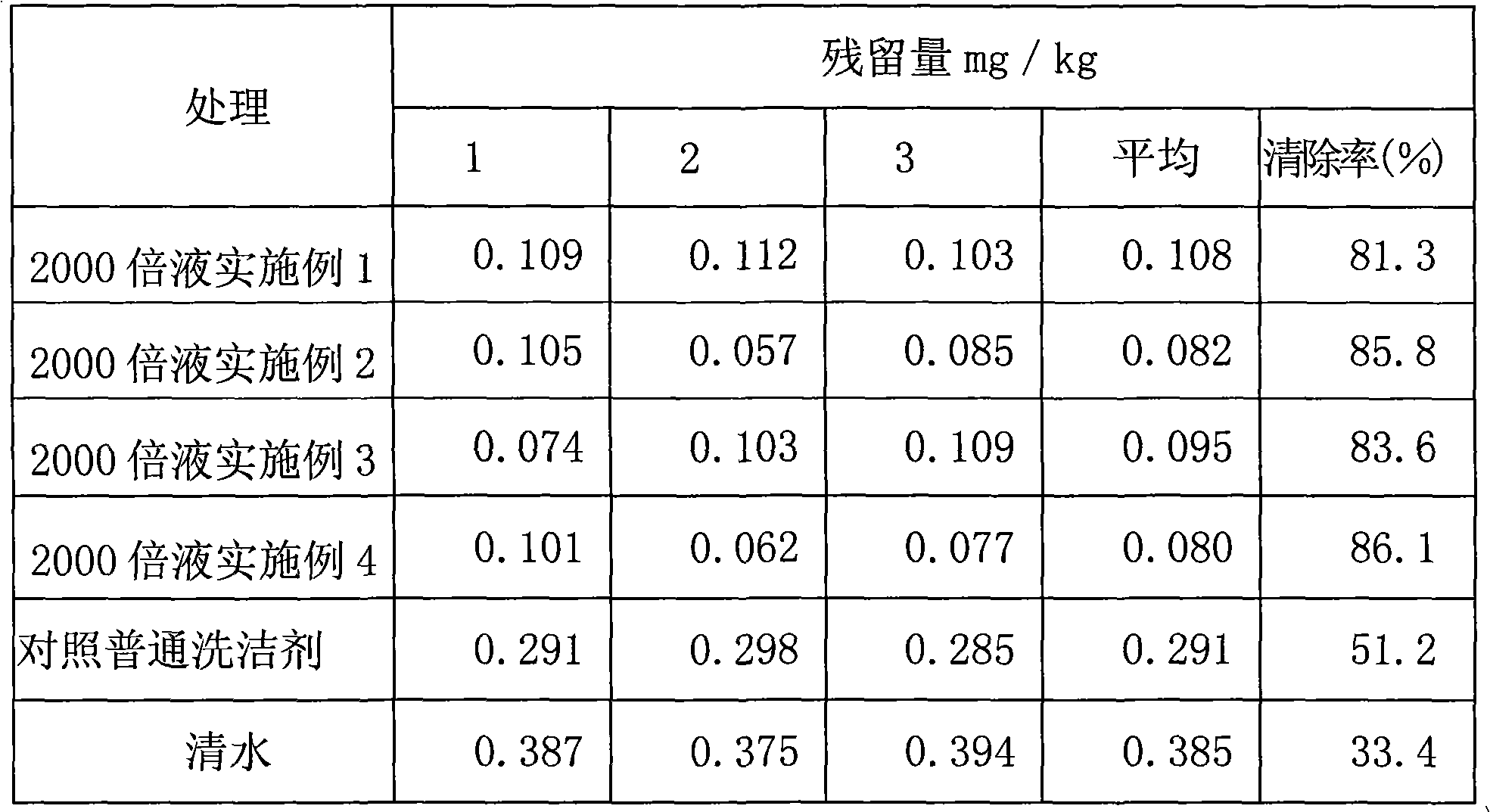
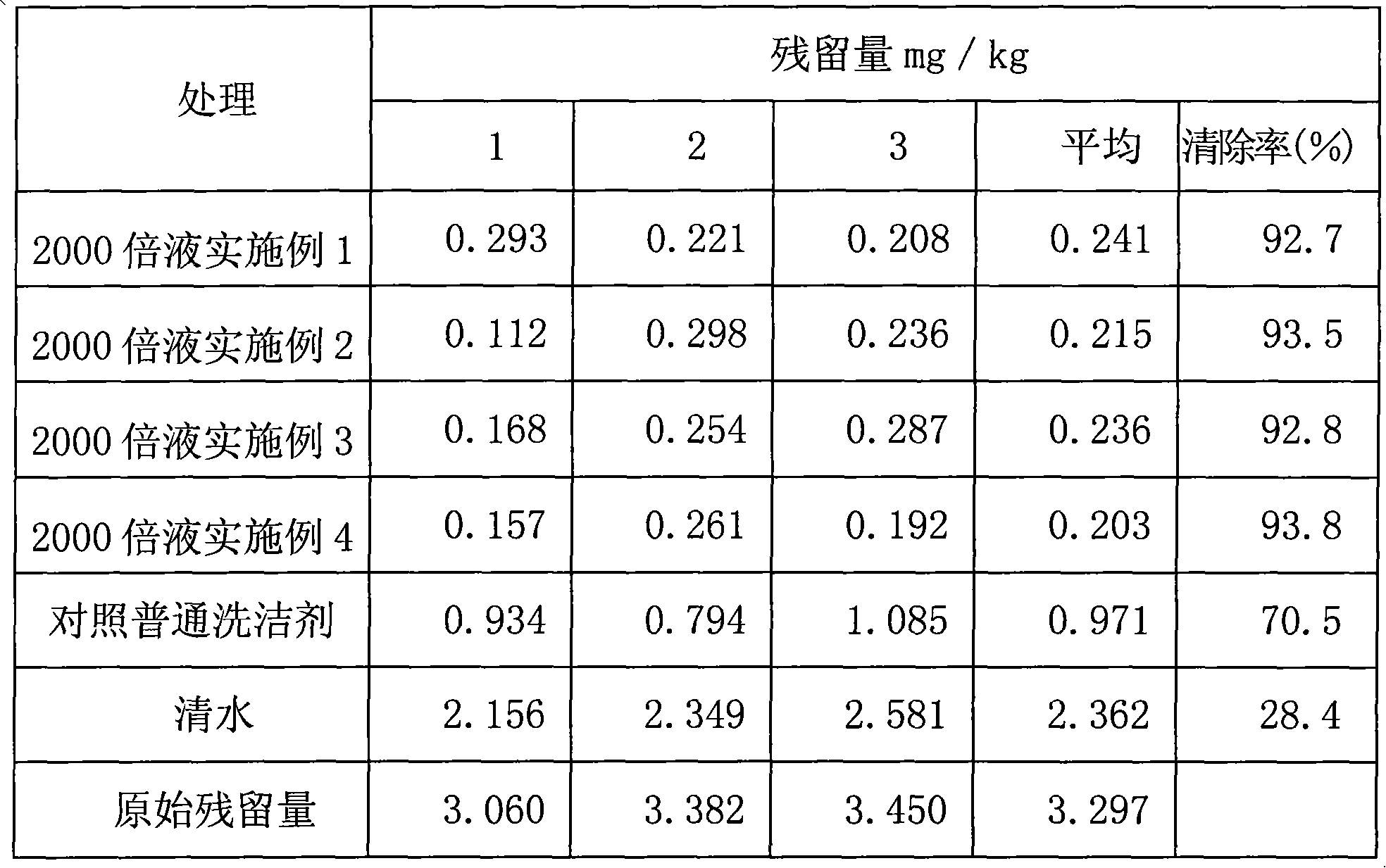
Effect test
Embodiment 1
[0019] A detergent for hand-washing tableware or vegetables and fruits, characterized in that it is prepared by blending the following raw materials: tea saponincrystal 3, AES 8, 6501 1, sulfonic acid 2, caustic soda 0.2, AOS 3, EDTA-2Na 0.2, Kayson 0.1, essence 0.5, ethanol 2, deionized water 80;
[0020] The manufacturing process is as follows: first prepare the buffer solution with deionized water and caustic soda, add tea saponin crystals to the buffer solution at 80-90°C, stir and dissolve; then add AES, 6501, sulfonic acid, AOS, EDTA-2Na, Kaisong and essence, and then stirred to form a latex; cooled to room temperature, then added ethanol and stirred evenly to obtain detergent; after packaging and inspection, the finished product was put into storage.
Embodiment 2
[0022] A detergent for hand-washing tableware or vegetables and fruits, characterized in that it is prepared by blending the following raw materials: tea saponin crystal 11, AES 6, 65013, sulfonic acid 3, caustic soda 0.3, AOS 2, EDTA-2Na 0.1 , Kayson 0.2, essence 0.4, ethanol 2, deionized water 72;
[0023] Its manufacturing process is with embodiment 1.
Embodiment 3
[0025] A detergent for hand-washing tableware or vegetables and fruits, characterized in that it is prepared by blending the following raw materials: tea saponin crystal 9, AES 4, 65017, sulfonic acid 1, caustic soda 0.1, AOS 1, EDTA-2Na 0.3 , Kayson 0.4, essence 0.2, ethanol 1, deionized water 76;
[0026] Its manufacturing process is with embodiment 1.
the structure of the environmentally friendly knitted fabric provided by the present invention; figure 2 Flow chart of the yarn wrapping machine for environmentally friendly knitted fabrics and storage devices; image 3 Is the parameter map of the yarn covering machine
Login to View More
PUM
Login to View More
Abstract
The invention relates to a detergent for washing tableware or vegetables and fruits by hands, belonging to the technical field of detergents. The detergent comprises the following components in parts by weight: 3-20 parts of tea saponincrystal, 4-8 parts of sodiumalcoholether sulphate (AES), 1-7 parts of cocoanut fatty aciddiethanolamide (6501), 1-3 parts of sulfoacid, 0.1-0.3 part of caustic soda flasks, 1-3 parts of sodium alpha-olefin sulfonate (AOS), 0.1-0.3 part of EDTA-2Na, 0.1-0.4 part of Kathon, 0.2-0.5 part of essence, 1-3 parts of ethanol and 60-80 parts of deionized water. By utilizing the detergent, clingage on the tableware or residual pesticide on the vegetables and fruits can be effectively washed, and fruit wax which is used on the surfaces of the vegetables and fruits for retaining freshness can be removed rapidly; and the detergent is not harmful to human bodies and does not cause pollution to the environment.
Description
technical field [0001] The invention belongs to the technical field of detergents, in particular to a detergent for hand-washing tableware or vegetables and fruits. Background technique [0002] The vast majority of existing detergents are synthesized from sodium dodecylsulfonate as the main raw material. In their product instructions, they are marked with: "Precautions: Please keep out of reach of children. If you accidentally If you drink it by mistake, please drink plenty of water to dilute it and see a doctor in time." In daily use, when washing tableware with detergent, it needs to be rinsed repeatedly, and there may be a very small amount of chemical substances remaining, which may also cause damage to people over time. Similarly, due to the impact of pesticide residues in vegetables and fruits on human health has been widely concerned, food poisoning incidents caused by eating vegetables and fruits containing pesticide residues also occur from time to time. People al...
Claims
the structure of the environmentally friendly knitted fabric provided by the present invention; figure 2 Flow chart of the yarn wrapping machine for environmentally friendly knitted fabrics and storage devices; image 3 Is the parameter map of the yarn covering machine
Login to View More
Application Information
Patent Timeline
Application Date:The date an application was filed.
Publication Date:The date a patent or application was officially published.
First Publication Date:The earliest publication date of a patent with the same application number.
Issue Date:Publication date of the patent grant document.
PCT Entry Date:The Entry date of PCT National Phase.
Estimated Expiry Date:The statutory expiry date of a patent right according to the Patent Law, and it is the longest term of protection that the patent right can achieve without the termination of the patent right due to other reasons(Term extension factor has been taken into account ).
Invalid Date:Actual expiry date is based on effective date or publication date of legal transaction data of invalid patent.




 Login to View More
  Login to View More