

Solution gradient dilution device with microfluidic chip
A microfluidic chip and gradient dilution technology, which is applied in the field of chemical analysis, can solve the problems of combined dilution, increased chip area, difficult and different substances, etc., and achieve the effect of fast and stable concentration, fine concentration differentiation, and various concentration types
- Summary
- Abstract
- Description
- Claims
- Application Information
AI Technical Summary
Problems solved by technology
Method used
Image



Examples
Embodiment 1
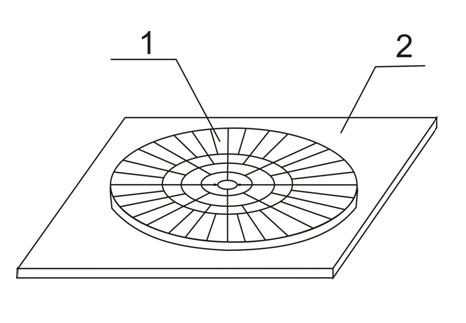
[0031] The structure of the microfluidic chip solution gradient dilution device of this embodiment is as follows: figure 1 As shown, it is a microfluidic chip with an upper and lower two-layer structure, the upper layer is made of polydimethylsiloxane, one side has a microchannel network structure, and the lower layer 2 is a transparent flat glass substrate without a channel structure.
[0032] The disk-shaped radial microchannel network of the upper substrate is as figure 2 As shown, according to the standard manufacturing process of the SU-8 photoresist positive mold, the positive mold of the microchannel network is formed on the silicon wafer, the thickness of the positive mold is 40 mm, and then polydimethylsiloxane prepolymerized After heating and polymerizing, curing and forming, after curing and turning over the mold, 7 concentric circular channels and 7 levels of meandering channels are obtained. Around the first circular channel, two holes with a diameter of 0.45 Th...
Embodiment 2
[0037] For the microfluidic chip with 3 inlets and 6 channels as the dilution device, the manufacturing process and concentration gradient formation method are the same as the 2 inlet chip in Example 1, the difference lies in the concentration gradient formation process of the chip with 3 inlets. First, it is necessary to introduce three solutions A, B and C at the same time, and then flow through the microchannel network. The microchannel network includes 5 levels of meandering channels, and the number of meandering channels is 6, 12, 24, and 48 respectively. lines, 96 lines, a group of 192 linear channels and 6 concentrically arranged circular channels, the final concentration gradient is divided into two cases: first, if the initial concentration is 0 (blank solution), 1 B (B solution) and 1 C (C solution), then generate a set of diluted gradient dilutions of solution B from 0 to 1, a total of 64 kinds, a set of diluted gradient dilutions of solution C from 0 to 1', a total...
PUM
| Property | Measurement | Unit |
|---|---|---|
| Length | aaaaa | aaaaa |
| Diameter | aaaaa | aaaaa |
Abstract
Description
Claims
Application Information
 Login to View More