Fluorescent nanoparticle solution, as well as preparation method and application thereof
What is AI technical title?
AI technical title is built by Patsnap AI team. It summarizes the technical point description of the patent document.
A technology of fluorescent nanometers and particles, applied in the direction of fluorescence/phosphorescence, chemical instruments and methods, luminescent materials, etc., can solve the problems of no literature reports, etc., and achieve the effect of broad application prospects
Inactive Publication Date: 2012-11-07
NANKAI UNIV
View PDF2 Cites 11 Cited by
Summary
Abstract
Description
Claims
Application Information
AI Technical Summary
This helps you quickly interpret patents by identifying the three key elements:
Problems solved by technology
Method used
Benefits of technology
Problems solved by technology
[0003] Tetraphenylethylene and its derivatives, due to their aggregation-induced emission characteristics, exhibit strong fluorescence in the aggregated state, see (1) J.Liu, J.W.Y.Lam, B.Z.Tang.Chem.Rev.2009,109,5799-5867; (2) M.Wang, G.Zhang, D.Zhang, D.Zhu, B.Z.Tang.J.Mater.Chem.2010,20,1858–1867, received more and more attention, so they are used as fluorescent detectors Needles and organic electroluminescent materials are widely used in the fields of detection, sensing and preparation of organic electroluminescent devices, see (1) Y.Liu, C.Deng, L.Tang, A.Qin, R.Hu, J.Z. Sun, B.Z.Tang.J.Am.Chem.Soc.2011,133,660-663, but these reports are rarely involved in the study of its supramolecular assembly behavior and assembly
In these upper / lower edge modifications, the upper edge sulfonation of calixarene not only brings it good water solubility, but also improves its binding ability to organic guest molecules, see D.-S.Guo, K. Wang, Y.Liu.J.Inclusion Phenom. & Macrocyclic Chem.2008, 62, 1–21, thus greatly opened up the research on the assembly of calixarene, which includes the use of sulfonated calixarene to construct amphiphilic materials, see K.Wang, D.-S.Guo, Y.Liu.Chem.Eur, J.2010, 16, 8006-8011, also used bridged sulfonated calixarene to construct linear supramolecular polymers, see D.-S .Guo, Y.Liu.Chem.Soc.Rev.2012, in press, but so far there are few literature reports on sulfonated calixarene-induced aggregation of organic cations to form nanoparticles and accompanying supramolecules from non-fluorescence to fluorescence emission self-assembly behavior
Method used
the structure of the environmentally friendly knitted fabric provided by the present invention; figure 2 Flow chart of the yarn wrapping machine for environmentally friendly knitted fabrics and storage devices; image 3 Is the parameter map of the yarn covering machine
View more
Image
Smart Image Click on the blue labels to locate them in the text.
Viewing Examples
Smart Image
Click on the blue label to locate the original text in one second.
Reading with bidirectional positioning of images and text.
Smart Image
Examples
Experimental program
Comparison scheme
Effect test
Embodiment 1
[0020] A preparation method of the fluorescent nanoparticle solution, comprising the following steps:
[0021] 1) Dissolve 1896 mg (0.003 mol) of 1,2-bis[4-(4-bromobutoxy)phenyl]-1,2-stilbene in 0.05 L of tetrahydrofuran, stir under ice bath, and pour in 0.12 mol of trimethylamine gas, the reaction mixture was warmed to room temperature, and after stirring for 24 hours, 0.01 L of water was added, the mixture was stirred for 24 hours, and the solvent was removed by rotary evaporation. Solid, 51% yield.
[0022] 1 H NMR (400MHz, D 2 O,δ): 6.86-6.69(m,14H), 6.30(br,4H), 3.46(d,4H), 3.12(br,4H), 2.91(d,18H), 1.49(br,8H); ESI -MS: 673.3 (MBr) + ,296.5((M-2Br) / 2) + .
[0023] 2) Dissolve the light yellow TPE solid and SC4A prepared above into water and mix them uniformly to prepare a fluorescent nanoparticle solution. The concentrations of TPE and SC4A used are 0.000072mol / L and 0.000036mol / L, respectively.
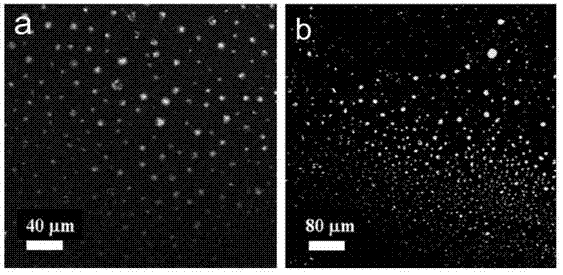
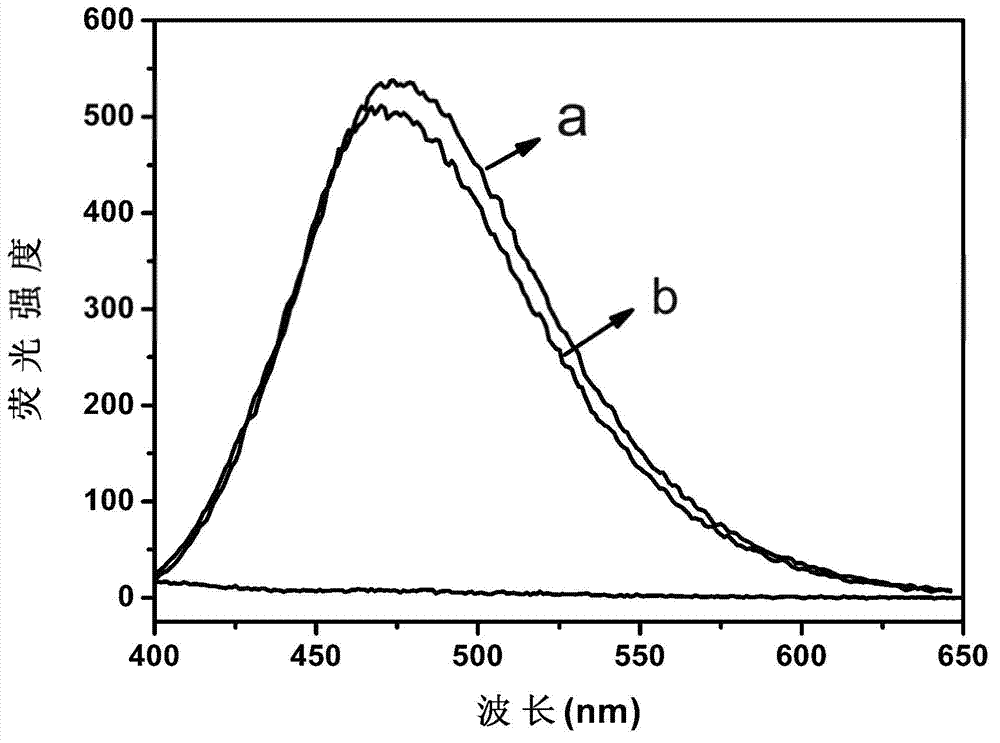
[0024] figure 1 a is the fluorescence spectrum after the interacti...
Embodiment 2
[0029]A preparation method of the fluorescent nanoparticle solution, comprising the following steps:
[0030] 1) Dissolve 1896 mg (0.003 mol) of 1,2-bis[4-(4-bromobutoxy)phenyl]-1,2-stilbene in 0.05 L of tetrahydrofuran, stir under ice bath, and pour in 0.12mol of trimethylamine gas, the reaction mixture was warmed to room temperature, and after stirring for 24 hours, 0.01 L of water was added, the mixture was stirred for 24 hours, and the solvent was removed by rotary evaporation. Solid, 51% yield.
[0031] 1 H NMR (400MHz, D 2 O,δ): 6.86-6.69(m,14H), 6.30(br,4H), 3.46(d,4H), 3.12(br,4H), 2.91(d,18H), 1.49(br,8H); ESI -MS:673.3(M-Br) + ,296.5((M-2Br) / 2) + .
[0032] 2) Dissolve the light yellow TPE solid and bisSC4A prepared above into water and mix them uniformly to prepare a fluorescent nanoparticle solution. The concentrations of TPE and bisSC4A used are 0.000072 mol / L and 0.000018 mol / L, respectively.
[0033] figure 1 b is the fluorescence spectrum after the inte...
the structure of the environmentally friendly knitted fabric provided by the present invention; figure 2 Flow chart of the yarn wrapping machine for environmentally friendly knitted fabrics and storage devices; image 3 Is the parameter map of the yarn covering machine
Login to View More
PUM
Login to View More
Abstract
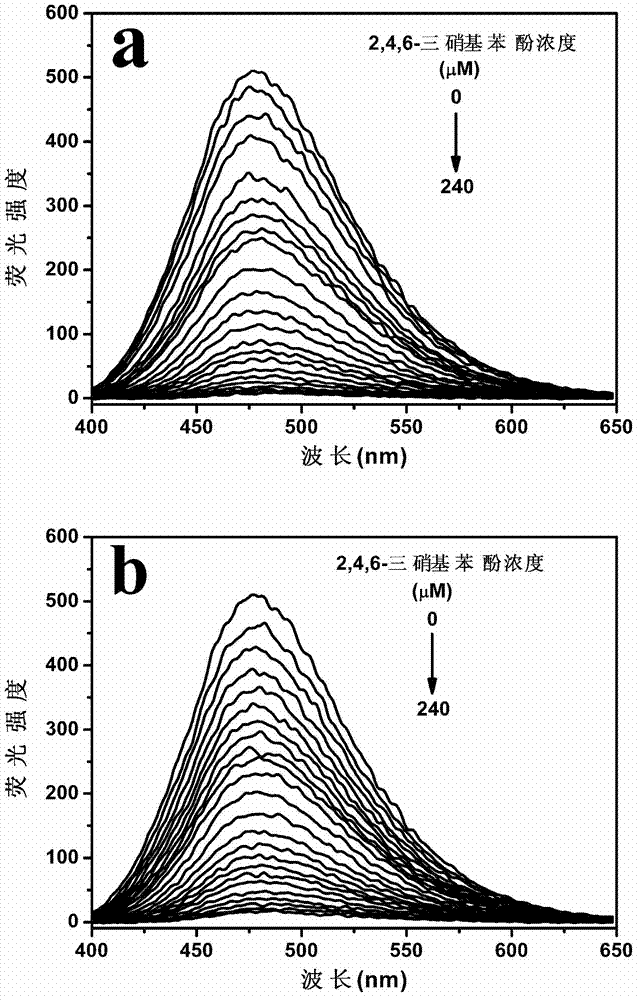
The invention provides a fluorescent nanoparticle solution. A building unit of the fluorescent nanoparticle uses sulfonato calix[4]arene derivative as the host and tetraphenylethylenequaternaryammonium salt as the guest. A supramolecular assembly is built through interactions of inclusion and complexation of the host-guest among the building units. The sulfonato calix[4]arene derivative is a single-bridged sulfonato calix[4]arene containing a sulfonato calix[4]arene unit or double-bridged sulfonato calix[4]arene containing two sulfonato calix[4]arene units. A preparation method provided by the invention is as follows: tetraphenylethylenequaternaryammonium salt is firstly prepared, and then tetraphenylethylenequaternaryammonium salt and sulfonato calix[4]arene derivative are dissolved into water and mixed uniformly to obtain the final product. The fluorescent nanoparticle solution provided by the invention has the advantages that: (1) the nanoparticle has the specific gathered fluorescence emission characteristic of tetraphenylethylene and the tetraphenylethylene derivatives; and (2) with the fluorescent nanoparticle, a high sensitive sensing to 2,4,6-trinitrophenol can be realized, which means that the fluorescent nanoparticle has a broad application prospects in the sensing technology field of explosive nitro compounds.
Description
【Technical field】 [0001] The invention belongs to the technical field of nano-supramolecular materials, in particular to a fluorescent nano-particle solution and a preparation method and application thereof. 【Background technique】 [0002] In recent years, the construction of functionalized nanoparticles has been one of the research hotspots of chemical and material scientists, see (1) M.Sastry, M.Rao, K.N.Ganesh.Acc.Chem.Res.2002,35,847–855 ;(2) H.Goesmann,C.Feldmann.Angew.Chem.Int.Ed.2010,49,1362–1395, among which fluorescent nanoparticles are unique due to their unique properties in fluorescencemicroscopy, immunolabeling and sensing More attention has been paid to performance, see (1) A.Palma, L.A.Alvarez, D.Scholz, D.O.Frimannsson, M.Grossi, S.J.Quinn, D.l F.O'Shea.J.Am.Chem.Soc.2011, 133 , 19618–19621; (2) X. Zhao, R. Tapec-Dytioco, W. Tan. J. Am. Chem. Soc. 2003, 125, 11474–11475. In the construction of these nanoparticles, most of them are purely inorganic nanopart...
Claims
the structure of the environmentally friendly knitted fabric provided by the present invention; figure 2 Flow chart of the yarn wrapping machine for environmentally friendly knitted fabrics and storage devices; image 3 Is the parameter map of the yarn covering machine
Login to View More
Application Information
Patent Timeline
Application Date:The date an application was filed.
Publication Date:The date a patent or application was officially published.
First Publication Date:The earliest publication date of a patent with the same application number.
Issue Date:Publication date of the patent grant document.
PCT Entry Date:The Entry date of PCT National Phase.
Estimated Expiry Date:The statutory expiry date of a patent right according to the Patent Law, and it is the longest term of protection that the patent right can achieve without the termination of the patent right due to other reasons(Term extension factor has been taken into account ).
Invalid Date:Actual expiry date is based on effective date or publication date of legal transaction data of invalid patent.



 Login to View More
  Login to View More