Intercooling or intercooling recuperating layout for aero-engine

A technology of aero-engine and regenerative cycle, applied in the cooling of engine, engine components, machine/engine, etc., can solve the problem of difficulty in meeting the rapid response of aero-engine, large mass of intercooler and regenerator, and increasing the weight of the whole engine. and other problems, to achieve the effect of light weight, high heat exchange efficiency and compact structure

CN104110309AActive Publication Date: 2014-10-22BEIHANG UNIV
5 Cites 19 Cited by

Patent Information

Authority / Receiving Office
CN · China
Patent Type
Applications(China)
Current Assignee / Owner
Publication Date
2014-10-22

Smart Images

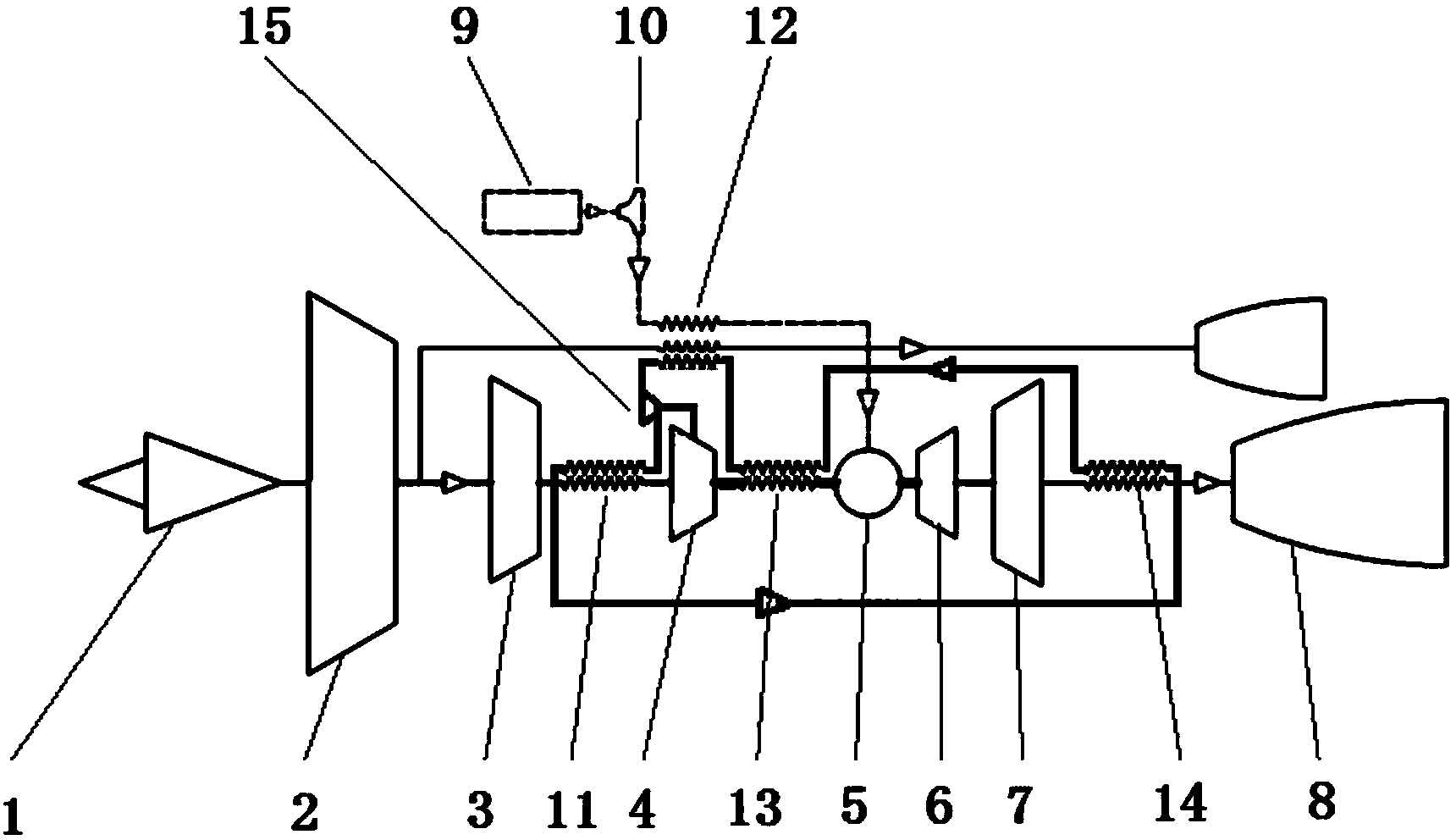
  • Figure 1
    Figure 1
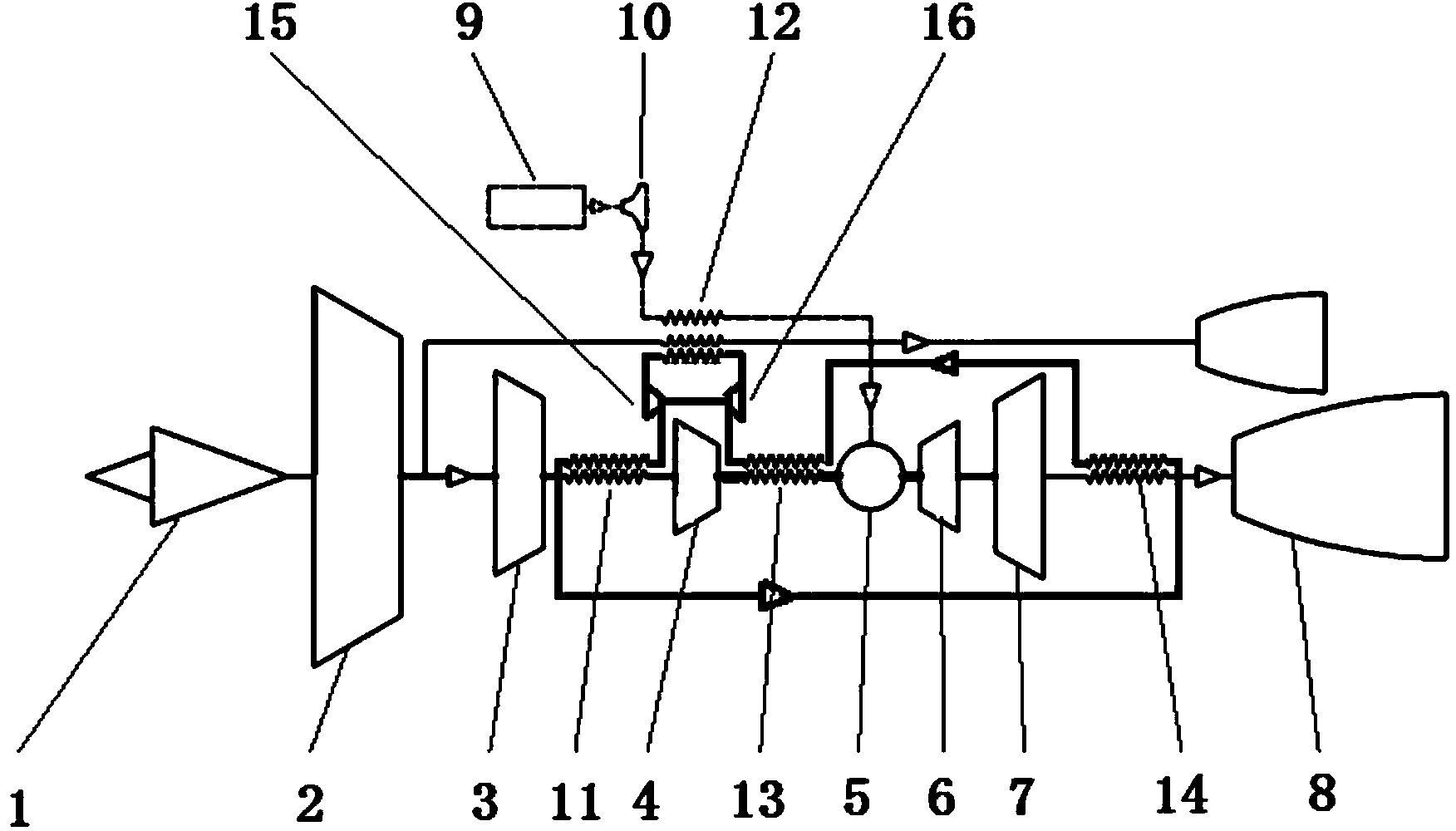
  • Figure 2
    Figure 2
  • Figure 3
    Figure 3
Patent Text Reader

Abstract

The invention provides an intercooling or intercooling recuperating layout for an aero-engine. The layout comprises a Brayton cycle in a main flow path and a supercritical state fluid cycle, wherein the two cycles are mutually independent and are coupled through a micro-scale heat exchanger. The micro-scale heat exchanger is a supercritical micro-scale compact rapid heat exchanger comprising a heat exchanging element and two working mediums, wherein the two working mediums exchange heat through the heat exchanging element. The micro-scale heat exchanger is characterized in that one of the working mediums employs a supercritical state fluid, the other working medium is not limited, the size of the heat exchanging element is in a micro-scale range, the critical pressure of the supercritical state fluid is at least 0.5 MPa, the temperature of the supercritical state fluid is at least 200 DEG C higher than critical temperature, and micro-scale refers to that the geometric scale of the basic heat exchanging element is no more than 2 mm. The intercooling or intercooling recuperating layout provided by the invention overcomes the disadvantages of conventional intercooling or intercooling recuperating layouts, improves the cycle efficiency of the aero-engine and reduces the oil consumption rate of the aero-engine.
Need to check novelty before this filing date? Find Prior Art

Description

technical field

[0001] The invention relates to the technical field of aeroengines, in particular to an intercooling or intercooling heat recovery cycle layout of an aeroengine, which is mainly used to improve the working performance of an aeroengine. Background technique

[0002] Further improving the performance of aero-engines and reducing fuel consumption is of great significance to the economy and environmental protection of aero-engines, and has always been the goal pursued by the field of aero-engines. As an effective way to reduce fuel consumption, the intercooling and heating cycle has become one of the research hotspots in recent years. The intercooling cycle means that the gas is fully cooled before entering the high-pressure compressor to reduce the inlet temperature of the high-pressure compressor, thereby increasing the Mach number at the inlet of the high-pressure compressor, reducing the power required by the compressor, and improving the engine cycle efficie...

Examples

Embodiment Construction

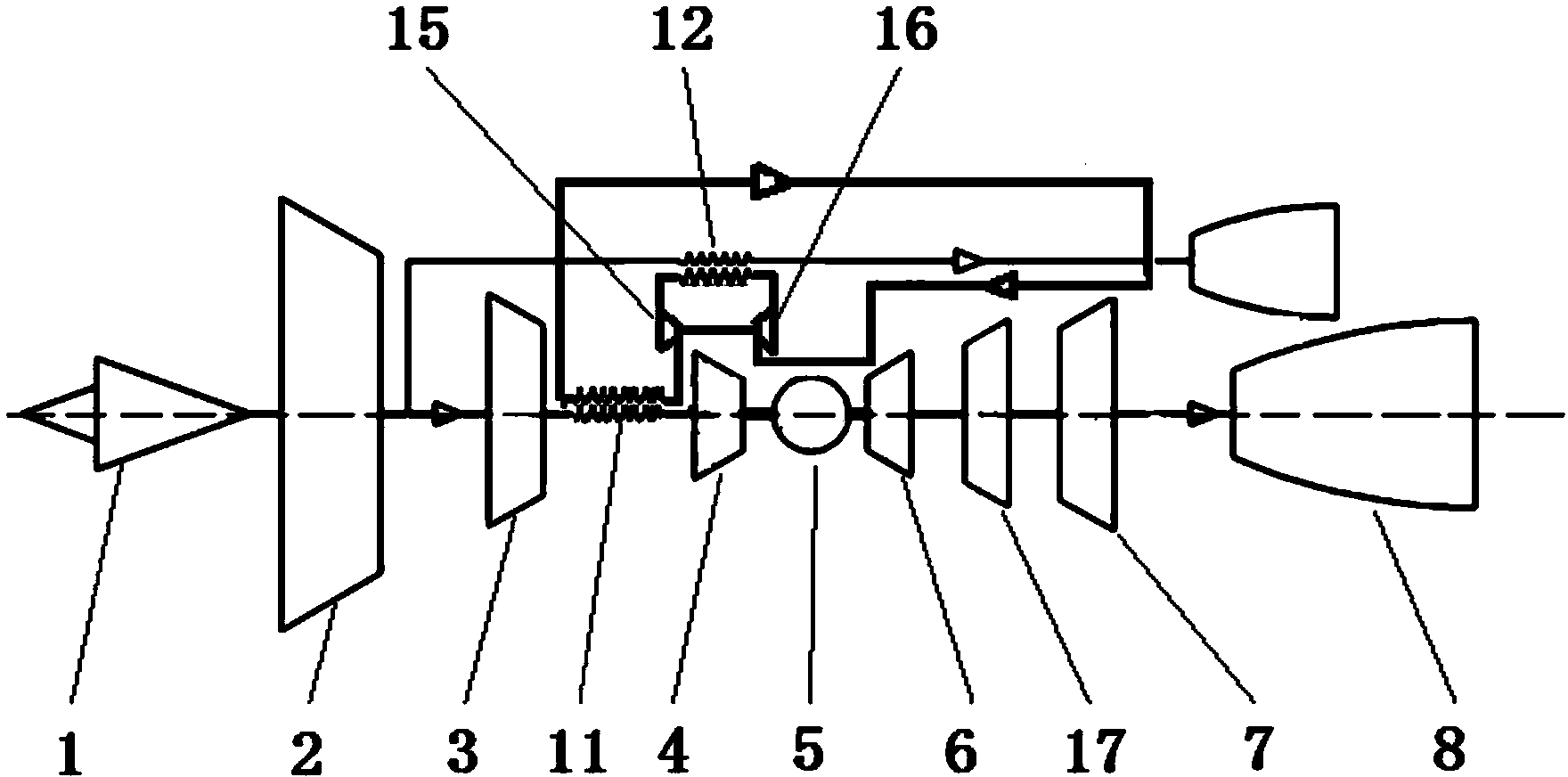
[0031] The invention can be used in the layout of the intercooling or intercooling heat recovery cycle in the fields of aeroengines, ground gas turbines and the like. The following implementation cases of the present invention are implemented on the basis of a certain type of large bypass ratio three-rotor civil aeroengine scheme, and a supercritical fluid circulation is added to its original flow path to form an intercooling cycle. Such as image 3As shown, the upper part is the intercooling circulation layout scheme, and the lower part is the conventional circulation layout scheme for comparison. The Brayton cycle in the mainstream flow path of the intercooling cycle layout scheme includes: intake duct 1, fan 2, medium-pressure compressor 3, high-pressure compressor 4, combustion chamber 5, high-pressure turbine 6, medium-pressure turbine 17, and low-pressure turbine 7. Exhaust nozzle 8, the above-mentioned components are arranged from front to back in numerical order and c...