Redox flow battery for hydrogen generation
A liquid flow battery and battery technology, applied in the direction of fuel cells, battery electrodes, fuel cell additives, etc., can solve the problems that electrolysis cannot be applied intermittently, and achieve the effect of high storage capacity
- Summary
- Abstract
- Description
- Claims
- Application Information
AI Technical Summary
Problems solved by technology
Method used
Image

Examples
Embodiment 1
[0074] Example 1: Generation of Hydrogen
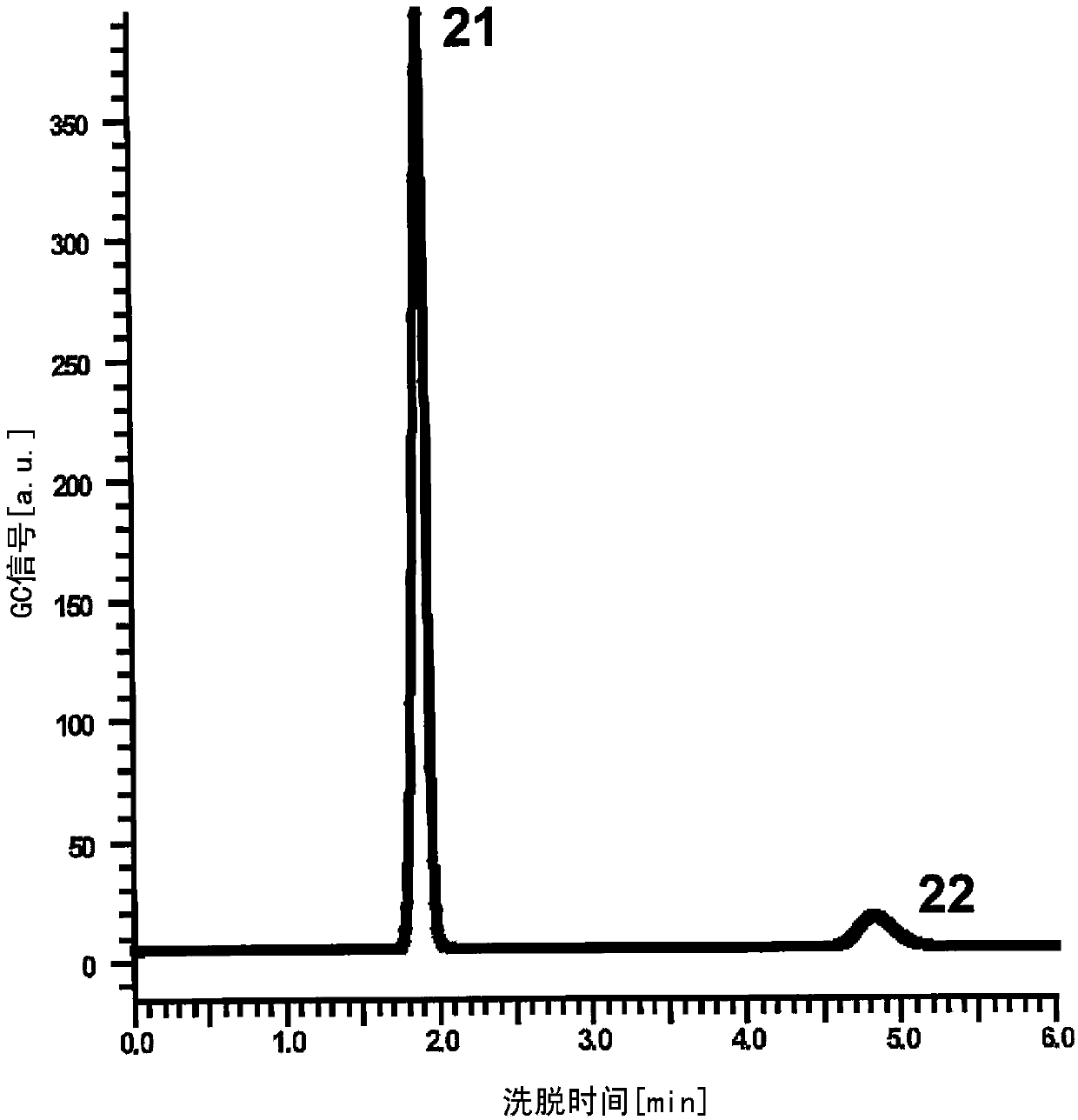
[0075] Under anaerobic conditions with magnetic stirring for 1 hour, by containing 1M H 2 SO 4 , 20mM V(II) and 3 mg silica loaded MOS 2 Or purchase the original Mo 2 C powder (SiO 2 :MoS 2 A 2 mL solution with a molar ratio of 10:1) successfully generated hydrogen gas. The atmosphere above the liquid (headspace) was sampled by a gas-tight syringe and injected into the GC. Mo 2 The result of C ( figure 2 ) are shown with the initial presence of N 2 (Peak 22) compared to the obvious presence of H 2 (Peak 21).
Embodiment 2
[0076] Example 2: Oxygen Generation
[0077] The chemical oxidation of water to form oxygen has been clearly observed in the following experimental conditions: 100 mM ceric ammonium nitrate (Ce (IV)) in 1M HNO 3 2 ml solution in 3 mg IrO 2 / SiO 2 reaction in the presence of . The atmosphere was sampled using a gas-tight syringe and injected into the GC. result( Image 6 ) shows the presence of O 2 (peak 61), and the background gas N of the test 2 (Peak 62).
Embodiment 3
[0078] Example 3: Quantification of electrolytes (Dimensioning)
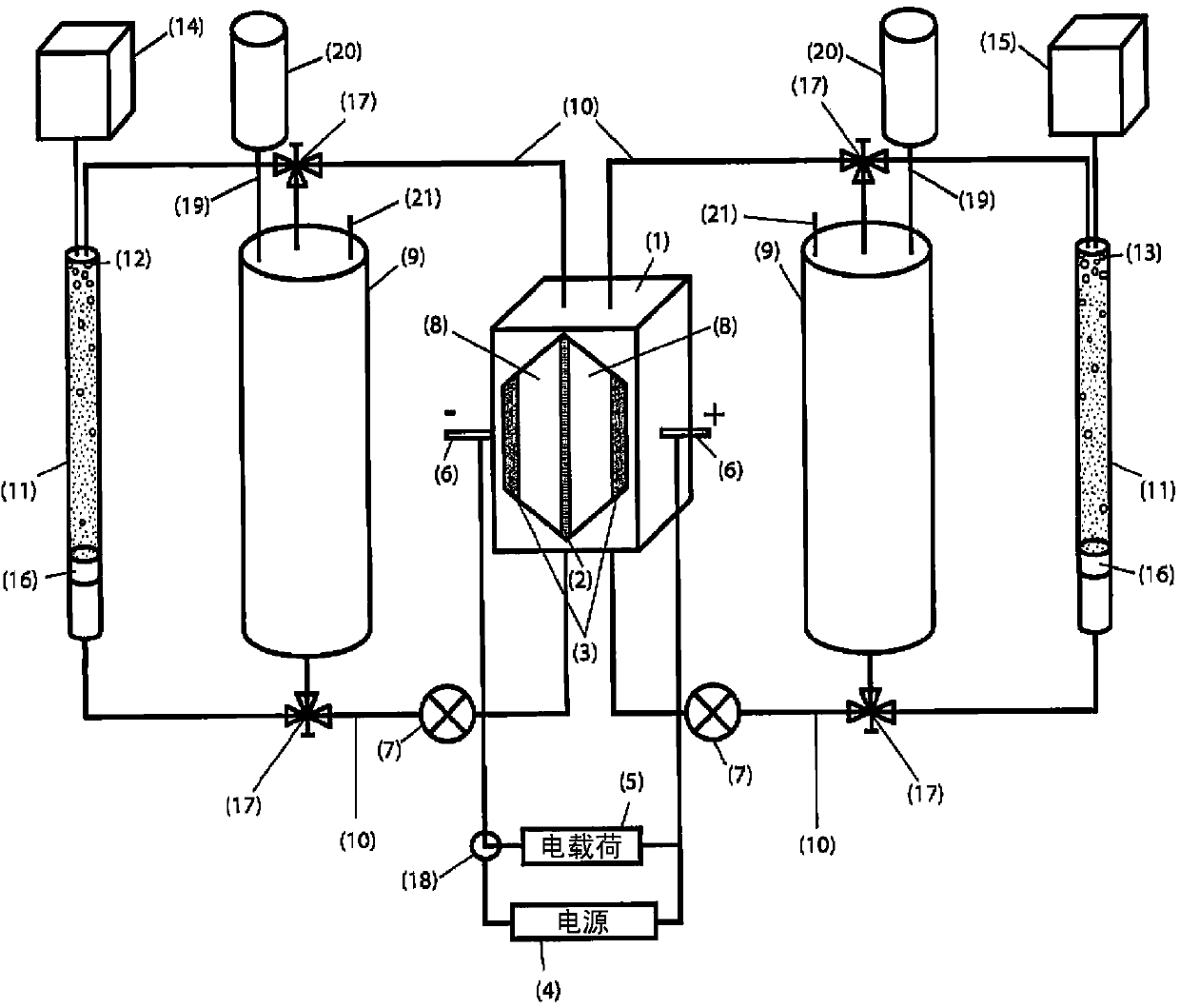
[0079] To produce 1 liter of H under standard conditions 2 and 0.5 L O 2 (i.e. 44.6 mmol H 2 and 22.3 mmol O 2 ), requiring 89.3 mmol of V(II) and Ce(IV). For an arbitrary concentration of 2M, the catholyte and anolyte have a volume of 89.3 ml. Each electrolyte may also contain an acidic supporting electrolyte (such as H 2 SO 4 ) and additives for increasing the solubility and stability of redox species. On a larger scale, in the Skyllas-Kazacos all-vanadium redox flow battery [Rychcik (1988), supra], 80 liters of each electrolyte was used for a 1 kW battery. The open circuit potential was close to 25V (17 cells) and the current obtained was 65A during charging and about 40.5A during discharging.
PUM
| Property | Measurement | Unit |
|---|---|---|
| conversion efficiency | aaaaa | aaaaa |
Abstract
Description
Claims
Application Information
 Login to View More
 - R&D
- Intellectual Property
- Life Sciences
- Materials
- Tech Scout
- Unparalleled Data Quality
- Higher Quality Content
- 60% Fewer Hallucinations
Browse by: Latest US Patents, China's latest patents, Technical Efficacy Thesaurus, Application Domain, Technology Topic, Popular Technical Reports.
© 2025 PatSnap. All rights reserved.Legal|Privacy policy|Modern Slavery Act Transparency Statement|Sitemap|About US| Contact US: help@patsnap.com