
Asymmetrical disk array caching dispatching method
A disk array and cache technology, applied in the field of asymmetric disk array cache scheduling, can solve the problems affecting the I/O performance of front-end applications, unbalanced I/O requests, and reducing the reconstruction speed, so as to shorten the reconstruction time, shorten response time, and improve reliability
- Summary
- Abstract
- Description
- Claims
- Application Information
AI Technical Summary
Problems solved by technology
Method used
Image

Examples
Embodiment 1
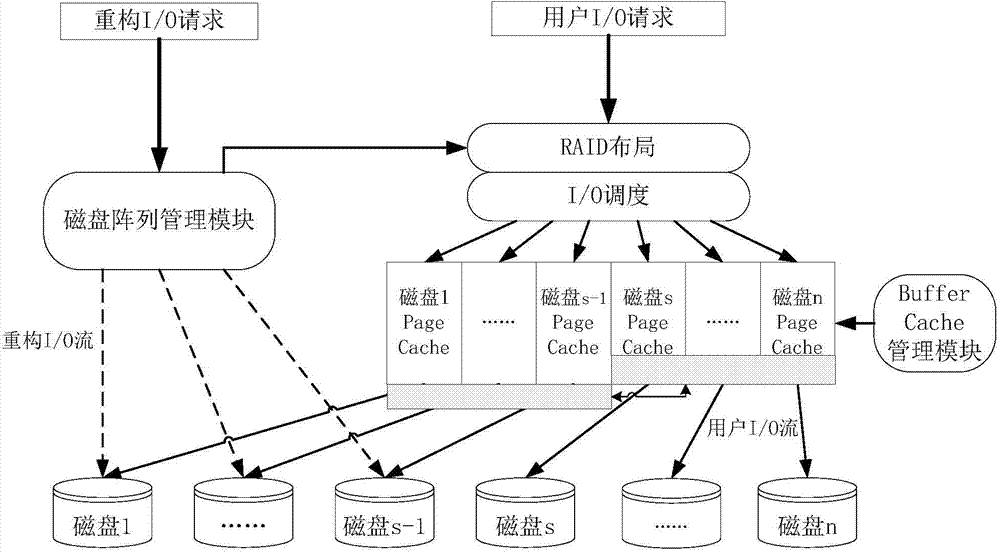
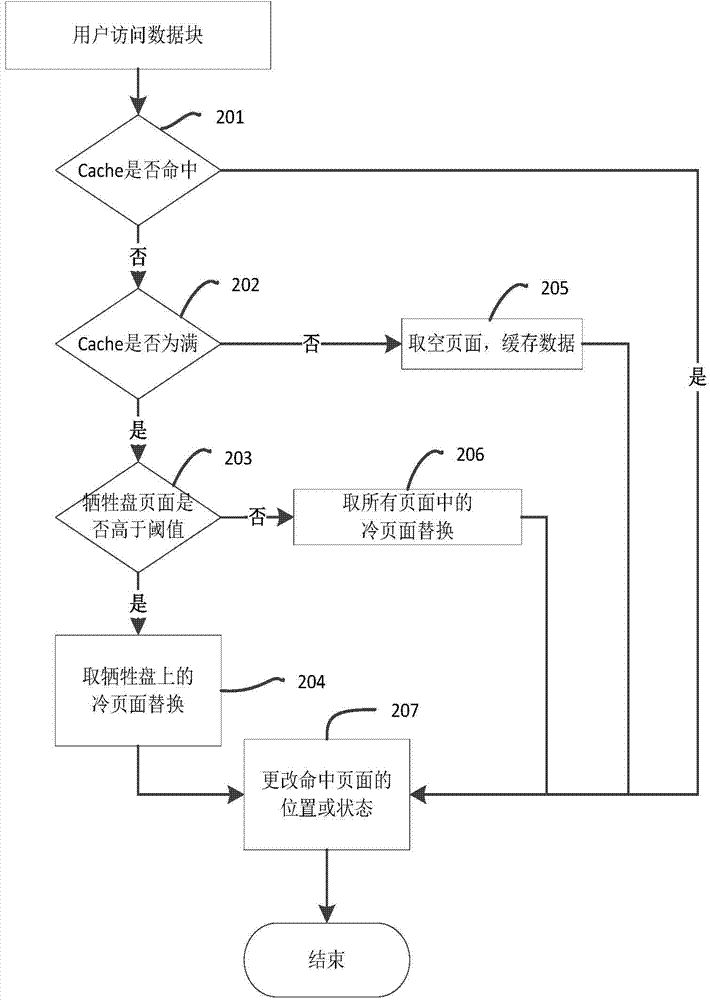
[0041] Taking 1 disk failure in n disks based on the RAID-6 system as an example (n is greater than or equal to 3) below, the asymmetric disk array cache scheduling method of the present invention and the least recently used page replacement algorithm (Least Recently Used, below LRU for short) are combined to describe the specific implementation of the present invention.
[0042] In the LRU algorithm, the weight of the cache page is determined by the storage time interval, which represents the last stored timestamp (timestamp), that is, the access sequence number. In the embodiment of the present invention, the LRU-based asymmetric disk array cache scheduling method needs to maintain the above evaluation method, and which cache page will be rejected is determined by the weight.
[0043] In the embodiment of the present invention, the Buffer Cache structure includes a global LRU linked list and a local LRU linked list, each disk corresponds to a local LRU linked list, the local...
Embodiment 2
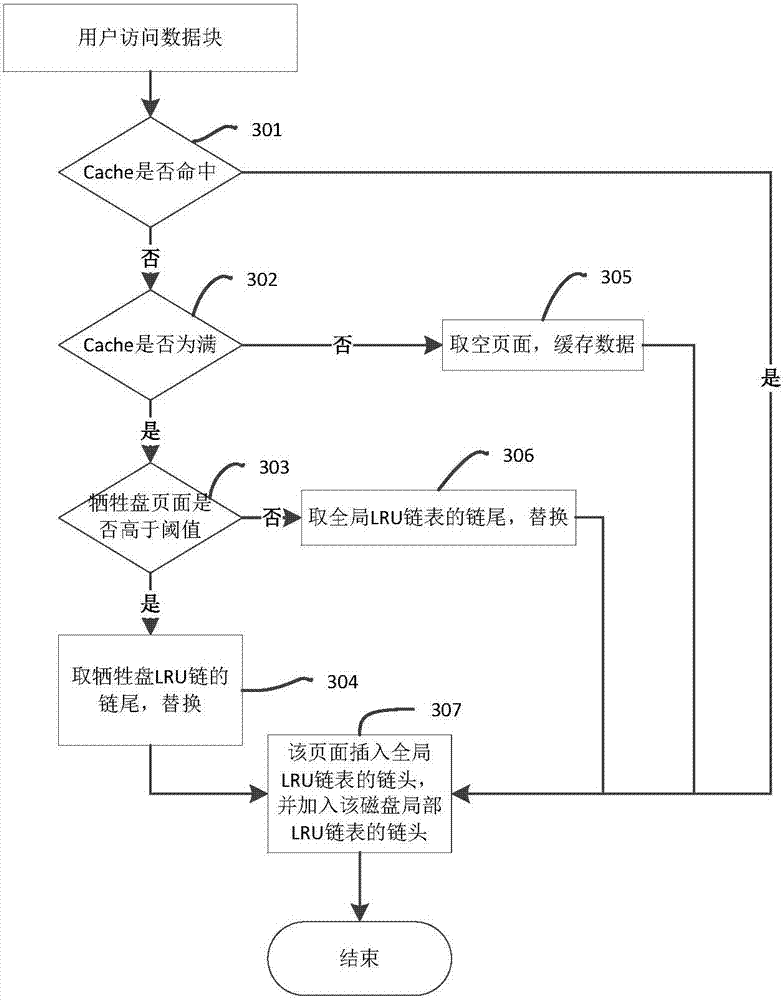
[0054] Taking the failure of one of the n disks in the RAID-10 system as an example (n is greater than or equal to 4), the specific implementation of the present invention will be described by combining the asymmetric disk array cache scheduling method of the present invention with the LRU algorithm.
[0055] In the embodiment of the present invention, the Buffer Cache structure includes a global LRU linked list and a local LRU linked list, each disk corresponds to a local LRU linked list in the cache, what the local LRU linked list stores is the cache page of the same disk, and what the global LRU linked list stores is Cache pages for all disks.
[0056] In the case of a disk failure, RAID-10 needs to read the mirror disk of the failed disk to reconstruct the data, that is, the remaining n-2 disks are all sacrificial disks.
[0057] Figure 4 For the flow chart of the LRU-based asymmetric disk array cache scheduling method on RAID-10 of the present invention, specifically co...
PUM
 Login to View More
 Abstract
Description
Claims
Application Information
 Login to View More