Unlock instant, AI-driven research and patent intelligence for your innovation.

A slurry bed residual oil hydrogenation method

A bed residual oil and slurry bed technology, applied in the field of residual oil hydrogenation in slurry bed

Active Publication Date: 2016-08-17
CHINA PETROLEUM & CHEM CORP +1
View PDF4 Cites 0 Cited by
  • Summary
  • Abstract
  • Description
  • Claims
  • Application Information

AI Technical Summary

Problems solved by technology

Due to the small difference in liquid velocity in each internal circulation zone, a large proportion of catalysts with different particle sizes will be back-mixed in each circulation zone, so it is still unavoidable to avoid the problem that catalyst deactivation is not synchronized but cannot be recovered separately

Method used

the structure of the environmentally friendly knitted fabric provided by the present invention; figure 2 Flow chart of the yarn wrapping machine for environmentally friendly knitted fabrics and storage devices; image 3 Is the parameter map of the yarn covering machine
View more

Image

Smart Image Click on the blue labels to locate them in the text.
Viewing Examples
Smart Image
  • A slurry bed residual oil hydrogenation method
  • A slurry bed residual oil hydrogenation method

Examples

Experimental program
Comparison scheme
Effect test

Embodiment 1

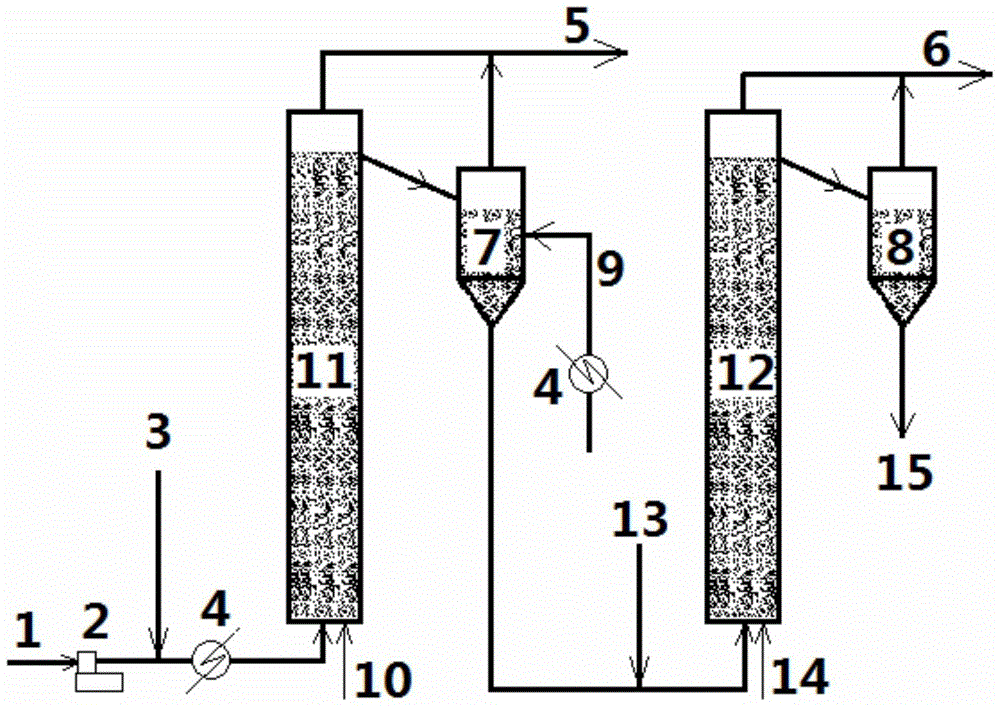
[0029] The other conditions are the same as in Comparative Example 1. After the effluent from the first reactor is separated by the gas-liquid separator, the liquid phase fluid is mixed with high aromatic oil (see Table 3 for properties) at a temperature of 490°C at a ratio of 1:1. The temperature of the mixed fluid is 455°C. The hydrogen mixing temperature of the second reactor is 480°C, and the ratio of hydrogen to liquid is 850ML / kg. In this way, the temperature of the second reactor can be maintained at 460°C. The operation results are shown in Table 2. The data show that the coke yield decreased significantly and the conversion increased in this mode of operation.

Embodiment 2

[0031] Other conditions are identical with embodiment 1. A high aromatic oil with the properties of Table 3 was hydrogenated to increase the hydrogen / carbon molar ratio from 1.18 to 1.35, then preheated to 490°C and mixed with the slurry from the first reactor. The reaction results are shown in Table 2. Visible product distribution is better than embodiment 1.

Embodiment 3

[0033] Other conditions are identical with embodiment 1. The operating temperature of the first reactor is 440°C, the hydrogen-oil ratio is 900NL / kg, the operating temperature of the second reactor is 465°C, the system pressure is 21MPa, and the residual oil feed rate is 0.85kg / h. The slurry from the first reactor is mixed with hydrogenated high aromatic oil (H / C=1.40) at a ratio of 1.3:1, and the temperature of the latter is 490°C. The hydrogen mixing ratio of the second reactor is 920NL / kg, and the hydrogen temperature is 485°C. The reaction results are shown in Table 2.

[0034] Table 1

[0035] project

Vacuum residue

Analytical method

Density (20°C) / (g / cm 3 )

1.0369

GB / T2540

w (residual charcoal) / %

27.3

GB / T17144

w (four components) / %

RIPP10-90

saturated hydrocarbon

14.6

Aromatics

37.1

colloid

25.5

Asphaltenes

22.8

w (element) / %

C

...

the structure of the environmentally friendly knitted fabric provided by the present invention; figure 2 Flow chart of the yarn wrapping machine for environmentally friendly knitted fabrics and storage devices; image 3 Is the parameter map of the yarn covering machine
Login to View More

PUM

PropertyMeasurementUnit
particle sizeaaaaaaaaaa
Login to View More

Abstract

The invention relates to a slurry bed residual oil hydrogenation method. According to the method, a manner that two slurry bed reactors are connected in series is adopted and the reaction temperature of a first reactor is lower than that of a second reactor. By diluting and heating slurry flowing out from the first reactor through a material having a certain characteristics, the temperature rise of the outlet material of the first reactor is met and meanwhile stable free radicals are obtained. By the method, the use of a heating furnace or a heat exchanger is avoided, the risk of coking during the operation process is reduced and the conversion rate is increased.

Description

technical field [0001] The invention relates to a residual oil hydrogenation method, more specifically, a slurry bed residual oil hydrogenation method. Background technique [0002] Hydropyrolysis of residual oil or asphaltenes is an ideal way to make full use of petroleum resources, especially now and in the future when petroleum resources are scarce, and the share of heavy oil or heavy oil in the crude oil market continues to increase, making full use of the resources derived from this The technical demand for low-quality residual oil increases accordingly. Compared with traditional crude oil, inferior feedstock oil is of poorer quality, which not only poses challenges to traditional refining technology, but also brings greater profit margins to refineries due to its lower price. [0003] Slurry bed is one of the effective methods for processing inferior residual oil. Especially in the case of using a disposable catalyst, the influence of the asphaltene content of the ra...

Claims

the structure of the environmentally friendly knitted fabric provided by the present invention; figure 2 Flow chart of the yarn wrapping machine for environmentally friendly knitted fabrics and storage devices; image 3 Is the parameter map of the yarn covering machine
Login to View More

Application Information

Patent Timeline
no application Login to View More
Patent Type & Authority Patents(China)
IPC IPC(8): C10G65/02
CPCC10G65/10
Inventor 吴治国王蕴王鹏飞任杰
Owner CHINA PETROLEUM & CHEM CORP