
An anionic iridium complex that can be used for oxygen sensing, and its preparation and application
A technology of iridium complexes and oxygen sensing, which is applied in the fields of compounds containing elements of group 8/9/10/18 of the periodic table, chemical instruments and methods, organic chemistry, etc., can solve the problem of aggregation quenching luminescence and insufficient stability Good selectivity, difficult synthesis and other problems, to achieve the effect of good selectivity, rich photophysical properties, and simple synthesis
- Summary
- Abstract
- Description
- Claims
- Application Information
AI Technical Summary
Problems solved by technology
Method used
Image

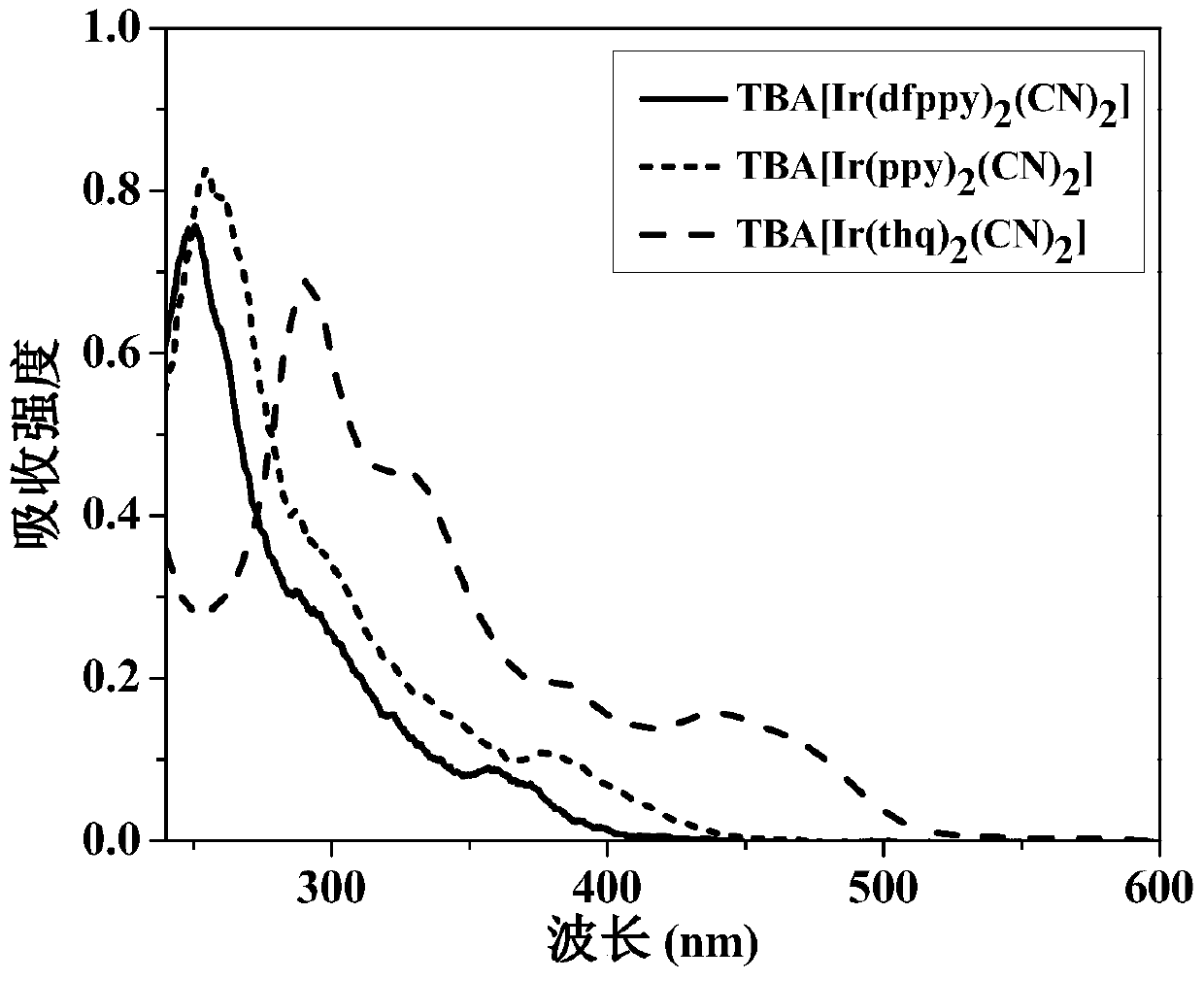
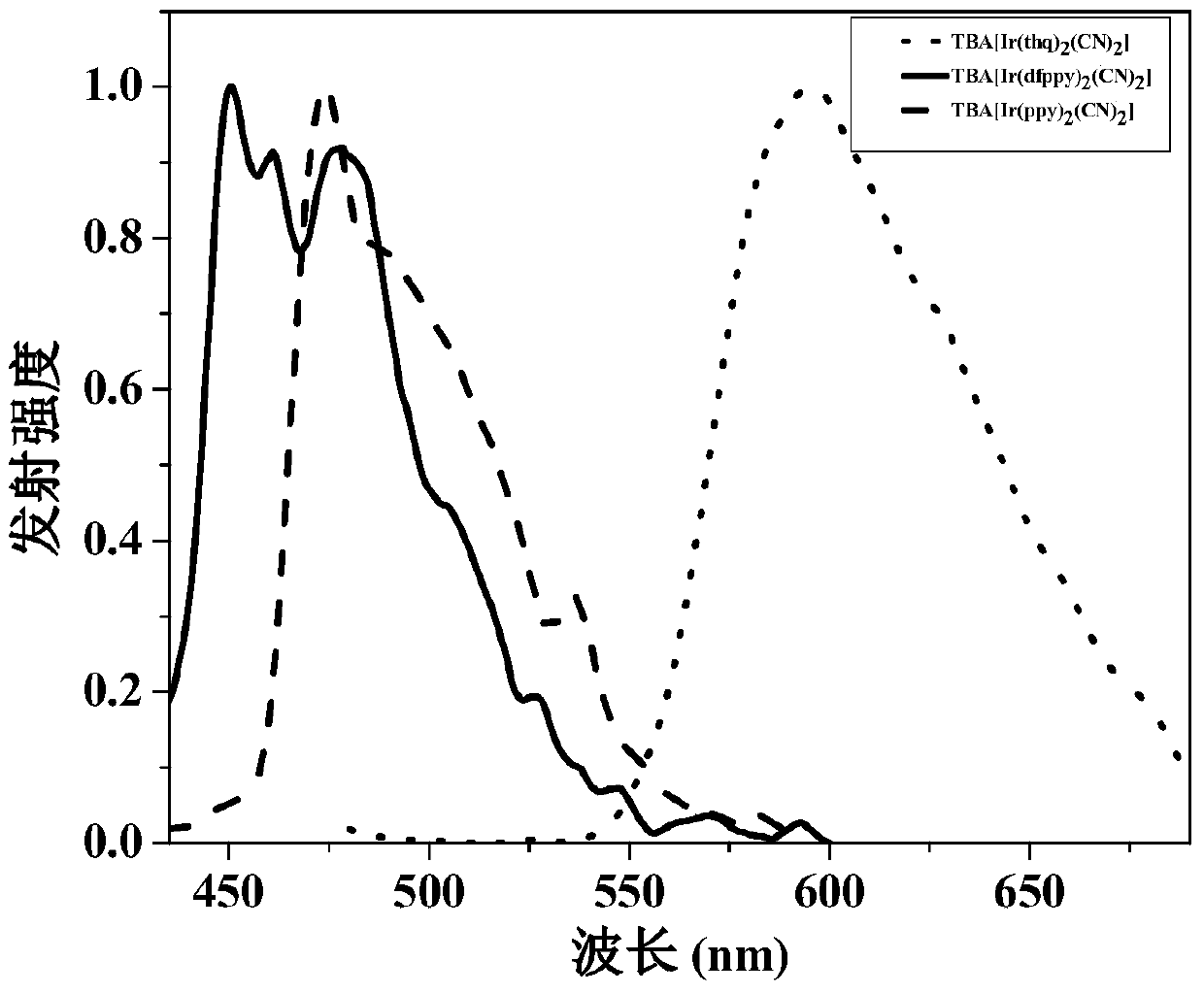
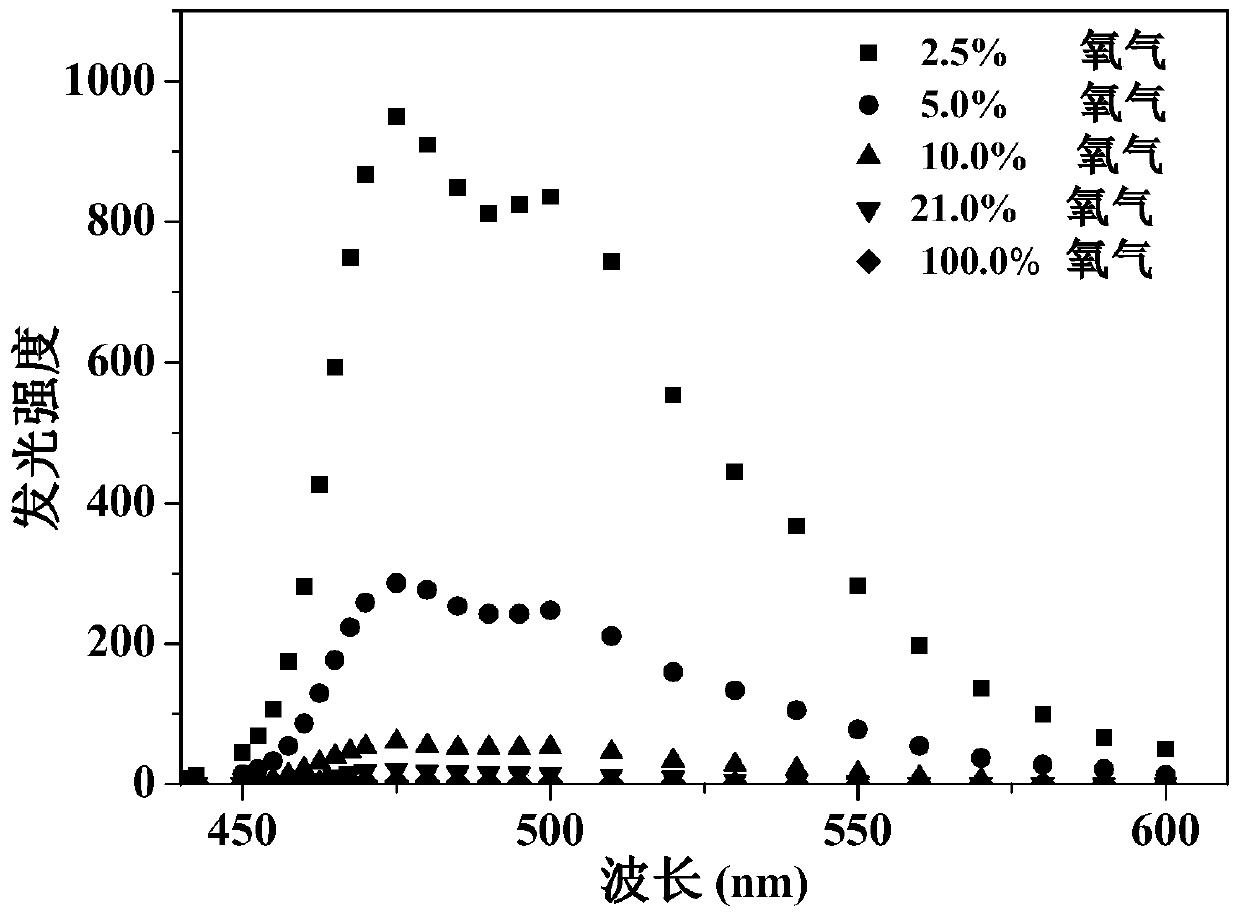
Examples
Embodiment 1
[0029] Embodiment 1, anionic iridium complex [Ir(dfppy) 2 (EN) 2 ] - wxya + preparation.
[0030] (1) Determine and prepare the C^N ligand. The C^N ligand is determined to be 2,4-difluorophenylpyridine (dfppy), which can be prepared according to the existing preparation methods in the prior art.
[0031] The reaction formula for preparing the monomer 2,4-difluoro-2-phenylpyridine is shown below.
[0032]
[0033] The specific process is: weigh 2-bromopyridine (1.0g, 6.37mmol), 2,4-difluorophenylboronic acid (1.03g, 6.5mmol) and tetrakis(triphenylphosphine)palladium (0.370g, 0.32mmol) and add In a 50mL two-necked bottle, vacuumize and blow nitrogen for three times, then inject toluene (9mL) and saturated K 2 CO 3 (aq) (3 mL), ethanol (3 mL), reflux at 80° C. for 15 hours. Cool to room temperature, extract with dichloromethane and distilled water, combine the organic phases, and spin dry under reduced pressure to obtain 1.12 g of the product with a yield of 90%. 1H NM...
Embodiment 2
[0041] Embodiment 2, anion iridium complex [Ir(ppy) 2 (EN) 2 ] - wxya + Preparation of:
[0042] (1) Determine and prepare the C^N ligand, confirm that the C^N ligand is 2-phenylpyridine (ppy), which can be prepared according to the existing preparation methods in the prior art.
[0043] (2) Anionic iridium complex [Ir(ppy) 2 (EN) 2] - wxya + Preparation of:
[0044] (A) Dimer iridium complex (C^N) 2 Ir(μ-Cl) 2 Ir(C^N) 2 The synthesis of 2-phenylpyridine dichloro bridge, the specific reaction is: weigh IrCl 3 .3H 2 O (528mg, 1.50mmol) and 2-phenylpyridine (ppy) (864mg, 4.50mmol) were added into a 50mL two-neck flask, and nitrogen was circulated three times under vacuum. Ethylene glycol ether (15 mL) and distilled water (3 mL) were injected with a syringe, the reaction temperature was 100° C., and the mixture was stirred under reflux for 36 hours under a nitrogen atmosphere until a precipitate formed. After stopping the reaction, cool to room temperature, filter t...
Embodiment 3
[0047] Embodiment 3, anion iridium complex [Ir(thq) 2 (EN) 2 ] - wxya + preparation.
[0048] (1) Determine and prepare the C^N ligand, confirm that the C^N ligand is 2-thienyl quinoline (thq), which can be prepared according to the existing preparation methods in the prior art.
[0049] (2) Anionic iridium complexes [Ir(thq) 2 (EN) 2 ] - wxya + Preparation of:
[0050] (A) Dimer iridium complex (C^N) 2 Ir(μ-Cl) 2 Ir(C^N) 2 The synthesis of, that is, the synthesis of 2-thiophene-quinoline dichloro bridge, its specific synthesis method is: weigh IrCl 3 ·3H 2 O (500mg, 1.42mmol) and 2-thiophene-quinoline (thq) (600.0mg, 2.84mmol) were added into a 50mL two-neck flask, and vacuum pumped and nitrogen was circulated three times. Ethylene glycol ether (12 mL) and distilled water (4 mL) were injected with a syringe, the reaction temperature was 120° C., and the mixture was refluxed and stirred for 36 hours under a nitrogen atmosphere until a precipitate formed. After st...
PUM
 Login to View More
 Abstract
Description
Claims
Application Information
 Login to View More