
Modified mineral fibers for producing wire insulating layer material
A mineral fiber and insulating layer technology, applied in the direction of rubber insulators, organic insulators, plastic/resin/wax insulators, etc., can solve the problems of poor dispersion, poor compatibility, and agglomeration of mineral fibers, and achieve improved compatibility and weather resistance Performance, the effect of interface state improvement
- Summary
- Abstract
- Description
- Claims
- Application Information
AI Technical Summary
Problems solved by technology
Method used
Image

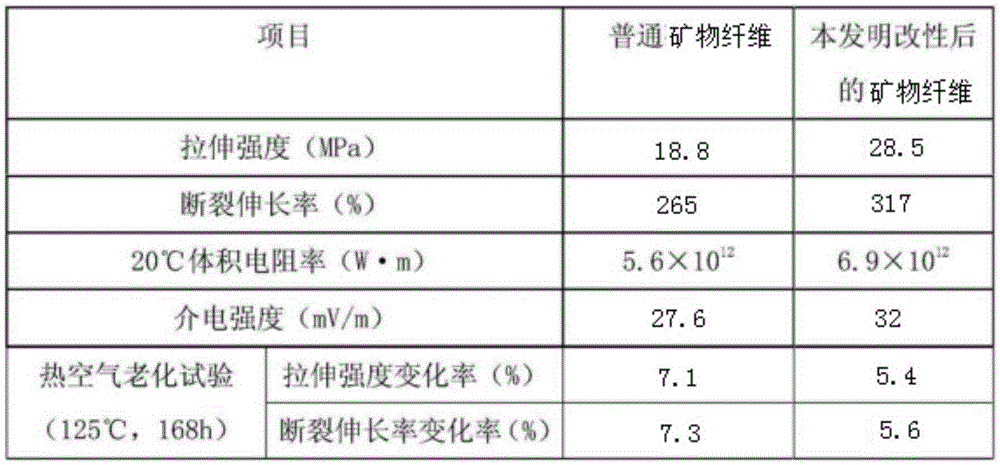
Examples
Embodiment 1
[0012] A modified mineral fiber for producing wire insulation layer materials, characterized in that: it is prepared from the following raw materials in parts by weight: 110 parts of mineral fiber, 25 parts of polybutylene terephthalate, sodium lauryl sulfate 1.5 parts, 7 parts of lauryl amidopropyl betaine, 12 parts of anatase titanium dioxide, 3 parts of zinc sulfide, 6 parts of isopropyl lanolate, 11 parts of ethyl laurate, 4 parts of calcium hydrogen phosphate, isopropyl tri 3.5 parts of (dodecylbenzenesulfonyl) titanate, 0.8 parts of dodecyltrimethylammonium chloride, bis(3,5-di-tert-butyl-4-hydroxybenzylphosphonic acid monoethyl ester) 0.7 parts of nickel, 7 parts of additives;
[0013] The additives are mixed by the following raw materials in parts by weight: 4 parts of 2-(2H-benzotriazol-2-yl)-p-cresol, 0.6 parts of zinc isooctanoate, bis(2,4-di-tert-butylbenzene base) 1.5 parts of pentaerythritol diphosphite, 1.6 parts of tert-butyl hydroquinone, 2.5 parts of barium ...
PUM
 Login to View More
 Abstract
Description
Claims
Application Information
 Login to View More