Molecular weight internal lane standard and application thereof
What is AI technical title?
AI technical title is built by Patsnap AI team. It summarizes the technical point description of the patent document.
A molecular weight internal standard, molecular weight technology, applied in the new molecular weight internal standard and its application, molecular weight internal standard field, to ensure the correct typing and easy interpretation.
Inactive Publication Date: 2016-02-03
SUZHOU NUHIGH BIOTECH
View PDF1 Cites 3 Cited by
Summary
Abstract
Description
Claims
Application Information
AI Technical Summary
This helps you quickly interpret patents by identifying the three key elements:
Problems solved by technology
Method used
Benefits of technology
Problems solved by technology
[0004] The present invention aims at the deficiencies existing in the use of the existing molecular weight internal standard, and provides a molecular weight internal standard and its application that can clearly distinguish a single base and ensure correct typing, thereby facilitating the interpretation of operators
Method used
the structure of the environmentally friendly knitted fabric provided by the present invention; figure 2 Flow chart of the yarn wrapping machine for environmentally friendly knitted fabrics and storage devices; image 3 Is the parameter map of the yarn covering machine
View more
Image
Smart Image Click on the blue labels to locate them in the text.
Viewing Examples
Smart Image
Click on the blue label to locate the original text in one second.
Reading with bidirectional positioning of images and text.
Smart Image
Examples
Experimental program
Comparison scheme
Effect test
Embodiment 1
[0028] Embodiment 1: the preparation method of novel molecular weight internal standard described in the present invention
[0029] The molecular weight internal standard of the present invention can be prepared by polymerasechain reaction (PCR) or enzymedigestion method, and the following two methods are described in detail respectively, so that those skilled in the art can implement without creative work.
[0031] 1.1 Design and synthesis of upstream and downstream primers
[0032] via a widely used exogenous DNA template. Use PrimerExpress software to analyze the complete sequence of exogenous DNA, design primers upstream (5'), and mark with NH635 at the 5' of the primers. Upstream primer 5'-GCCCGTCGAGAATACTGGCAATTTCACCTGC-3', annealing temperature 58°C. Take the upstream primer as the starting point, and find the end point of the downstream primer at the corresponding distance downstream. The length and sequence of the downstream...
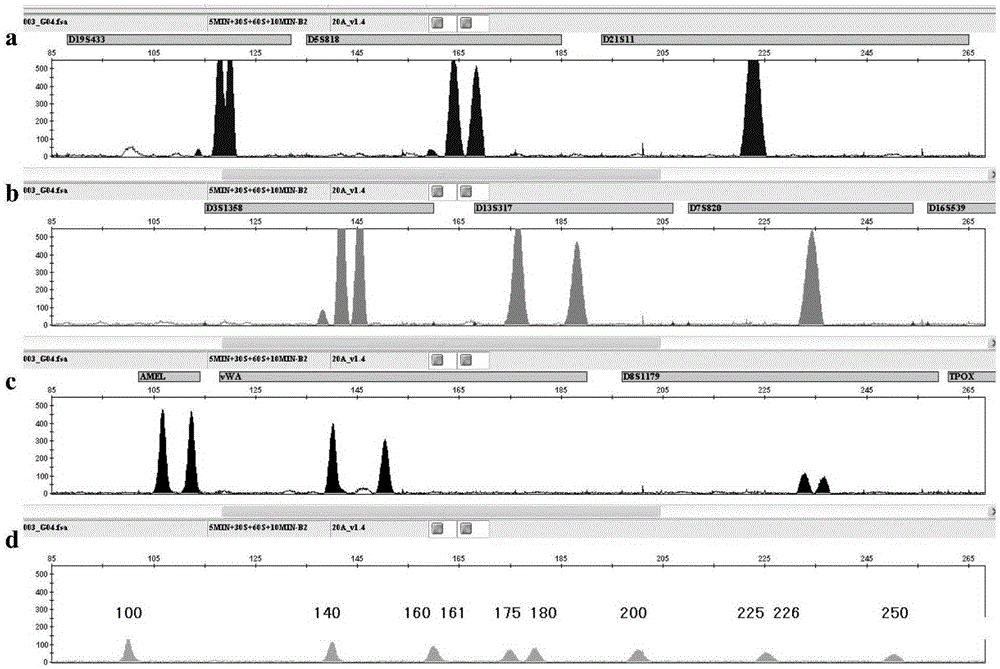
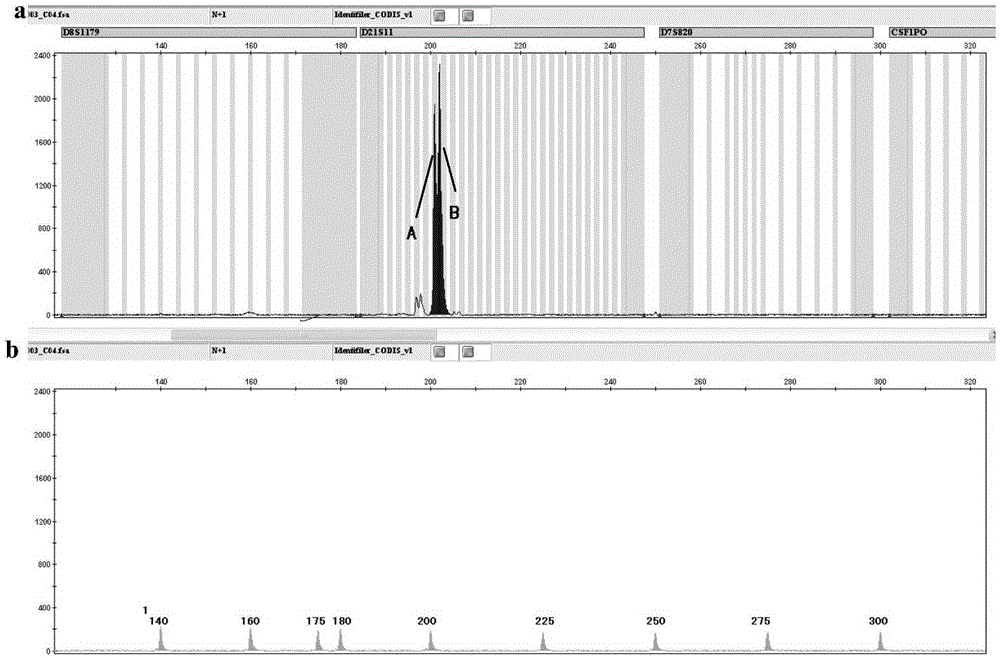
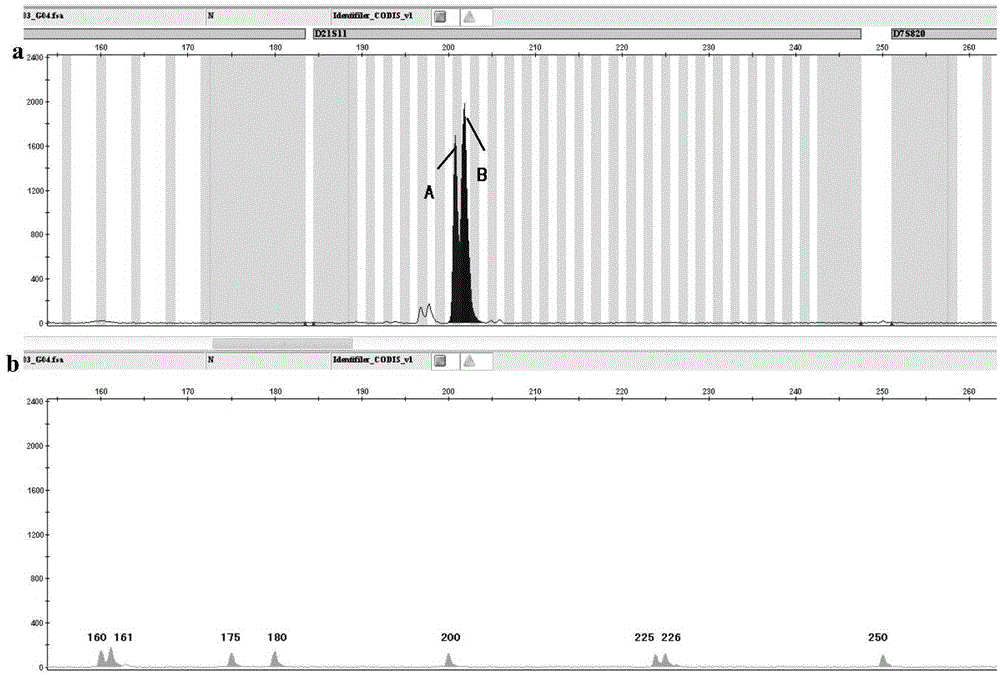
[0047] The molecular weight internal standard prepared according to the method described in Example 1 has a molecular weight of 75, 76, 80, 100, 140, 160, 161, 175, 180, 200, 225, 226, 250, 275, 300, 330, 331 , 360, 390, 445, 500, 501bp fragments.
[0048] When a certain part of the Buffer in the Buffer tank, the water in the water tank, the capillary, and the POP glue and formamide has expired or failed, use the molecular weight internal standard of the present invention to carry out STR typing detection, and the results are as follows figure 1 shown.
[0049] figure 1 The results show that the molecular weight internal standard of the present invention can distinguish the single base difference between 160bp and 161bp, 225bp and 226bp, ensuring single base resolution; while the LIZ-500 molecular weight internal standard cannot distinguish between 160bp and 161bp, nor can it separate 225bp and 226bp , cannot resolve single bases,...
the structure of the environmentally friendly knitted fabric provided by the present invention; figure 2 Flow chart of the yarn wrapping machine for environmentally friendly knitted fabrics and storage devices; image 3 Is the parameter map of the yarn covering machine
Login to View More
PUM
Login to View More
Abstract
The invention belongs to the technical field of biology and discloses a molecular weight internal lane standard. The molecular weight internal lane standard comprises n nucleotide fragments with recognizable markers and different molecular weights, wherein the n nucleotide fragments include at least p nucleotide fragment pairs differing by one basic group respectively, in other words, the basic group number of one fragment of any nucleotide fragment pair differing by one basic group is m, and the basic group number of the other fragment is m+1 or m-1. Compared with existing commercial molecular weight internal lane standards, the molecular weight internal lane standard has the advantages that the molecular weight internal lane standard is capable of distinguishing single basic group, effectively differentiating PCR (polymerasechain reaction) product fragments differing by one basic group and guaranteeing correct typing to facilitate interpretation of detection personnel, thereby being widely applicable to STR typing, sequencing, large-fragment analysis and genome analysis.
Description
technical field [0001] The invention belongs to the field of biotechnology, and in particular relates to a novel molecular weight internal standard and its application. In particular, it relates to a molecular weight internal standard capable of clearly distinguishing single bases and ensuring correct typing and its application Background technique [0002] Genome scanning is a method of finding markers closely linked to specific traits or genes from the genetic markers of the whole genome, and locating the related genes on the chromosome. Genotyping (Genotyping), also known as Genotype Analysis (Genotypicassay), is a technology that uses biological detection methods to determine an individual's genotype (Genotype), which uses technologies including polymerasechain reaction (PCR), DNA fragment analysis, Oligonucleotide probes (ASOprobes), gene sequencing, nucleic acid hybridization, genechip technology, etc. Gene scanning and genotyping technologies have developed rapidl...
Claims
the structure of the environmentally friendly knitted fabric provided by the present invention; figure 2 Flow chart of the yarn wrapping machine for environmentally friendly knitted fabrics and storage devices; image 3 Is the parameter map of the yarn covering machine
Login to View More
Application Information
Patent Timeline
Application Date:The date an application was filed.
Publication Date:The date a patent or application was officially published.
First Publication Date:The earliest publication date of a patent with the same application number.
Issue Date:Publication date of the patent grant document.
PCT Entry Date:The Entry date of PCT National Phase.
Estimated Expiry Date:The statutory expiry date of a patent right according to the Patent Law, and it is the longest term of protection that the patent right can achieve without the termination of the patent right due to other reasons(Term extension factor has been taken into account ).
Invalid Date:Actual expiry date is based on effective date or publication date of legal transaction data of invalid patent.


 Login to View More
  Login to View More