
A self-tensioning dragging device
A self-tensioning and traction technology, used in transmission, transportation and packaging, elevators in buildings, etc., can solve the problems that hydraulic cylinders cannot achieve equal thrust functions, cannot be used in precise transmission, and take up large space.
- Summary
- Abstract
- Description
- Claims
- Application Information
AI Technical Summary
Problems solved by technology
Method used
Image

Examples
Embodiment Construction
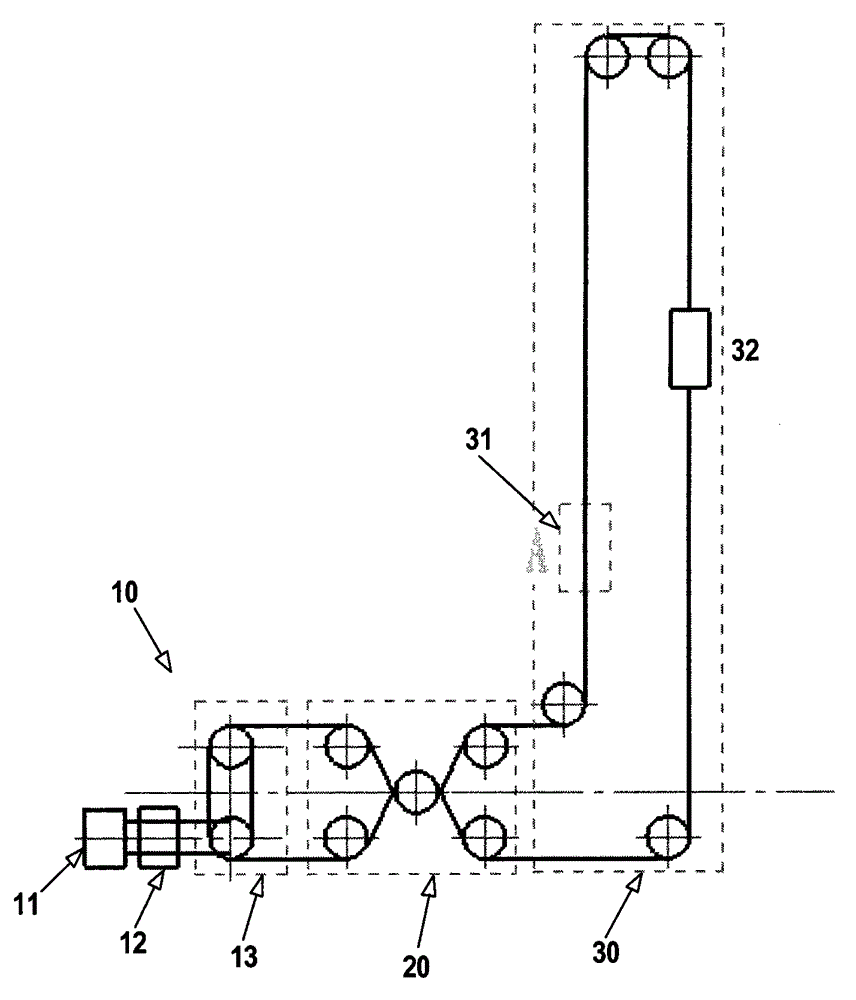
[0069] figure 2 is an overall view of a self-tensioning traction device according to an embodiment of the present invention, which includes a non-differential speed traction mechanism 13 .
[0070] Such as figure 2 As shown, the self-tensioning traction device mainly includes three mechanisms, namely a driving mechanism 10 , a self-tensioning balance mechanism 20 and a traction actuator 30 . The drive mechanism 10 includes a motor 11 , a speed reducer 12 (or a reduction motor) and a non-differential traction mechanism 13 . The non-differential traction mechanism 13 includes two drums 14 arranged side by side and having the same diameter.
[0071] According to the basic principle of traction, it can be known that the non-differential speed traction mechanism 13 can drive the load movement with a certain difference between the steel wire ropes on both sides. Following the mechanism 13 is a self-tensioning balancing mechanism 20 .
[0072] Such as figure 2 As shown, the s...
PUM
 Login to View More
 Abstract
Description
Claims
Application Information
 Login to View More