
Pulse time synchronization system for quantum enhanced laser detection
A technology of laser detection and pulse time, which is applied in the field of quantum enhanced laser detection, can solve the problems of optical path difference, optical path difference cannot be compensated, and cannot be synchronized, and achieve the effects of small size, flexible modulation, and low cost
- Summary
- Abstract
- Description
- Claims
- Application Information
AI Technical Summary
Problems solved by technology
Method used
Image

Examples
Embodiment Construction
[0021] The present invention will be described in detail below in conjunction with the accompanying drawings and embodiments.
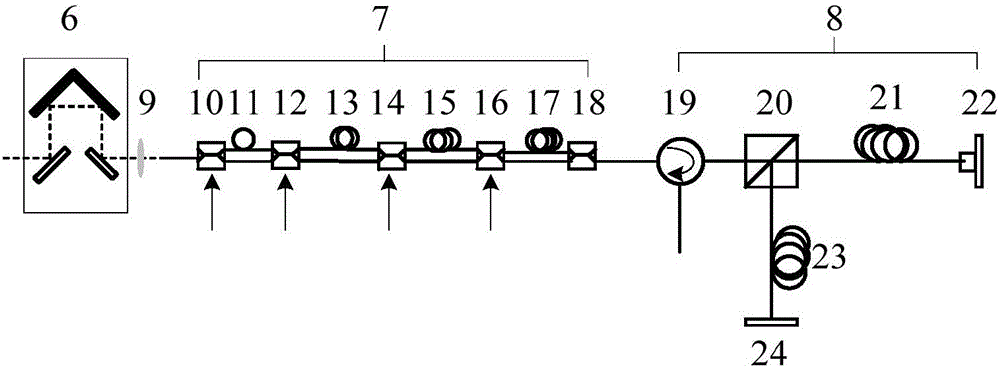
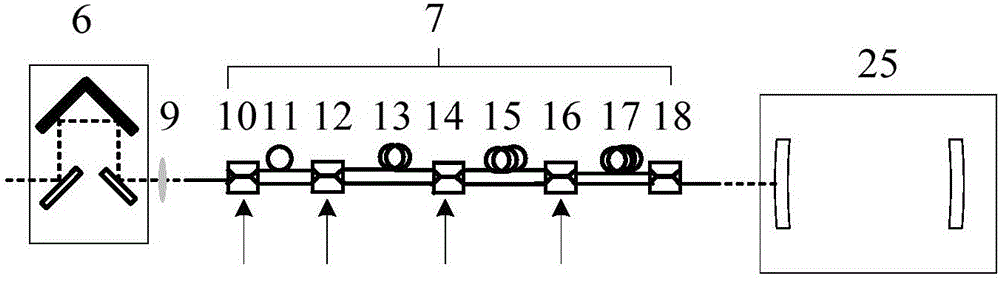
[0022] The invention describes a pulse time synchronization system for quantum-enhanced laser detection, which can promote homologous pump light, signal light and local oscillator light to achieve time synchronization at a nonlinear crystal or a balanced zero-beat detector.
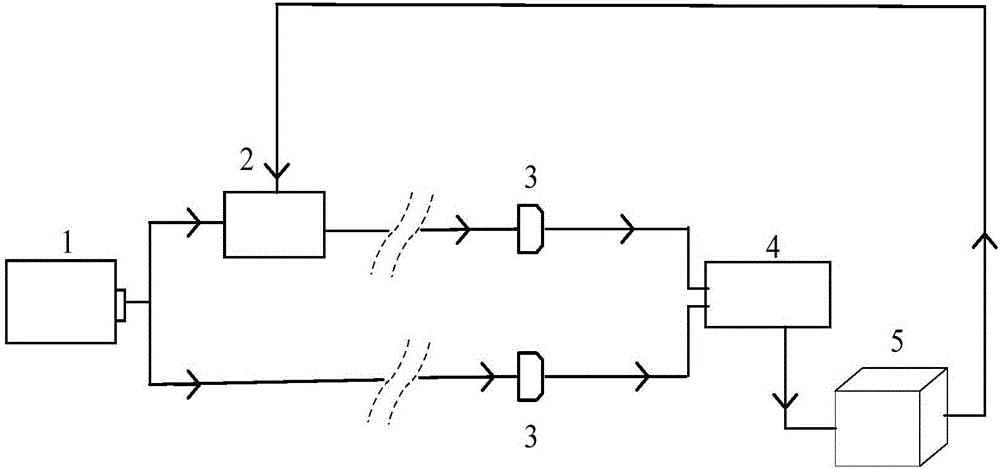
[0023] Such a pulse-time-synchronized system for quantum-enhanced laser detection such as figure 1 As shown, it includes a main laser light source 1, a delay unit 2, a time synchronization monitoring detector 3, a digital phase-lock unit 4 and a synchronization control unit 5, wherein the main laser light source 1 is divided into two beams by a beam splitter, and one beam is used as Local oscillator light and pump light, one beam is used as signal light; delay unit 2 is located in the optical path of local oscillator light and pump light, and is used to change the optical path of...
PUM
 Login to View More
 Abstract
Description
Claims
Application Information
 Login to View More