Synthetic apelin fatty acid conjugates with improved half-life
What is AI technical title?
AI technical title is built by PatSnap AI team. It summarizes the technical point description of the patent document.
A technology of conjugates and fatty acids, which is applied in the preparation of the composition and in the field of treating cardiovascular diseases, and can solve problems such as sensitivity to protease activity
Inactive Publication Date: 2017-11-28
NOVARTIS AG
View PDF87 Cites 0 Cited by
Summary
Abstract
Description
Claims
Application Information
AI Technical Summary
This helps you quickly interpret patents by identifying the three key elements:
Problems solved by technology
Method used
Benefits of technology
Problems solved by technology
[0009] However, such bioconjugates may still be susceptible to protease activity, or may no longer be as active as their non-conjugated analogs
Method used
the structure of the environmentally friendly knitted fabric provided by the present invention; figure 2 Flow chart of the yarn wrapping machine for environmentally friendly knitted fabrics and storage devices; image 3 Is the parameter map of the yarn covering machine
View more
Image
Smart Image Click on the blue labels to locate them in the text.
Viewing Examples
Smart Image
Click on the blue label to locate the original text in one second.
Reading with bidirectional positioning of images and text.
Smart Image
Examples
Experimental program
Comparison scheme
Effect test
Embodiment approach 1
[0054] In embodiment 1, the invention thus provides a conjugate or a pharmaceutically acceptable salt thereof comprising:
[0055] a. APJ agonist peptides having the following formula (I):
[0056] Q-R-P-R-L-C*-H-K-G-P-(Nle)-C*-F (I); or an amide or ester thereof, or a peptide substantially equivalent thereto; wherein the two cysteine amino acids marked with "*" are in their side chains Disulfide bonds are formed between the thiol functional groups of
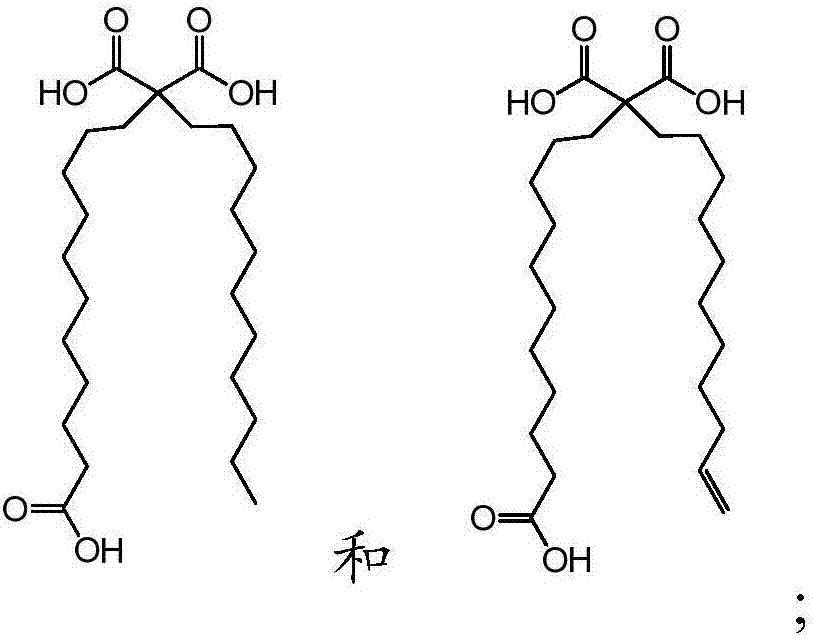
[0057] b. Fatty acids selected from:
[0058]
[0059] wherein the fatty acid is covalently linked to the N-terminus of the peptide via one of its carboxylic acid functional groups, optionally via a polyethylene glycol linker.
Embodiment approach 1A
[0060] In Embodiment 1A, the invention relates to a conjugate, or a pharmaceutically acceptable salt thereof, comprising:
[0061] a. APJ agonist peptides having the following formula (I):
[0062] Q-R-P-R-L-C*-H-K-G-P-(Nle)-C*-F (I); where the two cysteine amino acids marked with "*" form a disulfide bond between the thiol functional groups in their side chains; and
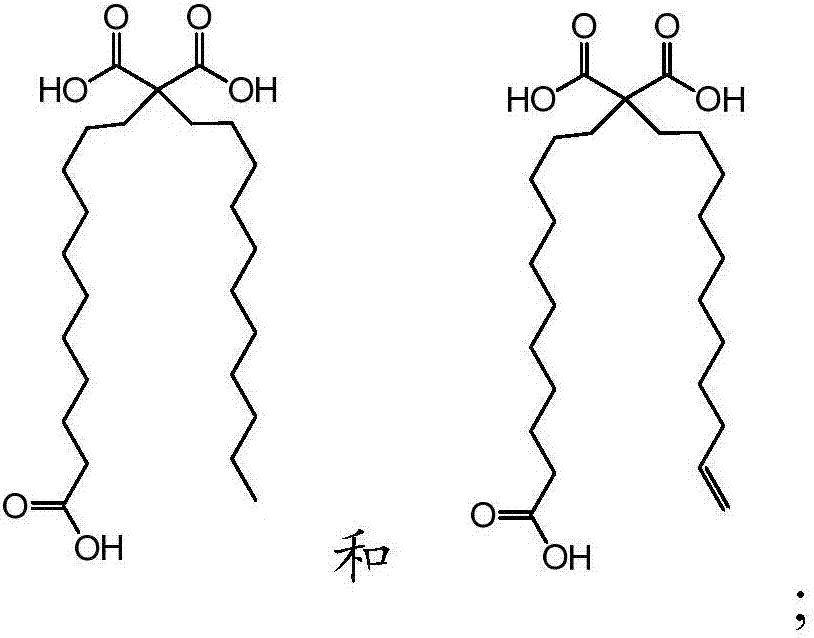
[0063] b. Fatty acids selected from:
[0064]
[0065] wherein the fatty acid is covalently linked to the N-terminus of the peptide via one of its carboxylic acid functional groups, optionally via a polyethylene glycol linker.
[0066] The fatty acids described in Embodiment 1 or 1A have been described in US Provisional Application No. 62 / 082327 (PAT056274-US-PSP2).
[0067] Any polyethylene glycol linker group is optional. The linker is polymeric in nature, being a polyethylene glycolmoiety containing two reactive groups / functional groups, one of which is reactive with the polypeptide of formula I and ...
[0402] To a solution of Intermediate 1b (300 mg, 0.096 mmol) in THF (100 mL) was added fatty acid-linker construct #_1 (960 mg, 0.575 mmol) in THF (35 mL) and water (15 mL). The reaction mixture was stirred at room temperature. When complete, the reaction was concentrated under partial vacuum and carried on to the next step as crude, assuming quantitative yield. (Product MW: 4681.870)
[0403]
[0404] Step 2: Deprotection:
[0405] To a solution of TFA (4.75 mL), TIPS (0.125 mL) and water (0.125 mL) was added DTT (296 mg, 1.920 mmol). Then, the premixed mixture was added to the compound of Step 1 (449 mg, 0.096 mmol), and stirred at room temperature. When complete, the reaction was concentrated under partial vacuum. The residue was treated with cold diethyl ether to give a cloudy reaction mixture which was allowed to stand at room...
the structure of the environmentally friendly knitted fabric provided by the present invention; figure 2 Flow chart of the yarn wrapping machine for environmentally friendly knitted fabrics and storage devices; image 3 Is the parameter map of the yarn covering machine
Field of invention: [0001] The present invention relates to compositions comprising a semi-synthetic biomolecule which is a bioconjugate of an APJ agonist polypeptide and a fatty acidmoiety. Specifically, compared to their corresponding naked polypeptides and / or compared to previously described Apelin bioconjugates, the bioconjugates of the present invention both retain APJ agonistic activity and exhibit resistance to the action of the peptide via peptidases. Greater resistance to proteolytic degradation. The invention also relates to methods of preparing said compositions and methods of using said compositions as pharmaceutically active agents for the treatment of cardiovascular diseases. Background of the invention: [0002] In the Western world, the incidence of heart failure accounts for about 1 / 100 of those over 65 years of age. The most common pathology is chronic insufficiency of myocardial contractility and thus cardiac output (ie, the effective volume of blood ej...
Claims
the structure of the environmentally friendly knitted fabric provided by the present invention; figure 2 Flow chart of the yarn wrapping machine for environmentally friendly knitted fabrics and storage devices; image 3 Is the parameter map of the yarn covering machine
Login to View More
Application Information
Patent Timeline
Application Date:The date an application was filed.
Publication Date:The date a patent or application was officially published.
First Publication Date:The earliest publication date of a patent with the same application number.
Issue Date:Publication date of the patent grant document.
PCT Entry Date:The Entry date of PCT National Phase.
Estimated Expiry Date:The statutory expiry date of a patent right according to the Patent Law, and it is the longest term of protection that the patent right can achieve without the termination of the patent right due to other reasons(Term extension factor has been taken into account ).
Invalid Date:Actual expiry date is based on effective date or publication date of legal transaction data of invalid patent.



 Login to View More
  Login to View More