Unlock instant, AI-driven research and patent intelligence for your innovation.

Resource Allocation Method Based on Interference Avoidance in Satellite-Ground Integrated Network

A resource allocation and interference avoidance technology, applied in the field of information and communication, can solve the problems of low throughput, poor inter-cell fairness, and lack of consideration of satellite interference, etc., to achieve the effect of reducing co-channel interference and ensuring throughput

Active Publication Date: 2021-10-26
HARBIN INST OF TECH
View PDF0 Cites 0 Cited by
  • Summary
  • Abstract
  • Description
  • Claims
  • Application Information

AI Technical Summary

Problems solved by technology

[0005] The existing satellite-integrated interference research scenarios mostly focus on the interference of the uplink of the satellite network terminal to the CGC, and do not consider the interference of the ground uplink to the satellite: the frequency reuse method adopted by the existing satellite-ground integrated network is aimed at ground The uplink of the terminal has serious interference to the satellite, low throughput and low energy efficiency; in terms of frequency resource allocation, the existing resource scheduling method does not take into account the ground soft frequency reuse strategy, so the throughput improvement of the satellite-ground integrated system is limited and Fairness among communities is poor

Method used

the structure of the environmentally friendly knitted fabric provided by the present invention; figure 2 Flow chart of the yarn wrapping machine for environmentally friendly knitted fabrics and storage devices; image 3 Is the parameter map of the yarn covering machine
View more

Image

Smart Image Click on the blue labels to locate them in the text.
Viewing Examples
Smart Image
  • Resource Allocation Method Based on Interference Avoidance in Satellite-Ground Integrated Network
  • Resource Allocation Method Based on Interference Avoidance in Satellite-Ground Integrated Network
  • Resource Allocation Method Based on Interference Avoidance in Satellite-Ground Integrated Network

Examples

Experimental program
Comparison scheme
Effect test

specific Embodiment

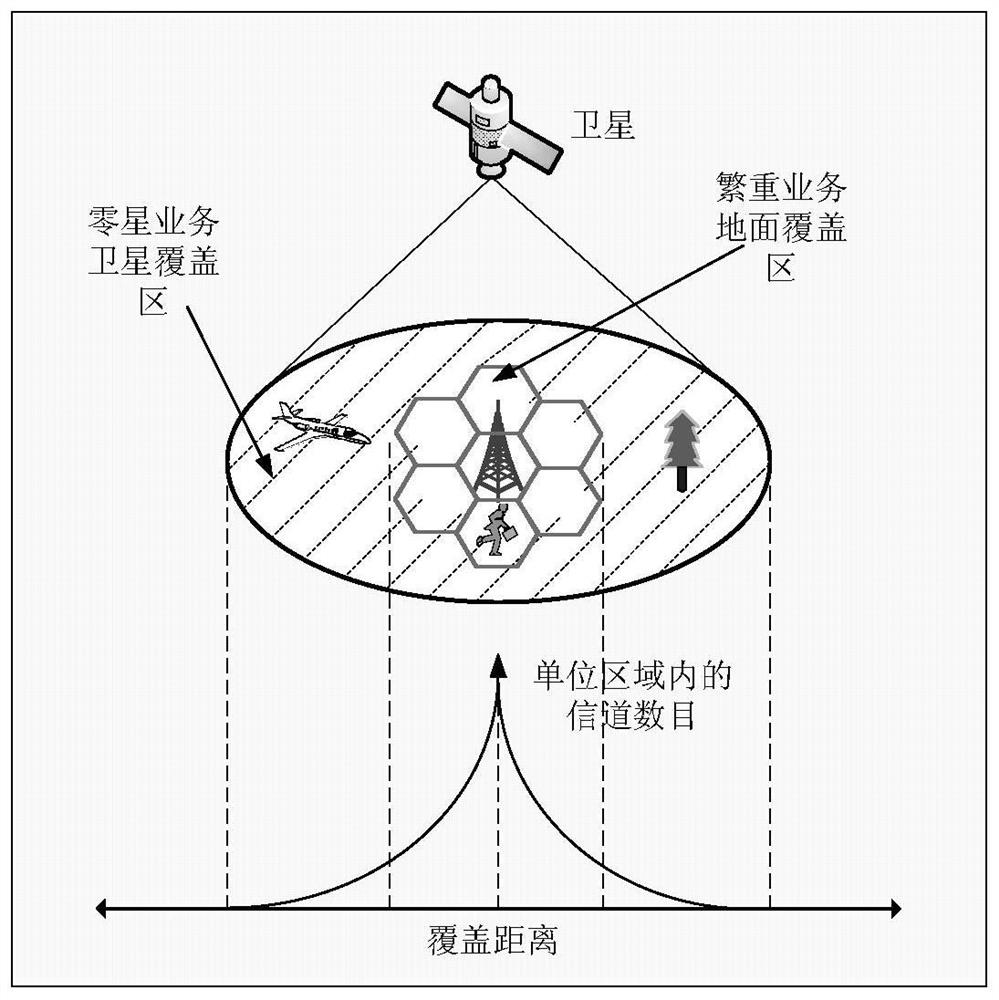
[0058] Specific embodiments: the general idea of ​​this embodiment is: the schematic diagram of satellite-ground integrated network coverage is as follows figure 1 As shown, on the basis of the existing satellite-ground integrated spectrum sharing scheme, the protection area is established to suppress interference, the frequency band isolation is sorted, and the factors that affect the signal-to-interference-noise ratio in the scheme are further found out. Combined with the ground soft frequency reuse strategy, an energy-efficient satellite-ground frequency reuse method based on fairness between cells is proposed, including:

[0059] Step A. The integrated network architecture of satellite and ground based on CGC technology is as follows: image 3 As shown, the satellite-ground integrated spectrum sharing model is established, and this stage is specifically as follows:

[0060] Step A1, the satellite adopts 37 multi-beam technology antennas, the MSS frequency band adopts seve...

the structure of the environmentally friendly knitted fabric provided by the present invention; figure 2 Flow chart of the yarn wrapping machine for environmentally friendly knitted fabrics and storage devices; image 3 Is the parameter map of the yarn covering machine
Login to View More

PUM

No PUM Login to View More

Abstract

The invention provides a resource allocation method based on interference avoidance in an energy-efficient satellite-terrestrial integrated network based on fairness, and relates to the technical field of information and communication. The method includes the following steps: Step 1: According to the position of the CGC base station or user in the cell, obtain the satellite beam isolation degree corresponding to the different frequency bands of the CGC base station or user, and sort the satellite beams of different frequency bands according to the isolation degree ; Step 2: When allocating resources to the edge users of the cell, the satellite beams with high isolation are preferentially allocated. Aiming at the scene where the uplink of the ground network terminal interferes with the satellite, the present invention adopts a resource allocation method in which the isolation degree is graded and sorted, and the resource allocation to the user is the preferred frequency with higher isolation degree, which fundamentally reduces the same-frequency interference . While ensuring high satellite-ground integrated network throughput, energy efficiency, and high anti-interference performance, it also ensures fairness between cell clusters.

Description

technical field [0001] The present invention relates to the field of information and communication technology, in particular to a resource allocation method based on the location of a CGC base station and the state of a terminal. Background technique [0002] The satellite network and the terrestrial network complement each other and affect each other, and work together on the terrestrial users. Ground users are mainly divided into two categories: satellite network end users and ground base station users. The proposal of the satellite-ground spectrum sharing method has greatly improved the spectrum utilization rate of the system. However, it also faces another problem. There will be certain co-frequency interference between the satellite network and the ground network, which leads to co-frequency interference of the satellite-ground link. Significantly reduced, SINR (Signal to Interference plus Noise Radio) and energy efficiency are low. Therefore, continuously optimizing ...

Claims

the structure of the environmentally friendly knitted fabric provided by the present invention; figure 2 Flow chart of the yarn wrapping machine for environmentally friendly knitted fabrics and storage devices; image 3 Is the parameter map of the yarn covering machine
Login to View More

Application Information

Patent Timeline
no application Login to View More
Patent Type & Authority Patents(China)
IPC IPC(8): H04W72/04H04W72/06
CPCH04W72/046H04W72/563Y02D30/70
Inventor 贾敏张曦木顾学迈郭庆刘晓锋
Owner HARBIN INST OF TECH
Features
  • R&D
  • Intellectual Property
  • Life Sciences
  • Materials
  • Tech Scout
Why Patsnap Eureka
  • Unparalleled Data Quality
  • Higher Quality Content
  • 60% Fewer Hallucinations
Social media
Patsnap Eureka Blog
Learn More