
Deoxyribonucleic acid (DNA) bar code standard sequences of sibling species of culicoides latreille, and molecular identification method of sibling species of culicoides latreile
A standard sequence and barcode technology, applied in recombinant DNA technology, DNA/RNA fragments, botanical equipment and methods, etc., to ensure accuracy and reliability, and rapid identification
- Summary
- Abstract
- Description
- Claims
- Application Information
AI Technical Summary
Problems solved by technology
Method used
Image

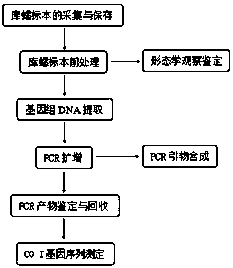
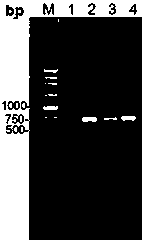
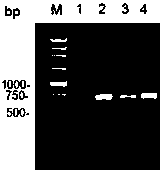
Examples
Embodiment 1
[0061] Example 1 Acquisition of COI gene sequences of Culicoides relatives such as Culicoides long-billed, Culicoides Hsinchu and Culicoides albino
[0062] 1. Collection and preservation of specimens of Culicoides relatives such as Culicoides long-beaked, Culicoides Hsinchu and Culicoides albino
[0063] Specimens of Culicoides relatives such as Culicoides long-billed, Culicoides Hsinchu, and Culicoides albino were collected from wild habitats in Yunnan, Sichuan and other provinces by net sweeping and lamp lure methods, and preserved in 95% alcohol. The dissection was performed under a stereoscope with a dissecting needle, and the rest except the chest were made into permanent mounts, which were appraised by authoritative experts to ensure the accuracy of the appraisal results. The thoraxes of Culicoides long-billed, Culicoides Hsinchu and Culicoides leucorrhizae were individually marked for molecular experiments.
[0064] 2. Genomic DNA extraction
[0065] After grinding t...
Embodiment 2
[0083] Example 2 Identification of Unknown Culicoides
[0084] 1. Collection and preservation of midge specimens
[0085] Midge specimens were collected from wild habitats by sweeping nets and lamp lures, and preserved in 95% alcohol. Dissection was performed under a stereoscope with a dissecting needle, and all but the chest were made into permanent mounts for morphological identification. Molecular experiments were carried out after marking the thorax of midges individually.
[0086] 2. Genomic DNA extraction
[0087] After the preserved midge breast was ground, the genome DNA of a single unknown midge was extracted according to the instructions of the QIAGEN DNeasy Blood & Tissue Kit, and stored at -20°C for later use.
[0088] 3. Primer synthesis
[0089] The primers used in this example are as follows:
[0090] Forward primer: 5'TAAACTTCAGGGTGACCAAAAAAATCA 3'.
[0091] Reverse primer: 5'GGTCAACAAATCATAAAGATATTGG 3'.
[0092] 4. PCR amplification
[0093] The PCR r...
PUM
 Login to View More
 Abstract
Description
Claims
Application Information
 Login to View More