
ISOMAP-based lithium battery (LIB) thermal-technology space-time modeling method
A modeling method, lithium battery technology, applied in calculation models, electrical digital data processing, biological neural network models, etc., can solve problems such as difficult temperature distribution
- Summary
- Abstract
- Description
- Claims
- Application Information
AI Technical Summary
Problems solved by technology
Method used
Image

Examples
Embodiment 1
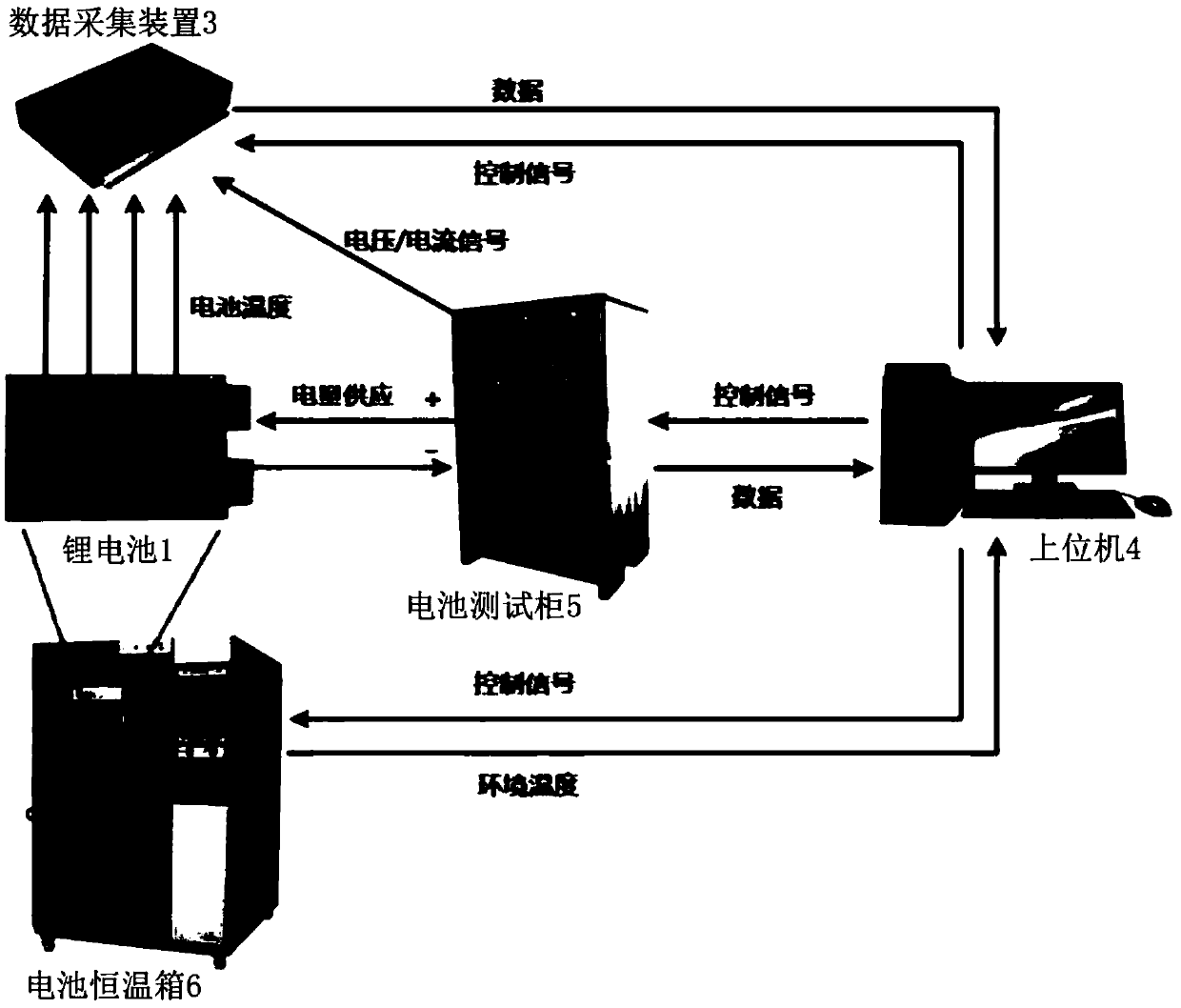
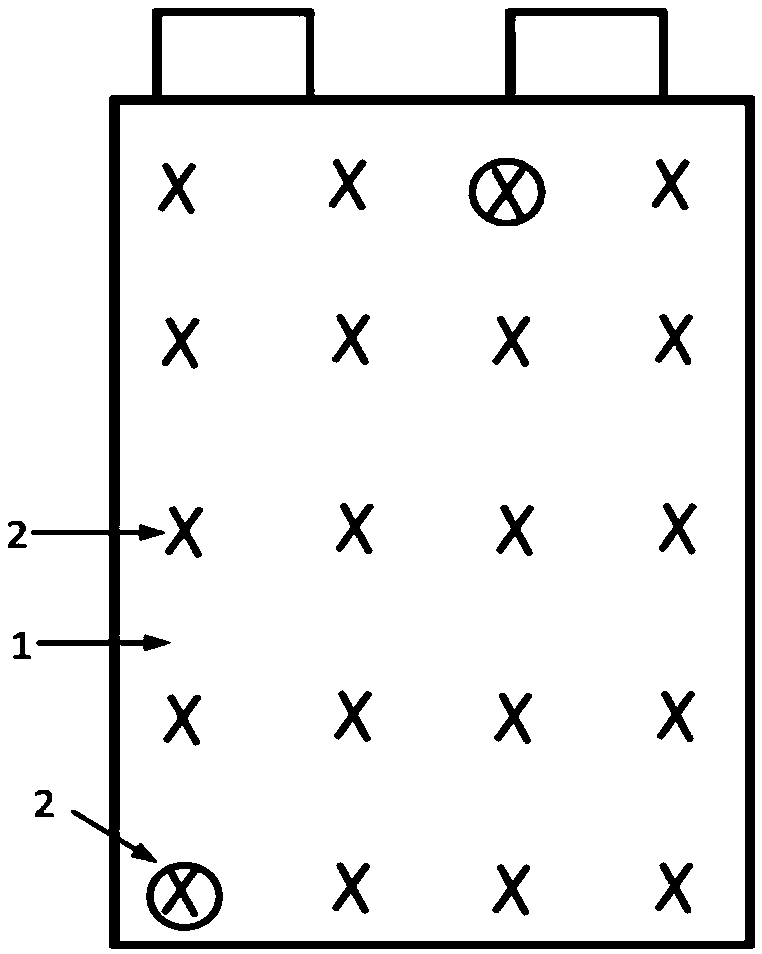
[0092] The ISOMAP-based spatio-temporal modeling method of lithium battery thermal process in this embodiment: Step 1, such as figure 1 , figure 2 As shown, a lithium battery charge and discharge control platform is built, and a plurality of temperature sensors 2 are uniformly arranged on the surface of the lithium battery 1, and the data acquisition device 3 transmits the temperature data collected by each temperature sensor 2 to the host computer 4, the The lithium battery 1 is electrically connected to the battery test cabinet 5, and the battery test cabinet 5 provides an input signal to the lithium battery 1, so that the lithium battery 1 is charged and discharged in a cycle; step 2, the host computer 4 counts the temperature data of all temperature sensors 2, Obtain the spatio-temporal data of the temperature distribution of the lithium battery 1 changing with time under the condition of cyclic charging and discharging, and define the spatio-temporal data as:
[0093]{T...
Embodiment 2
[0186] This example validates the proposed modeling method by conducting real-time experiments. The lithium battery 1 used is a 60Ah lithium iron phosphate battery purchased from a battery manufacturer in Shenzhen, China. This battery uses lithium iron phosphate as its positive electrode material, and has been successfully put into use in electric vehicles. Its basic parameters are shown in Table 1. Considering a flat prismatic 60Ah LiFePO 4 / graphite battery, a 2D thermal model is considered because the temperature variation along the thickness of the battery cell is negligible.
[0187] parameter name
parameter value
Nominal capacity / (Ah)
60
Nominal voltage / (V)
3.2
Battery size / (mm)
13*70*150
Charging cut-off voltage / (V)
3.65
Discharge cut-off voltage / (V)
2
Working temperature / (℃)
-20 to 55
Storage temperature / (℃)
-40 to 60
[0188] Table 1
[0189] The 60Ah lithium iron phosphate bat...
PUM
 Login to View More
 Abstract
Description
Claims
Application Information
 Login to View More