Welding method of back contact solar cell module

A technology of solar cells and welding methods, which is applied in the direction of electrical components, circuits, photovoltaic power generation, etc., can solve the problems of reducing the electrical performance and total power of components, gaps in electrode arrangement structures, and increasing welding workload, so as to reduce welding work The effect of reducing the amount of debris, reducing the fragmentation rate, and eliminating the steps of serial welding

CN108767043AInactive Publication Date: 2018-11-06徐州日托光伏科技有限公司
5 Cites 3 Cited by

Patent Information

Authority / Receiving Office
CN · China
Current Assignee / Owner
Publication Date
2018-11-06
Estimated Expiration
Not applicable · inactive patent

Smart Images

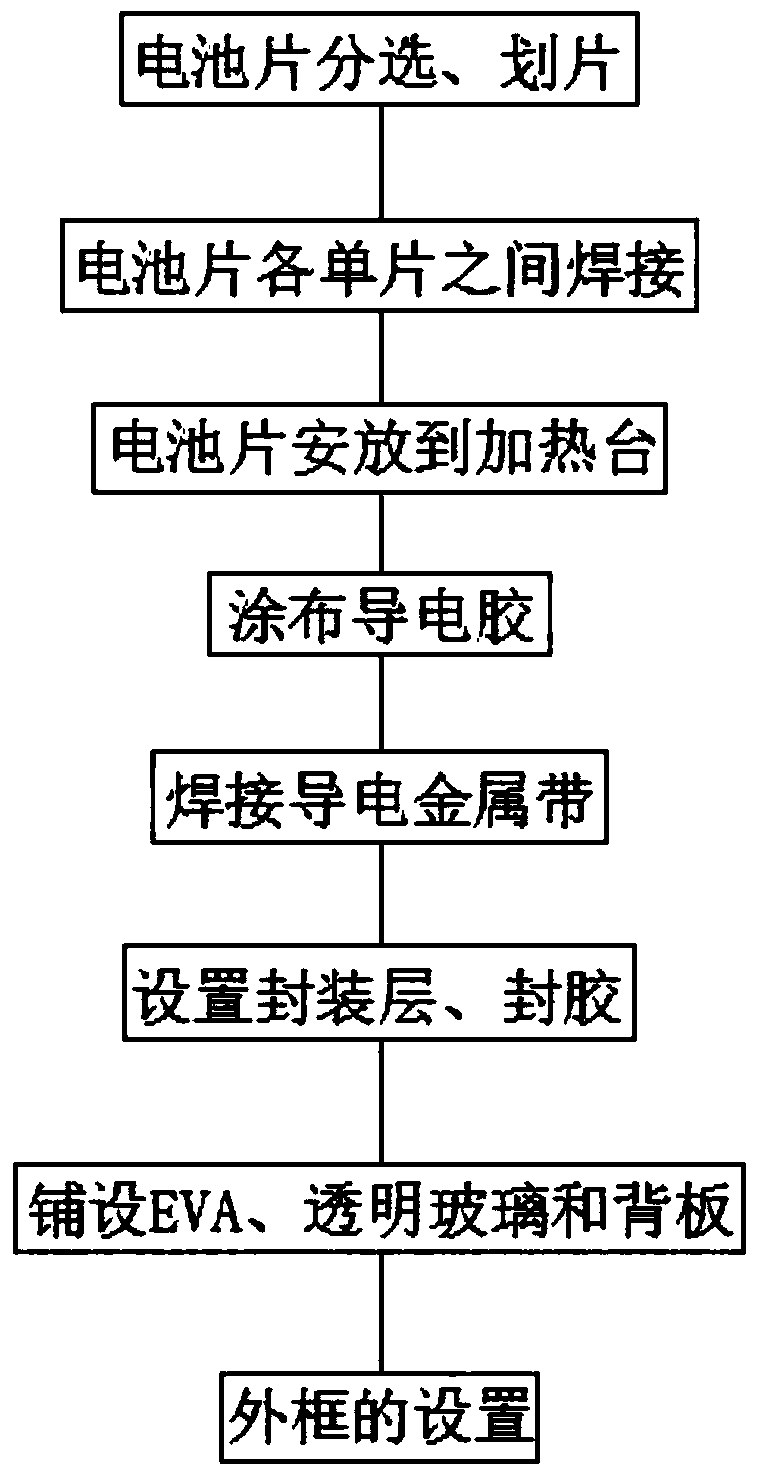
  • Figure 1
    Figure 1
Patent Text Reader

Abstract

The invention discloses a welding method of a back contact solar cell module; the welding method comprises the following steps that a, sorting is performed on battery pieces firstly, and then scribingis carried out on the sorted battery pieces by using cutting equipment; b, the single scribed battery pieces are welded through welding strips; c, a prepared battery piece is placed on a heating table, wherein the temperature of the heating table is 50-70 DEG C; the battery piece is a battery piece with a back electrode; and one surface, without the back electrode, of the battery piece is in contact with the upper surface of the heating table; d, the back electrode of the battery piece is uniformly coated with conductive adhesive, wherein the coating rate of the conductive adhesive is 100-300mm / s; and e, conductive metal strips are distributed on the conductive adhesive. In the battery piece interconnection process, the battery pieces are connected in a broken line or curve line mode through flow guide pieces, so that a series welding step is omitted, the welding workload is greatly reduced; and in addition, the electric performance and the total power of the assembly are improved, and an unexpected technical effect is achieved.
Need to check novelty before this filing date? Find Prior Art

Description

technical field

[0001] The invention relates to the technical field of a welding method, in particular to a welding method for a back-contact solar cell module. Background technique

[0002] At present, there are still some deficiencies in the welding method of the existing back contact solar cell assembly, for example; the existing welding method of the back contact solar cell assembly generally adopts traditional busbars when the back contact cells are interconnected, which not only increases the The serial welding step greatly increases the welding workload, and also reduces the electrical performance and total power of the components, and the electrode arrangement structure of the existing back-contact solar cell components generally has gaps, which need to be rotated during welding, which increases the The labor intensity during welding increases the fragmentation rate. Contents of the invention

[0003] The purpose of the present invention is to provide a welding me...

Examples

Embodiment Construction

[0023] In order to make the technical means, creative features, goals and effects achieved by the present invention easy to understand, the present invention will be further described below in conjunction with specific embodiments.

[0024] see figure 1 , the present invention provides a technical solution: a welding method for a back-contact solar cell module, the steps of the welding method are as follows:

[0025] a. Sorting the battery slices first, and then scribing the sorted battery slices using cutting equipment;

[0026] b. After step a is completed, then the diced battery slices are welded between each single piece of the battery slices through the welding strip;

[0027] c. After step b is completed, place the prepared cell on the heating table. The temperature of the heating table is 50-70°C. The cell is a cell with a back electrode, and the side of the cell without a back electrode contact with the upper surface of the heating table;

[0028] d. After step c is...