On-site rapid detection method and kit for detecting ASFV based on CRISPR/Cas system
What is AI technical title?
AI technical title is built by Patsnap AI team. It summarizes the technical point description of the patent document.
A detection kit and detection method technology, applied in the field of animal husbandry, can solve the problems of high requirements for experimental conditions, high detection cost, long inspection period, etc., and achieve the effects of low cost, improved accuracy, and efficient health status.
Active Publication Date: 2019-08-09
SOUTH CHINA UNIV OF TECH
View PDF2 Cites 13 Cited by
Summary
Abstract
Description
Claims
Application Information
AI Technical Summary
This helps you quickly interpret patents by identifying the three key elements:
Problems solved by technology
Method used
Benefits of technology
Problems solved by technology
Although these methods can effectively detect ASFV or its characteristic sequencenucleic acid, they have problems such as long inspection cycle, high requirements for experimental conditions, and high detection cost.
Method used
the structure of the environmentally friendly knitted fabric provided by the present invention; figure 2 Flow chart of the yarn wrapping machine for environmentally friendly knitted fabrics and storage devices; image 3 Is the parameter map of the yarn covering machine
View more
Image
Smart Image Click on the blue labels to locate them in the text.
Viewing Examples
Smart Image
Click on the blue label to locate the original text in one second.
Reading with bidirectional positioning of images and text.
Smart Image
Examples
Experimental program
Comparison scheme
Effect test
Embodiment 1
[0044] In the embodiment of the present invention, based on the CRISPR / Cas12a technology, the ASFV characteristic sequencenucleic acid is quickly detected on site. The method is used for non-diagnostic or therapeutic purposes, and includes the following steps:
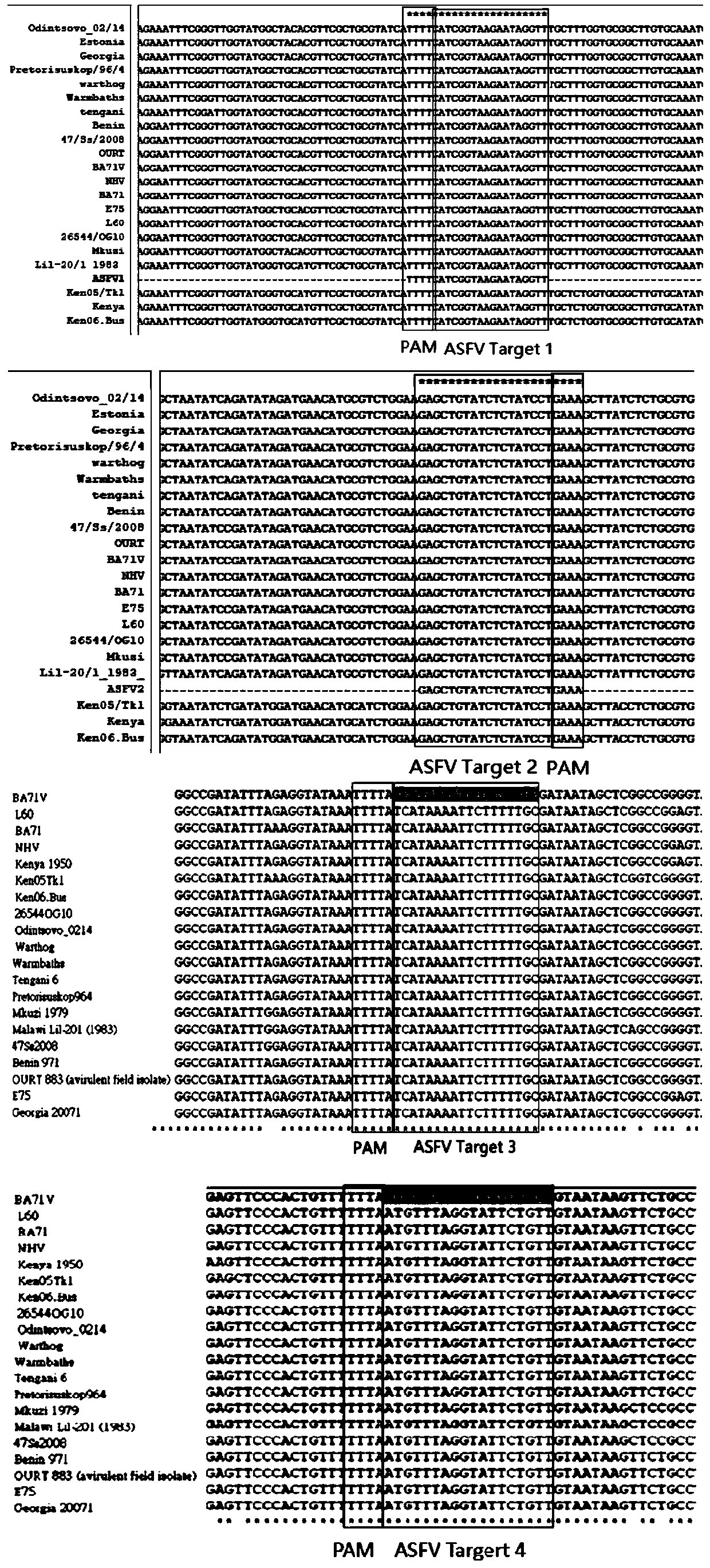
[0045] 1) Design target-specific crRNA for 21 important virus strains of ASFV. The sequence of the designed crRNA is shown in SEQ ID NO: 1-4 in the sequence listing, and then construct a crRNA in vitro transcription vector and carry out in vitro transcription and purification.
[0046] For 21 important virus strains BA71V, L60, BA71, NHV, Kenya 1950, Ken05Tk1, Ken06.Bus, 26544OG10, Odintsovo_0214, Warthog, Warmbaths, Tengani 6, Pretorisuskop964, Mkuzi1979, Malawi Lil-201(1983), 487Ss2 , OURT 883, E75, Georgia 20071, Estonia 2014 virus strain corresponding genome (NCBI accession number is NC_001659.2, KM262844.1, KP055815.1, KM262845.1, AY261360.1, KM111294.1, KM111295.1, KM1029 1, KP843857.1, AY261366.1, AY261365.1, A...
Embodiment 2
[0060] In the embodiment of the present invention, based on the CRISPR / Cas12a technology, the ASFV characteristic sequence nucleic acid is quickly detected on site. The method is used for non-diagnostic or therapeutic purposes, and includes the following steps:
[0061] 1) Design target-specific crRNA for 21 important virus strains of ASFV. The sequence of the designed crRNA is shown in SEQ ID NO: 1-4 in the sequence listing, and then construct a crRNA in vitro transcription vector and carry out in vitro transcription and purification.
the structure of the environmentally friendly knitted fabric provided by the present invention; figure 2 Flow chart of the yarn wrapping machine for environmentally friendly knitted fabrics and storage devices; image 3 Is the parameter map of the yarn covering machine
Login to View More
PUM
Login to View More
Abstract
The invention discloses an on-site rapid detection method and kit for detecting ASFV based on a CRISPR / Cas system. According to the method, the specificity of crRNA is utilized to effectively guarantee the accuracy of nucleic acid detection of a viruscharacteristic sequence, whether or not the ASFV exists in a sample can be determined through test paper or fluorescence within 1-2 hours at normaltemperature, and the accuracy is improved somewhat compared with the accuracy of a traditional PCR-based detection method. By adopting the method and the kit, the ASFV can be conveniently and quicklydetected on site, such as a pig farm and a slaughterhouse, complex temperature control instruments such as a PCR instrument and a centrifuge are not needed, an observable result can be quickly obtained only by a constant temperature device and a simple fluorescence detection device, and if a lateral flow test paper color development scheme is used, macroscopic on-site detection without instrumentscan be even achieved, so that the health condition of the pig farm can be known more efficiently, and loss is avoided; the lower-cost, faster and more convenient detection method is provided for ASFVdetection.
Description
technical field [0001] The invention relates to the field of animal husbandry, in particular to an on-site rapid detection method and a kit for detecting African swine fevervirus (ASFV), specifically using Cas12a / crRNA specific on-site rapid identification and detection of ASFV. Background technique [0002] African swine fever is an acute, hemorrhagic, and highly contagious swine disease caused by African swine fevervirus (ASFV). The onset time of African swine fever is short, the fatality rate is high, and the mortality rate of acute infection can reach 100%, which seriously affects economic benefits. Since August 2018, there has been an African swine fever epidemic in China with a relatively large impact. [0003] Since the symptoms of African swine fever and common swine fever are similar, they can only be distinguished by laboratory means. However, the current detection method for this virus takes a long time to detect and has high requirements for instruments. The...
Claims
the structure of the environmentally friendly knitted fabric provided by the present invention; figure 2 Flow chart of the yarn wrapping machine for environmentally friendly knitted fabrics and storage devices; image 3 Is the parameter map of the yarn covering machine
Login to View More
Application Information
Patent Timeline
Application Date:The date an application was filed.
Publication Date:The date a patent or application was officially published.
First Publication Date:The earliest publication date of a patent with the same application number.
Issue Date:Publication date of the patent grant document.
PCT Entry Date:The Entry date of PCT National Phase.
Estimated Expiry Date:The statutory expiry date of a patent right according to the Patent Law, and it is the longest term of protection that the patent right can achieve without the termination of the patent right due to other reasons(Term extension factor has been taken into account ).
Invalid Date:Actual expiry date is based on effective date or publication date of legal transaction data of invalid patent.


 Login to View More
  Login to View More