Method for detecting gas-liquid dispersion state of jet bubbling reactor
A bubble reactor and dispersion state technology, which is applied in the field of detection of gas-liquid dispersion state of jet bubble reactor, can solve the problems of gas-liquid mass transfer efficiency and reaction rate reduction, yield reduction, and destruction of flow field, etc. Achieve the effect of small measurement error, improve production efficiency and sensitive response
- Summary
- Abstract
- Description
- Claims
- Application Information
AI Technical Summary
Problems solved by technology
Method used
Image



Examples
Embodiment 1
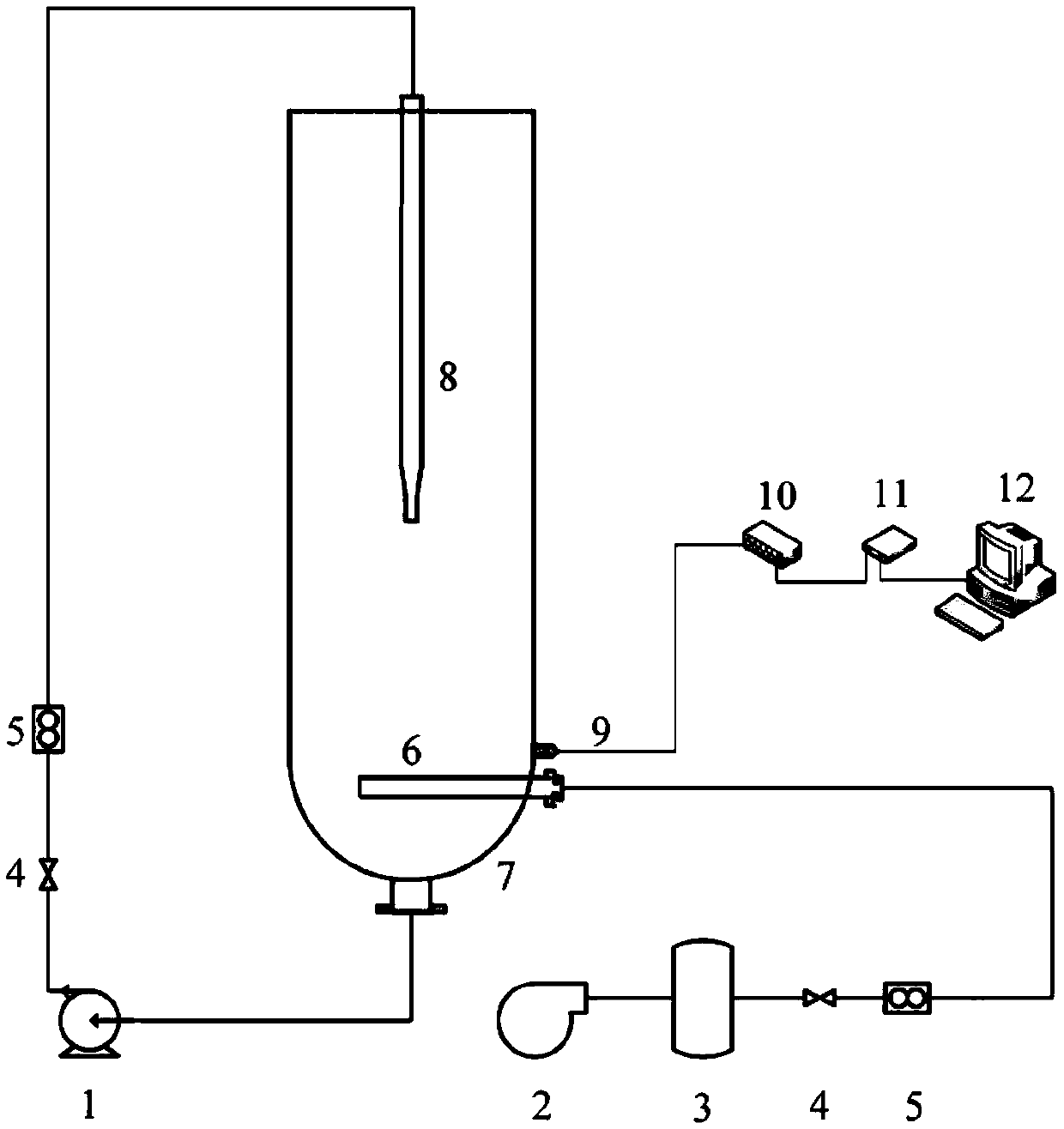
[0046] use as figure 1 In the acoustic emission detection device shown, the liquid (water) discharged from the bottom of the reactor 7 is measured by the flow meter 5 under the pumping action of the centrifugal pump 1, and then sprayed into the reactor 7 through the liquid nozzle 8 to form a liquid cycle. The fan 2 will Gas (air) blows into the reactor 7 from the gas distributor 6 through the flowmeter 5, and the acoustic wave sensor 9 receives the acoustic signal generated by the fluid movement in the reactor, and the acoustic wave sensor is connected to the computer 12 through the main amplifier 10 and the data acquisition card 11. An acceleration sensor is placed on the outer wall of the reactor close to the 1 / 7 static liquid level at the bottom of the reactor cylinder, the sampling frequency is 100kHz, and the sampling time is 10s. The variation law of the fluctuation distribution index of the acoustic signal with the Reynolds number of the liquid jet is as follows: figu...
Embodiment 2
[0048] The difference from Example 1 is that the sampling frequency is 50 kHz, and the acceleration sensor is placed on the outer wall of the reactor near the bottom 1 / 4 of the static liquid level of the reactor cylinder. The change law of FI with the liquid jet Reynolds number is as follows: figure 2 As shown in (b), the gas-liquid dispersion state is determined by the slope k of the curve of FI changing with the Reynolds number at the outlet of the liquid nozzle: when k=0, it corresponds to the flooding state; when k>0, it corresponds to the carrier gas state; when k< When 0, it corresponds to a completely dispersed state. Among them, when k changes from zero to a positive value, the corresponding liquid Reynolds number is the pan-point liquid Reynolds number, and the relative deviation from the measurement result of the visual method is 0; when k changes from a positive value to a negative value, the corresponding liquid Reynolds number The number is the Reynolds number o...
Embodiment 3
[0050] The difference from Example 1 is that the acoustic wave sensor is an acoustic emission sensor, and the acoustic emission sensor is placed on the outer wall of the reactor close to the bottom 1 / 2 of the static liquid level of the reactor cylinder, and the sampling frequency is 1 MHz. The change law of FI with the liquid jet Reynolds number is as follows: figure 2 As shown in (c), the gas-liquid dispersion state is determined by the slope k of the curve of FI changing with the Reynolds number at the exit of the liquid nozzle: when k=0, it corresponds to the flooding state; when k>0, it corresponds to the carrier gas state; when k< When 0, it corresponds to a completely dispersed state. Among them, when k changes from zero to a positive value, the corresponding liquid Reynolds number is the pan-point liquid Reynolds number, and the relative deviation from the measurement result of the visual method is 0; when k changes from a positive value to a negative value, the corres...
PUM
 Login to View More
 Abstract
Description
Claims
Application Information
 Login to View More
 - R&D
- Intellectual Property
- Life Sciences
- Materials
- Tech Scout
- Unparalleled Data Quality
- Higher Quality Content
- 60% Fewer Hallucinations
Browse by: Latest US Patents, China's latest patents, Technical Efficacy Thesaurus, Application Domain, Technology Topic, Popular Technical Reports.
© 2025 PatSnap. All rights reserved.Legal|Privacy policy|Modern Slavery Act Transparency Statement|Sitemap|About US| Contact US: help@patsnap.com