
Method for preparation of gem-diboron compound by olefin selective 1, 1-diboronation
A compound and selective technology, applied in the field of selective 1,1-diboronation of olefins to prepare geminal diboron compounds, can solve the problems of complex ligands of precious metals, reduced atom economy, poor functional group compatibility, etc. Product separation and purification, improved atom economy, mild reaction conditions
- Summary
- Abstract
- Description
- Claims
- Application Information
AI Technical Summary
Problems solved by technology
Method used
Image

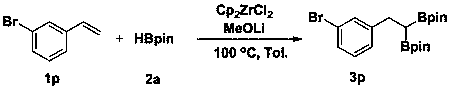
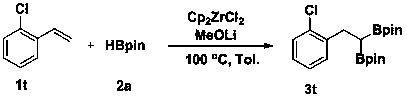
Examples
Embodiment 1
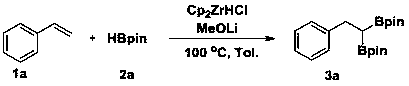
[0022] Example 1 A method for the selective 1,1-diboration of olefins to prepare gem-diboron compounds:
[0023]
[0024] Add Cp to the reaction tube sequentially 2 ZrCl 2 (0.01 mmol, 2.9 mg), MeOLi (0.2 mmol, 7.6 mg), toluene (1 mL), pinacol borane 2a (0.6 mmol, 87 μL), styrene 1a (0.2 mmol, 23 μL), in nitrogen (1 atm) atmosphere at 100 °C for 8 h. GC-MS detection yield was 88%.
Embodiment 2
[0025] Example 2 A method for the selective 1,1-diboration of olefins to prepare gem-diboron compounds:
[0026]
[0027] Add Cp to the reaction tube sequentially 2 ZrCl 2 (0.01 mmol, 2.9 mg), MeOLi (0.2 mmol, 7.6 mg), toluene (1 mL), pinacol borane 2a (0.6 mmol, 87 μL), styrene 1a (0.2 mmol, 23 μL), in nitrogen (1 atm) atmosphere at 130 °C for 2 h. GC-MS detection yield was 92%.
Embodiment 3
[0028] Example 3 A method for the selective 1,1-diboration of olefins to prepare gem-diboron compounds:
[0029]
[0030] Add Cp to the reaction tube sequentially 2 ZrCl 2 (0.01 mmol, 2.9 mg), MeOLi (0.2 mmol, 7.6 mg), toluene (1 mL), pinacol borane 2a (0.6 mmol, 87 μL), styrene 1a (0.2 mmol, 23 μL), in nitrogen (1 atm) atmosphere at 80 °C for 16 h. GC-MS detection yield was 81%.
PUM
 Login to View More
 Abstract
Description
Claims
Application Information
 Login to View More