Underexposure image recovery method based on deep learning

A technology of image restoration and deep learning, applied in the direction of neural learning methods, image enhancement, image analysis, etc., can solve the problems that the image cannot be guaranteed at the same time, the detailed information of the area is lost, and the image is prone to whitening areas, etc., to achieve clear details and less noise , improve the effect of optimization

CN112001863AActive Publication Date: 2020-11-27TAIYUAN UNIVERSITY OF SCIENCE AND TECHNOLOGY
3 Cites 12 Cited by

Patent Information

Authority / Receiving Office
CN · China
Patent Type
Applications(China)
Current Assignee / Owner
Publication Date
2020-11-27

Smart Images

  • Figure 1
    Figure 1
  • Figure 2
    Figure 2
  • Figure 3
    Figure 3
Patent Text Reader

Abstract

The invention discloses an underexposure image recovery method based on deep learning, and belongs to the field of image quality enhancement. The problems of low shooting contrast, low brightness, much noise, high complexity of a mainstream image recovery algorithm and high calculation cost caused by uncomfortable light source in the shooting process are solved. The method mainly comprises the following steps: firstly, the input of a multi-scale decomposition network for shooting images with different illuminance is a low-illuminance image, and a series of feature maps smaller than the original image are obtained through down-sampling convolution; secondly, the reflectivity and illuminance of images with different resolutions are obtained at an up-sampling decoding end through decomposition, on the basis of the decomposition, image brightness enhancement is carried out by using a multi-scale brightness adjustment network oriented to image illumination imbalance, and then reconstructionand recovery are carried out by using an image reconstruction network; finally, the reflectivity image and the enhanced illuminance image are integrated to obtain a final restored illumination image.
Need to check novelty before this filing date? Find Prior Art

Description

technical field

[0001] The invention belongs to the field of image quality enhancement, and in particular relates to a method for restoring brightness of an underexposed image based on deep learning. Background technique

[0002] In real life scenarios, different shooting environments will cause many brightness problems in the captured images. When taking professional photography, the light source is between the photographer and the subject. Due to the good lighting, good shooting effects can be achieved. However, in many cases, the position of the light source is uncontrollable, which often leads to the "big black face" situation in the captured portraits. The underexposed areas in this kind of photos can hardly see the details, and the visual experience is often poor. The further processing of the image also poses great challenges. Professional photographers often use light sources such as reflectors and flashes to increase illumination, but artificial light sources can e...

Examples

Embodiment Construction

[0032] In order to make the objects, features and advantages of the present invention more comprehensible, specific implementations of the present invention will be described in detail below in conjunction with the accompanying drawings.

[0033] In order to better understand the image restoration method of the present invention, the image restoration network of the present invention will be introduced in detail below.

[0034] 1. The specific implementation of underexposed image restoration network

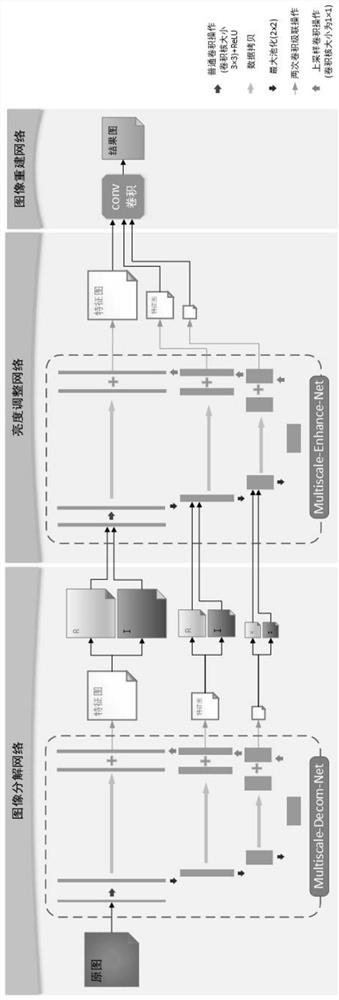
[0035] Such as figure 1 As shown, the image enhancement process is divided into three steps: decomposition, adjustment and reconstruction. In the decomposition step, the Multiscale-Decom-Net based on the encoder-decoder structure outputs the input original image as feature maps of different resolutions. , taking the structure in the figure as an example, the original image is transformed into feature maps of three resolutions after being processed by the Multiscale-Decom-Net net...