

RTC self-compensating circuit based on temperature sensor
A temperature sensor and self-compensation technology, applied in the application of thermometers, thermometers, instruments, etc., can solve the problems of high software participation, insufficient accuracy and efficiency, and difficulty in ensuring the accuracy of temperature compensation circuits, etc., to achieve easy implementation and compensation High precision and efficiency, flexible and configurable temperature coefficient
- Summary
- Abstract
- Description
- Claims
- Application Information
AI Technical Summary
Problems solved by technology
Method used
Image


Examples
Embodiment 1
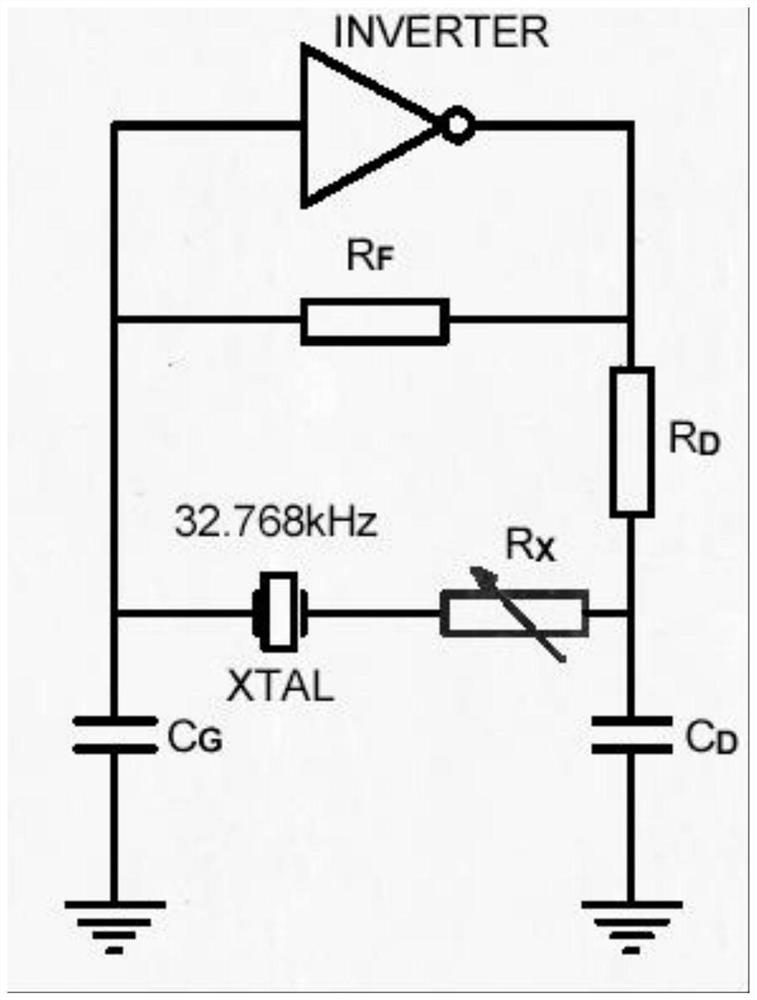
[0017] See figure 2 , A temperature sensor-based RTC self-compensation circuit, including a temperature sensor, an analog-to-digital converter, and a temperature register. The temperature sensor, analog-to-digital converter and temperature register are connected in sequence, and the temperature register is also connected with a compensation coefficient generator. The coefficient generator is also connected to the RTC counter. The input of the RTC counter is connected with a crystal oscillator. The crystal oscillator is a circuit module that generates 32768 Hz by connecting a quartz crystal with a 32K resonant frequency. The quartz crystal is at different temperatures. Its resonance frequency has a certain fluctuation, which is also the main source of inaccurate timing of the RTC counter. Temperature sensors and analog-to-digital converters are commonly used circuits in general SOC systems to detect chip temperature and perform analog-to-digital conversion on some analog inputs....
Embodiment 2
[0024] On the basis of Embodiment 1, the RTC counter is connected to a time-minute-second controller, and the calculation accuracy of the counter is further ensured through an external device.
PUM
 Login to View More
 Abstract
Description
Claims
Application Information
 Login to View More