Urban public transportation network division space community detection method based on HW-Louvain
A technology for urban public transport and network division, applied in the direction of instruments, relational databases, data processing applications, etc., can solve the problems of few detection methods for urban public transport network communities, achieve community structure stability, solve isotropy, and highlight network connection strength difference effect
- Summary
- Abstract
- Description
- Claims
- Application Information
AI Technical Summary
Problems solved by technology
Method used
Image

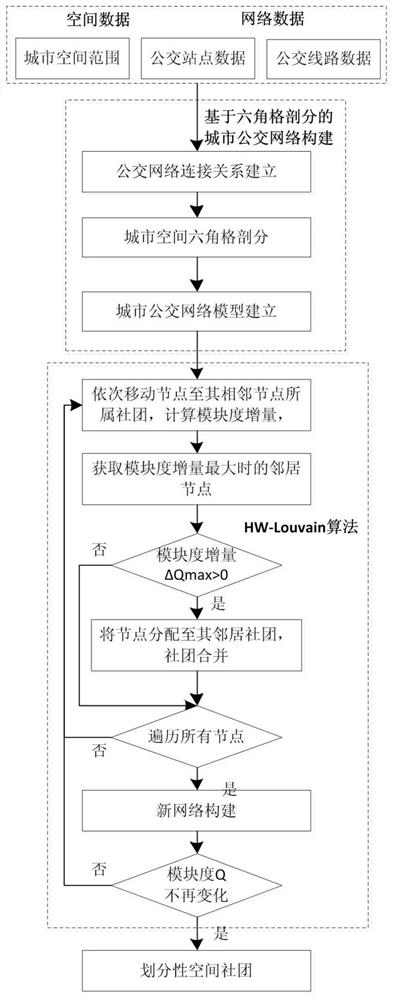


Examples
specific Embodiment approach
[0039] The first step is to establish the basic network connection relationship between bus stops. The bus line determines the connection relationship between the bus stops it passes through, etc. The existing urban bus network model is constructed with discrete bus stations as network nodes, such as image 3 As shown in (a), commonly used models include L-space mode and P-space mode. L-space mode such as figure 2 Shown in (a), in the present invention, the site of each bus line is required to establish a connection relationship according to the P-space mode, and the P-space mode connection strategy is as follows figure 2 (b) shown. The number of connections a station has represents the number of stations that the station can reach without transferring, and the distance between stations can be interpreted as the line distance or the number of stations that two stations need to pass through to connect. Using the P-space model to construct the network connection of the bus...
PUM
 Login to View More
 Abstract
Description
Claims
Application Information
 Login to View More