
Liveness detection and route convergence in software-defined networking distributed system
A software-defined networking and routing technology, applied in the field of computer networks, it can solve problems such as interruption of cloud-based service delivery, failure of normal operation, service degradation, etc., to avoid business path monitoring, fast fault detection, and good routing consistency.
- Summary
- Abstract
- Description
- Claims
- Application Information
AI Technical Summary
Problems solved by technology
Method used
Image

Examples
example 1
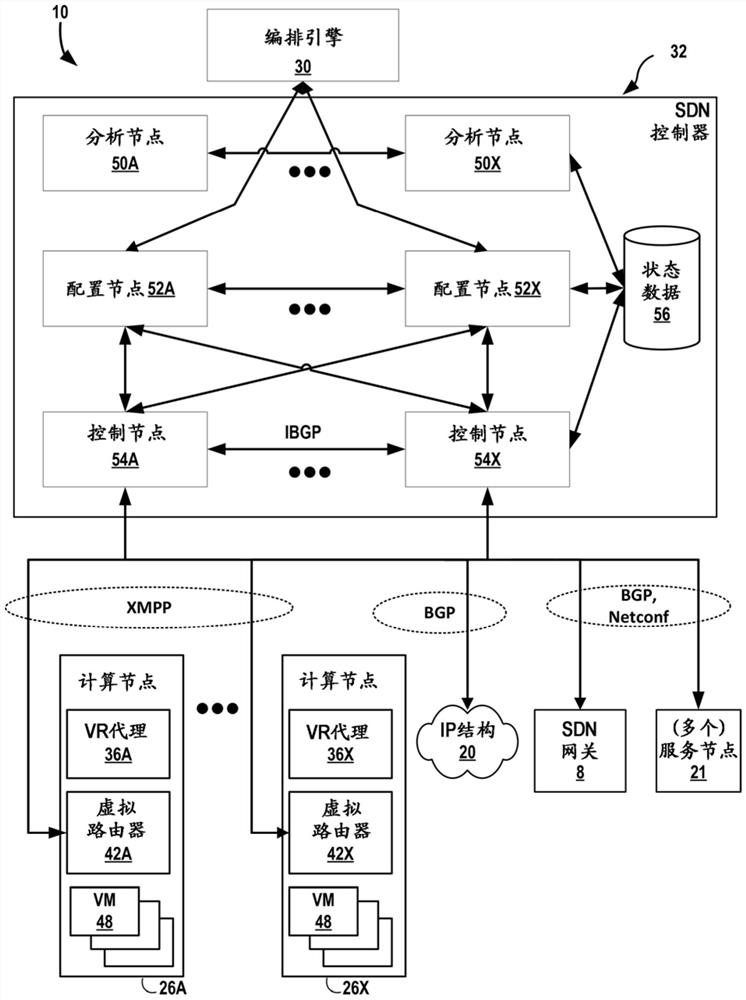
[0201] Example 1. A method comprising: determining, by a software-defined networking (SDN) controller managing an overlay network, a next step for a corresponding overlay network route for a destination in the underlay network based on whether the underlay network route is stored for the destination in the underlay network whether the hop is reachable by the SDN controller, the underlying network route comprises a route advertised by a node in an Internet Protocol (IP) structure of the underlying network; and in response to determining that the next hop for the overlay network route is unreachable, avoiding The controller advertises overlay network routes and withdraws overlay network routes from any network peers that previously advertised overlay network routes to it.
example 2
[0202] Example 2. The method according to example 1, wherein determining whether the next hop for the corresponding overlay route is reachable by the SDN controller comprises: determining whether the underlying route is stored in underlying routing information maintained by the SDN controller, wherein the underlying route The information stores the routes advertised to the SDN controller by the IP structure of the underlying network.
example 3
[0203]Example 3. The method of example 1, wherein the nodes in the IP fabric comprise spine switches, the method further comprising: receiving, by the SDN controller via a Border Gateway Protocol session between the SDN controller and the spine switch, the active A plurality of underlay network routes for tunnel endpoints, wherein the underlay network route includes an underlay network route of the plurality of underlay network routes, wherein the active tunnel endpoint includes a session based on a failure detection protocol between the active tunnel endpoint and a leaf node of the IP fabric Tunnel endpoints indicated as reachable.
PUM
 Login to View More
 Abstract
Description
Claims
Application Information
 Login to View More