Unlock instant, AI-driven research and patent intelligence for your innovation.

Facial expression recognition model of double-branch generative adversarial network based on self-attention feature filtering classifier

A facial expression and recognition model technology, which is applied in the field of computer vision, can solve the problems of image partial expression collapse, unfavorable facial expression recognition, easy to mix with noise, etc., to achieve the effect of reducing expression collapse, eliminating influence, and improving accuracy

Pending Publication Date: 2022-04-05
JIANGXI NORMAL UNIV
View PDF0 Cites 1 Cited by
  • Summary
  • Abstract
  • Description
  • Claims
  • Application Information

AI Technical Summary

Problems solved by technology

[0007] 3. Technical issues: 1. The expression features extracted by the existing facial expression recognition methods are usually mixed with other facial attributes, which is not conducive to the recognition of facial expressions, and the two-branch separated Generative Adversarial Network (Two-branch Disentangled Generative Adversarial, TDGAN ) method generator uses CNN to extract expression features. The eigenvalues ​​have a limited receptive field, and the features extracted by CNN are easily mixed with noise. The difference is almost the same, which will lead to local expression collapse in the generated image

Method used

the structure of the environmentally friendly knitted fabric provided by the present invention; figure 2 Flow chart of the yarn wrapping machine for environmentally friendly knitted fabrics and storage devices; image 3 Is the parameter map of the yarn covering machine
View more

Image

Smart Image Click on the blue labels to locate them in the text.
Viewing Examples
Smart Image
  • Facial expression recognition model of double-branch generative adversarial network based on self-attention feature filtering classifier
  • Facial expression recognition model of double-branch generative adversarial network based on self-attention feature filtering classifier

Examples

Experimental program
Comparison scheme
Effect test

Embodiment Construction

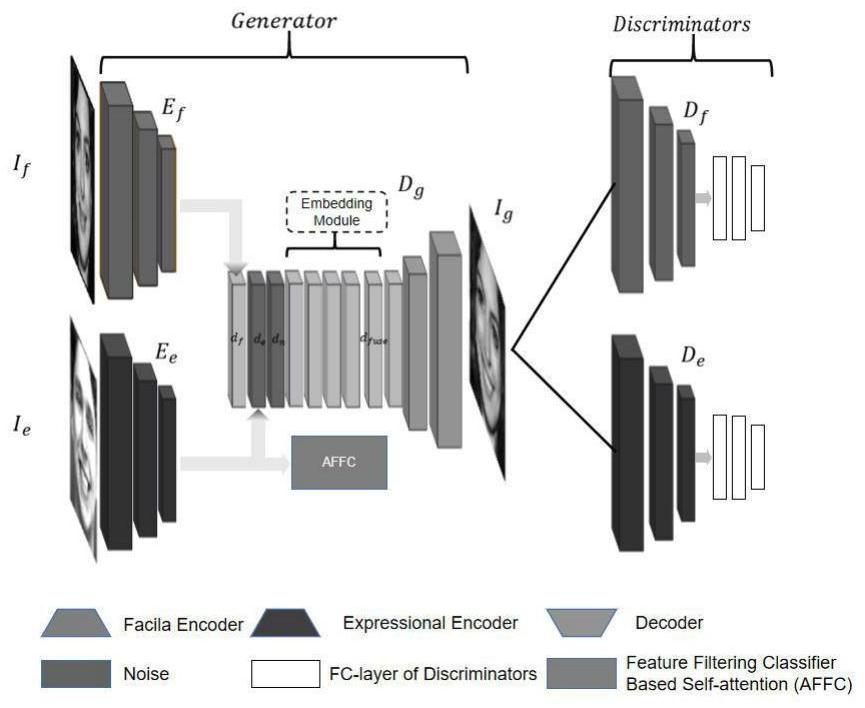
[0011] Instructions attached figure 1 It is the overall model structure diagram of the present invention, which is mainly composed of three modules: generator, discriminator and feature filter based on self-attention mechanism. The generator G is an encoder-decoder structure consisting of two encoders and a decoder, and the two encoders are the face encoder E f and expression encoder E e , constructed using a convolutional neural network, the face encoder E f Extract the input face image I f facial features d f , expression encoder E e Extract the input expression image I e facial expression d e , the extracted facial features d f , expression features d e and the introduced noise d n The feature d is obtained through the fusion of the embedding module fuse . The fused feature d fuse into decoder D g Generate image I in g . The discriminator has two branches, which are the expression discriminator D e and face discriminator D f . Expression Discriminator D e...

the structure of the environmentally friendly knitted fabric provided by the present invention; figure 2 Flow chart of the yarn wrapping machine for environmentally friendly knitted fabrics and storage devices; image 3 Is the parameter map of the yarn covering machine
Login to View More

PUM

No PUM Login to View More

Abstract

Expression features extracted by an existing facial expression recognition method are usually mixed with other facial attributes, which is not beneficial to recognition of facial expressions, and a facial expression recognition model of a double-branch generative adversarial network based on a self-attention feature filtering classifier is provided. The objective of the invention is to generate discriminative expressions by using a generative adversarial network in combination with an attention mechanism and a feature filtering classifier. According to the method, a feature filtering classifier based on a self-attention mechanism is provided as an expression classification module, cascaded LayerNorm and Relu are used for zeroing a low activation unit and retaining a high activation unit, multi-level features are generated, a prediction result of the multi-level features is output by using a fusion method of the self-attention mechanism, and the recognition accuracy is improved; and supervising model learning of discriminative expression representation based on dual image consistency loss of a sliding module.

Description

technical field [0001] The invention belongs to the field of computer vision and is applied to facial expression recognition tasks. Background technique [0002] 1. Explanation of terms: 1. Facial Expression Recognition (Facial Expression Recognition): refers to the process of using machine learning and deep learning technology to perform emotional analysis, processing and extraction of human faces in images or videos. [0003] 2. Generative Adversarial Network: In 2014, the Goodfellow team proposed the Generative Adversarial Network. The GAN model consists of at least two modules: a generator G that captures the data distribution and a discriminator D that estimates the probability that a sample comes from the training data. G's training procedure is to maximize the probability of D being wrong. It was first used in the field of image generation. [0004] 3. Feature Filtering Classifier (Feature Filtering Classifier) ​​is composed of cascaded LayerNorm and Relu units. ...

Claims

the structure of the environmentally friendly knitted fabric provided by the present invention; figure 2 Flow chart of the yarn wrapping machine for environmentally friendly knitted fabrics and storage devices; image 3 Is the parameter map of the yarn covering machine
Login to View More

Application Information

Patent Timeline
no application Login to View More
Patent Type & Authority Applications(China)
IPC IPC(8): G06V40/16G06V10/764G06V10/82G06V10/80G06N3/04G06N3/08
Inventor 程艳蔡壮陈豪迈项国雄
Owner JIANGXI NORMAL UNIV