This helps you quickly interpret patents by identifying the three key elements:
Problems solved by technology
Method used
Benefits of technology
Benefits of technology
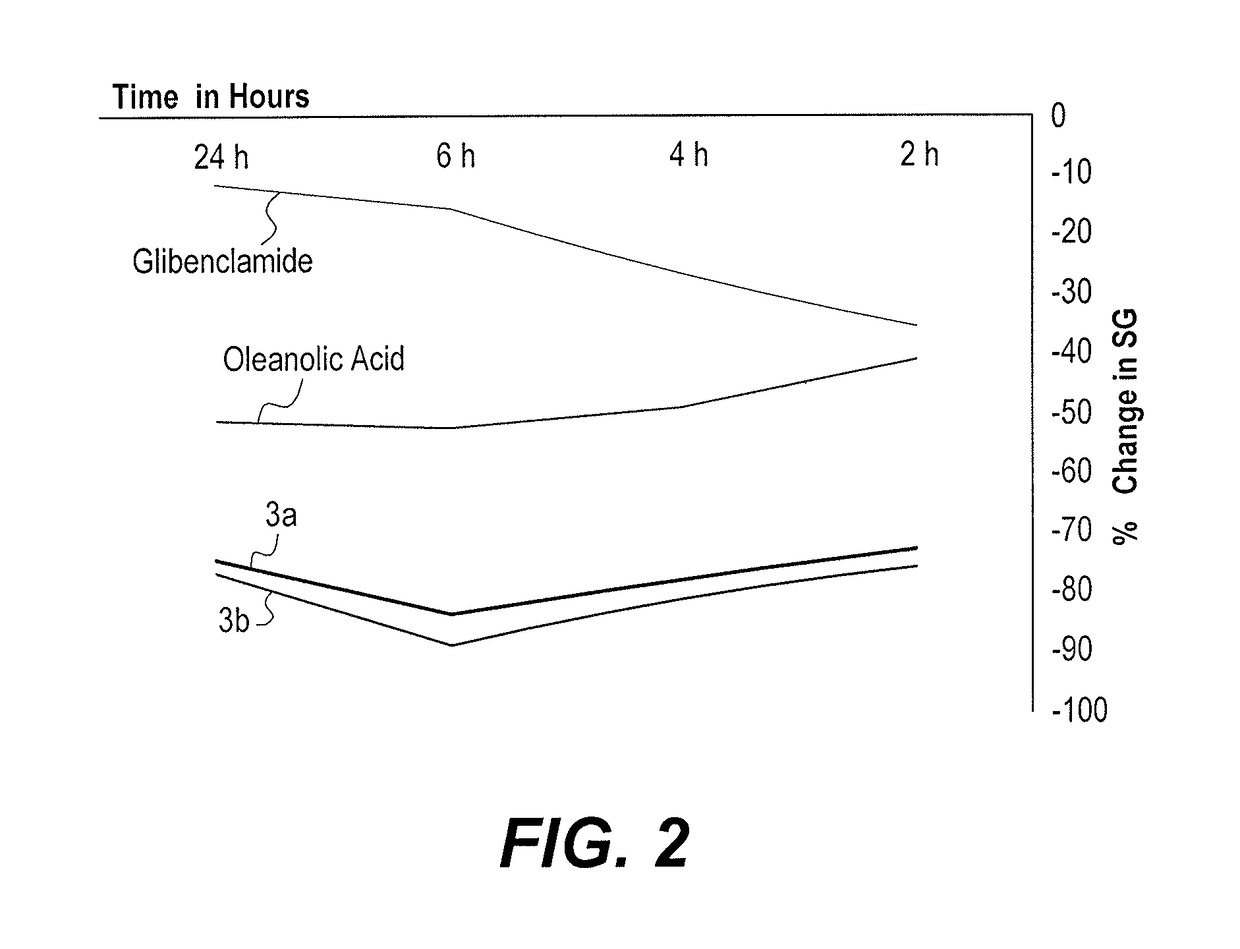
The patent describes the synthesis of new compounds that can lower blood sugar levels. These compounds are made by combining certain acids and a sulfonamide molecule. The resulting compounds were tested in mice with diabetes and were found to be more effective than existing drugs.
Problems solved by technology
In Type II DM, a patient's body develops insulin resistance, resulting in hyperglycemia.
Method used
the structure of the environmentally friendly knitted fabric provided by the present invention; figure 2 Flow chart of the yarn wrapping machine for environmentally friendly knitted fabrics and storage devices; image 3 Is the parameter map of the yarn covering machine
View more
Image
Smart Image Click on the blue labels to locate them in the text.
Viewing Examples
Smart Image
Click on the blue label to locate the original text in one second.
Reading with bidirectional positioning of images and text.
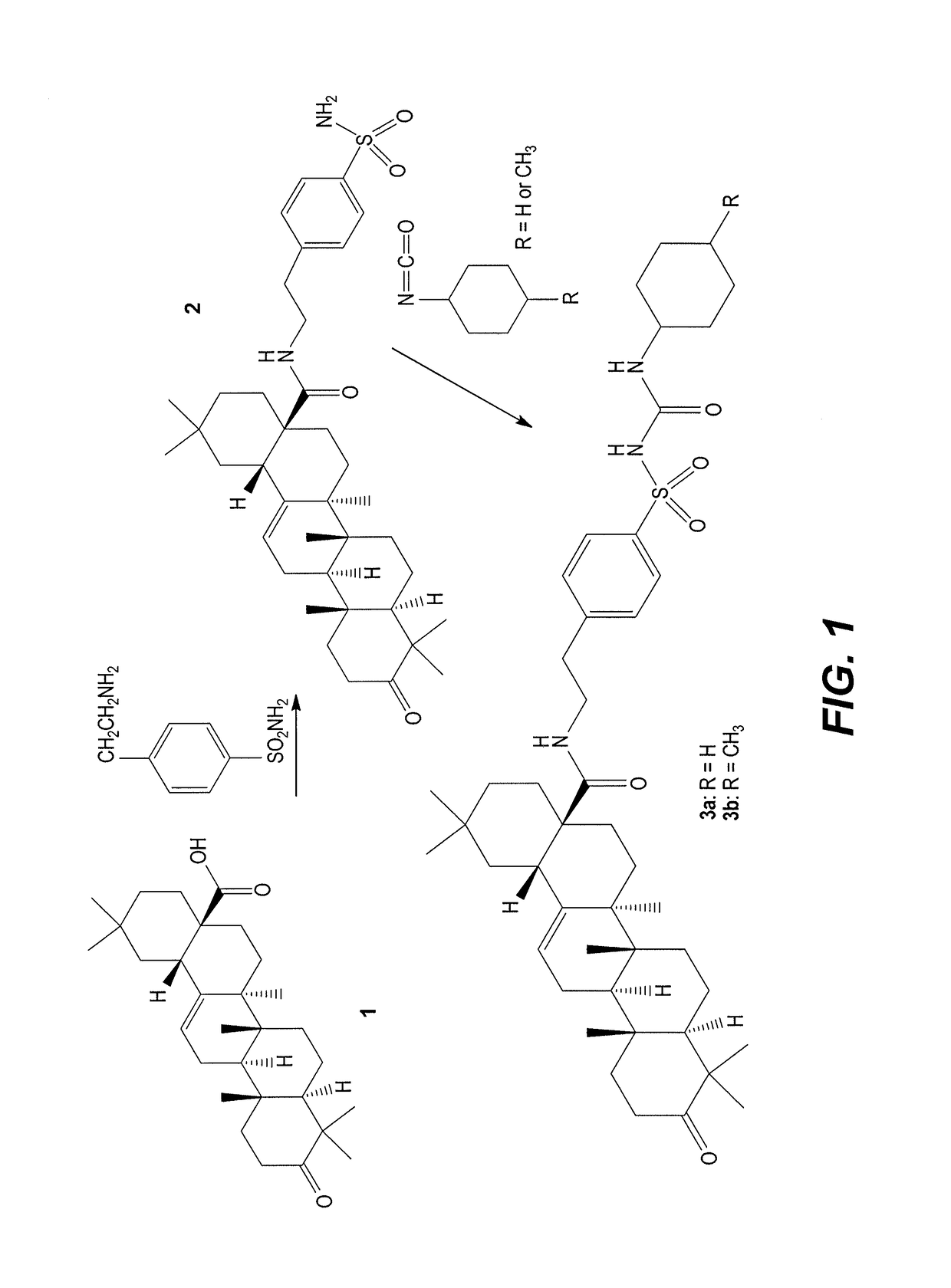
[0013]An exemplary reaction scheme for preparing the sulfonylurea derivatives of oleanolic acid is shown in FIG. 1. Briefly, N-[(p-ethyl)-benzene-sulfonamide]-3-oxo-18β-olean-12-ene-28-carboxamide (2) is prepared by condensing 3-oxo-Olean-12-en-28-oic acid (1), also referred to a 3-oxo-oleanolic acid, with 4-(2-aminoethyl)benzenesulfonamide using the mixed anhydride technique adopted for the preparation of amides using trifluoroaceticanhydride. Compound 2 is then reacted with cyclohexyl isocyanate or 4-methylcyclohexyl isocyanate to produce the sulfonylurea derivatives 3a and 3b, respectively.
example 2
Synthesis of Intermediate
[0014]In more detail, the intermediate compound, N-[(4-ethyl)-benzenesulfonamide]-3-oxo-18β-olean-12-ene-28-carboxamide (2), was synthesized as follows. Trifluoroaceticanhydride (4 mmol) was added dropwise to a solution of compound 1 (4 mmol) in dioxane (100 ml) at 0-5° C. The resulting mixture was reacted for 1.5 hr, then 4-(2-amino-ethyl)benzenesulfonamide (4 mmol) was added, and the resulting mixture was stored without stirring overnight. The reaction mixture was then evaporated under reduced pressure to dryness and the resulting solid product was crystallized from ethyl acetate / methanol to give compound 2. Yield 90%, mp. 287-289° C., [α]D25=+112 (c 1, CHCl3); IR (KBr): 3551-3410 (NH2, NH), 3050 (CH—Ar), 2931 (CH-aliph), 1748 (C═O), 1335 (S═O) cm−1. 1H NMR (pyridine-d5): δ ppm 0.83 (d, 1H, CH), 0.89 (s, 3H, CH3), 0.93 (s, 3H, CH3), 0.98 (s, 3H, CH3), 1.02 (d, 1H, CH), 1.06 (s, 3H, CH3), 1.11 (s, 3H, CH3), 1.18-1.27 (m, 8H, 2CH and 2CH3), 1.37-1.70 (m, 7H,...
example 3
Synthesis of Final Product
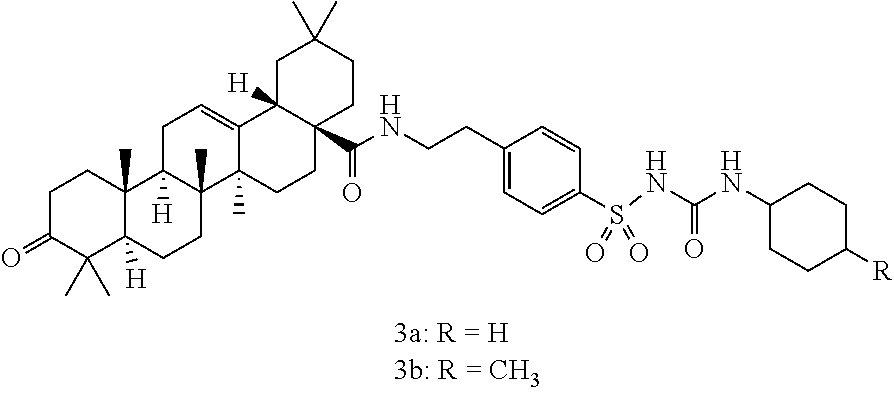
[0015]In more detail, the final products, N1-[4-(3-oxo-18β-olean-12-ene-28-amido-ethyl)benzenesulfonyl]-N2-cyclohexylurea derivatives (3a,3b) were synthesized as follows. Unsubstituted or substituted cyclohexyl isocyanates, namely, cyclohexyl isocyanate or 4-methylcyclohexyl isocyanate (1.1 mmol), were added dropwise to a solution of compound 2 (1 mmol) in sodiumhydroxide (8 ml, 10%) and acetone (20 ml) at 0-5° C. The resulting reaction mixture was kept at the same temperature for 3 hr, diluted with a water / methanol mixture (1:1), and then filtered off. The resulting filtrate was acidified with HCl, and a separated solid was filtered off, dried and recrystallized from acetic acid to yield sulfonylurea derivative compounds 3a or 3b, as follows.
the structure of the environmentally friendly knitted fabric provided by the present invention; figure 2 Flow chart of the yarn wrapping machine for environmentally friendly knitted fabrics and storage devices; image 3 Is the parameter map of the yarn covering machine
Login to View More
PUM
Login to View More
Abstract
The sulfonylurea derivatives of oleanolic acid include compounds replacing the 5-chloro-2-methoxybenzoic acid moiety found in glibenclamide with oleanolic acid. The resulting triterpenoidal sulfonylurea derivatives are compounds having the following formula:or a pharmaceutically acceptable salt thereof. The derivatives are synthesized by condensation of 3-oxo-Olean-12-en-28-oic acid with 4-(2-aminoethyl)benzenesulfonamide to form an intermediate product, followed by reaction with cyclohexyl isocyanate or 4-methylcyclohexyl isocyanate to give 3a or 3b, respectively. The sulfonylurea derivative compounds were screened for their oral hypoglycemic activity in vivo using the alloxan-induced diabetic mouse model and proved more potent than either glibenclamide or oleanolic acid.
Description
BACKGROUND1. Field[0001]The disclosure of the present patent application relates to compounds exhibiting anti-diabetic activity, and particularly to sulfonylurea derivatives of oleanolic acid.2. Description of the Related Art[0002]Diabetes mellitus (DM) is a metabolic disorder characterized by chronic hyperglycemia. The American Diabetes Association suggests that by the year 2030, over 350 million people worldwide will be afflicted with this disease and its complications. In Type II DM, a patient's body develops insulin resistance, resulting in hyperglycemia. At present, four types of chemical drugs, including sulfonylureas, biguanides, α-glucosidase inhibitors and euglycemic agents, are used clinically for the treatment of Type 2 DM. Oleanolic acid is a natural triterpenoid, which has been shown to lower blood glucose. The sulfonylureas have been shown to increase insulin release from the pancreas.[0003]Recent developments in anti-diabetic treatment have focused on replacing insuli...
Claims
the structure of the environmentally friendly knitted fabric provided by the present invention; figure 2 Flow chart of the yarn wrapping machine for environmentally friendly knitted fabrics and storage devices; image 3 Is the parameter map of the yarn covering machine
Login to View More
Application Information
Patent Timeline
Application Date:The date an application was filed.
Publication Date:The date a patent or application was officially published.
First Publication Date:The earliest publication date of a patent with the same application number.
Issue Date:Publication date of the patent grant document.
PCT Entry Date:The Entry date of PCT National Phase.
Estimated Expiry Date:The statutory expiry date of a patent right according to the Patent Law, and it is the longest term of protection that the patent right can achieve without the termination of the patent right due to other reasons(Term extension factor has been taken into account ).
Invalid Date:Actual expiry date is based on effective date or publication date of legal transaction data of invalid patent.
Login to View More
IPC IPC(8): A61K31/64A61K9/00A61P3/10
CPCA61K31/64A61P3/10A61K9/0053
InventorAMR, ABD EL-GALIL E.AL-OMAR, MOHAMED A.ALMEHIZIA, ABDULRAHMAN ABDULAZIZNAGLAH, AHMED MOHAMED


 Login to View More
  Login to View More