
Semiconductor device
a semiconductor and semiconductor technology, applied in the field of semiconductor devices, can solve the problems of low power consumption of the display device in which a transistor including an oxide semiconductor is used, and achieve the effects of low leakage current, high on-state current, and stable electrical characteristics
- Summary
- Abstract
- Description
- Claims
- Application Information
AI Technical Summary
Benefits of technology
Problems solved by technology
Method used
Image

Examples
embodiment 1
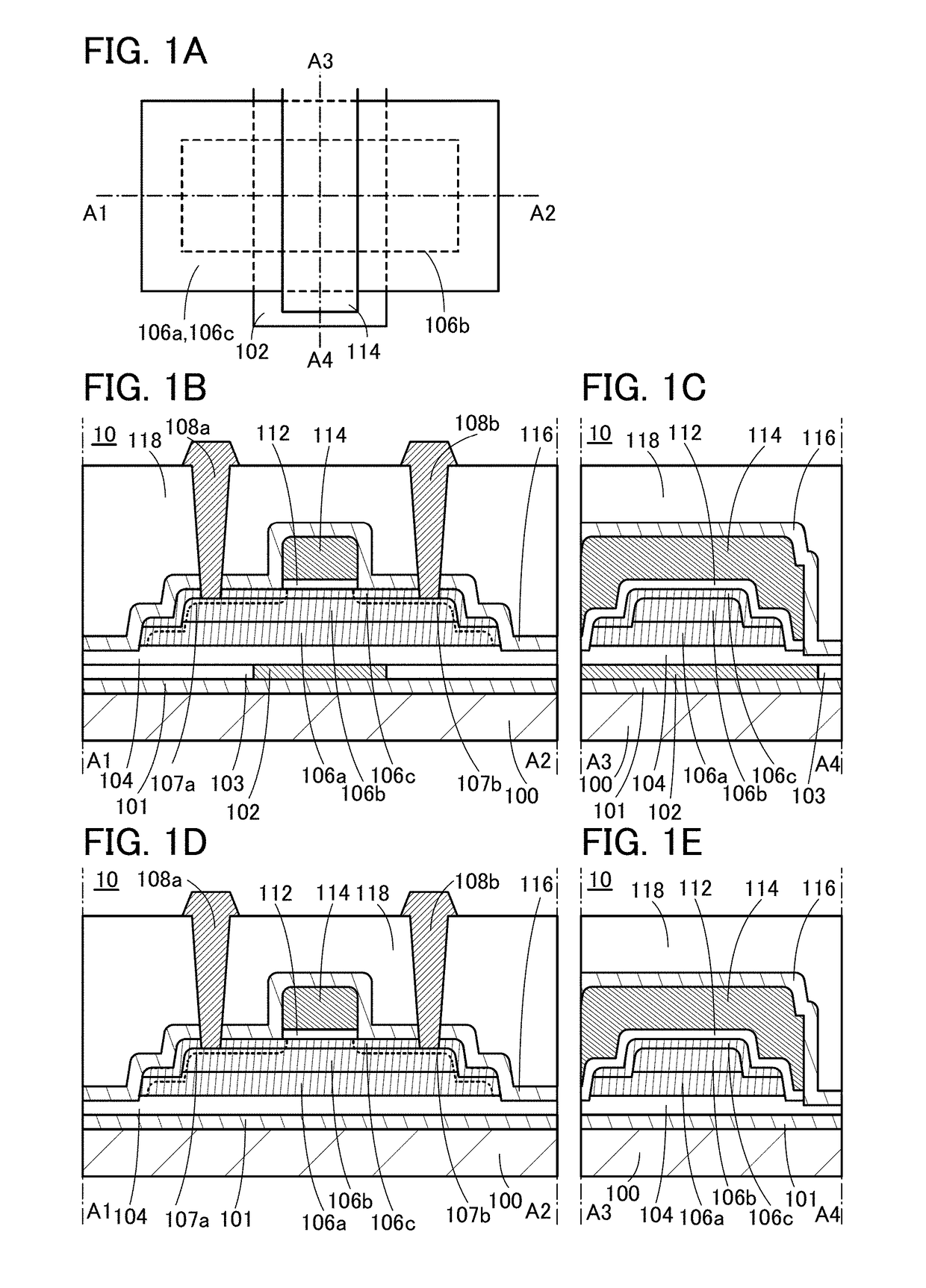
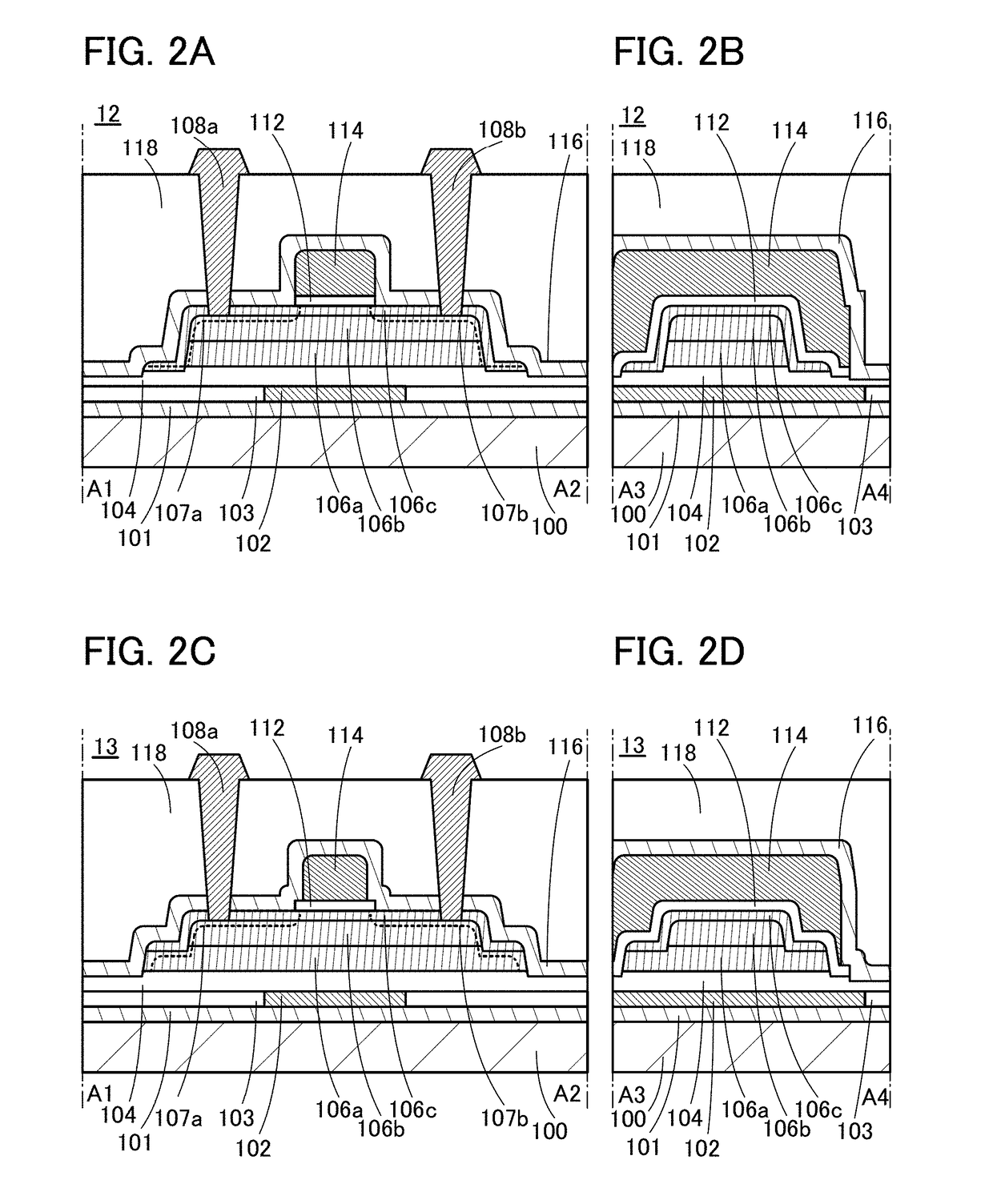
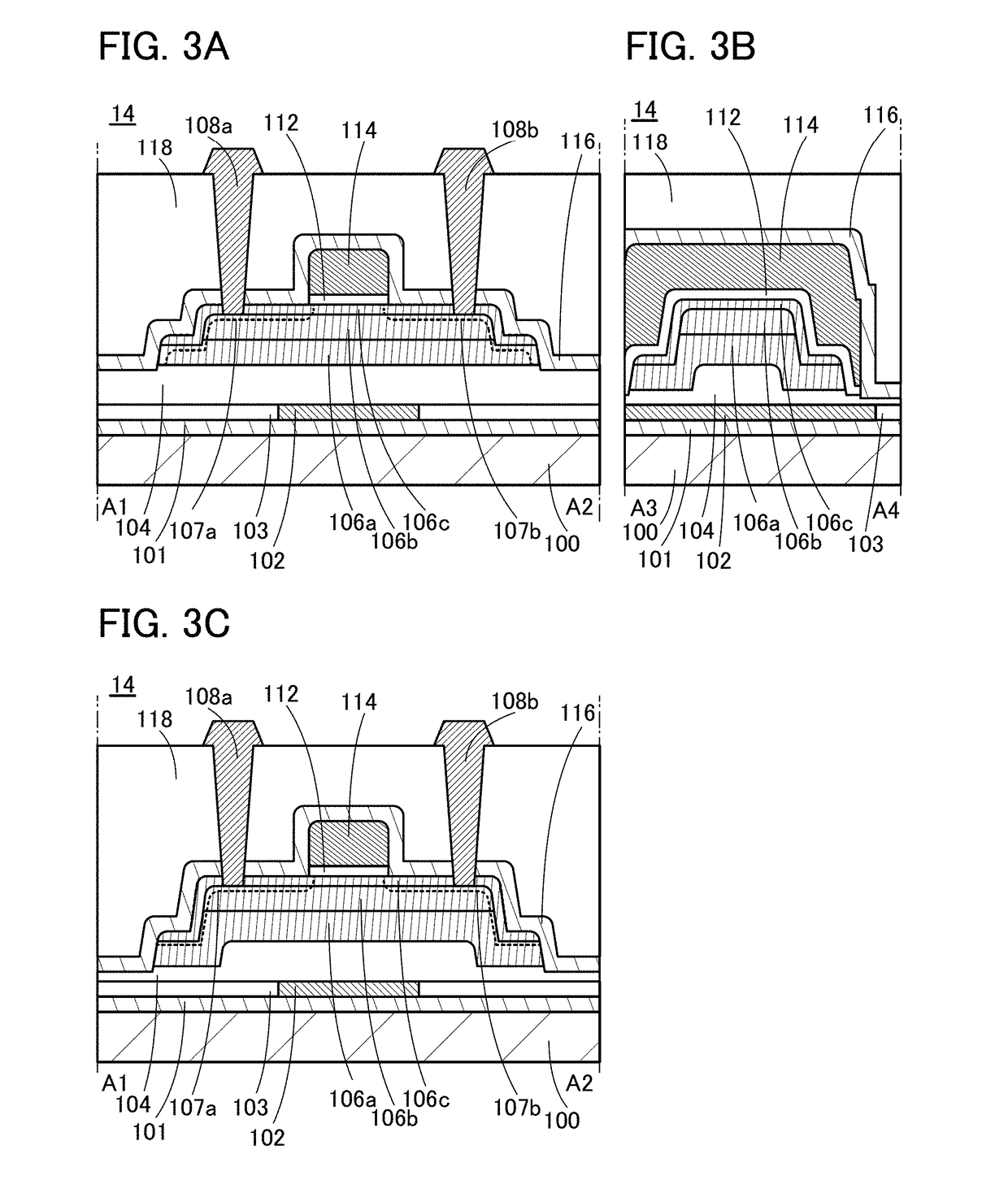
[0088]In this embodiment, structures of semiconductor devices of embodiments of the present invention will be described with reference to FIGS. 1A to 1E, FIGS. 2A to 2D, and FIGS. 3A to 3C.
[0089]Structures of transistors, which are examples of the semiconductor devices of embodiments of the present invention, will be described below.
[0090]A structure of a transistor 10 will be described with reference to FIGS. 1A to 1C. FIG. 1A is a top view of the transistor 10. FIG. 1B is a cross-sectional view taken along dashed-dotted line A1-A2 in FIG. 1A. FIG. 1C is a cross-sectional view taken along dashed-dotted line A3-A4 in FIG. 1A. A region along dashed-dotted line A1-A2 shows a structure of the transistor 10 in the channel length direction, and a region along dashed-dotted line A3-A4 shows a structure of the transistor 10 in the channel width direction. The channel length direction of a transistor refers to a direction in which carriers move between a source (source region or source elec...
modification example 1
of Transistor
[0186]Modification examples of the transistor 10 are described below with reference to FIGS. 2A to 2D and FIGS. 3A to 3C. FIGS. 2A to 2D and FIGS. 3A to 3C are cross-sectional views of the transistors in the channel length direction and those in the channel width direction like FIGS. 1B and 1C. Note that the components in the following modification examples of the transistor 10 can be combined with each other as appropriate.
[0187]A transistor 12 illustrated in FIGS. 2A and 2B is different from the transistor 10 in that the end portion of the side surface of the insulator 106a is substantially aligned with the end portion of the side surface of the semiconductor 106b. Here, the thickness of the insulator 106a is preferably larger than the sum of the thicknesses of the insulator 106c and the insulator 112. With such a structure, substantially the entire side surface of the semiconductor 106b in the channel width direction can face the conductor 114 with the insulator 106c...
embodiment 2
[0196]In this embodiment, a method for manufacturing the semiconductor device of one embodiment of the present invention will be described with reference to FIGS. 4A to 4F and FIGS. 5A to 5D.
[0197]A method for manufacturing the transistor 10 illustrated in FIGS. 1A to 1E will be described below.
[0198]First, the substrate 100 is prepared. Any of the above-mentioned substrates can be used for the substrate 100.
[0199]Next, the insulator 101 is formed. Any of the above-mentioned insulators can be used for the insulator 101.
[0200]The insulator 101 can be formed by a sputtering method, a chemical vapor deposition (CVD) method, a molecular beam epitaxy (MBE) method, a pulsed laser deposition (PLD) method, an atomic layer deposition (ALD) method, or the like.
[0201]CVD methods can be classified into a plasma enhanced CVD (PECVD) method using plasma, a thermal CVD (TCVD) method using heat, a photo CVD method using light, and the like. Moreover, the CVD method can include a metal CVD (MCVD) me...
PUM
 Login to View More
 Abstract
Description
Claims
Application Information
 Login to View More