Intermediates useful for the synthesis of a selective inhibitor against protein kinase and processes for preparing the same
Active Publication Date: 2021-12-14
YUHAN
View PDF7 Cites 0 Cited by
Summary
Abstract
Description
Claims
Application Information
AI Technical Summary
This helps you quickly interpret patents by identifying the three key elements:
Problems solved by technology
Method used
Benefits of technology
Benefits of technology
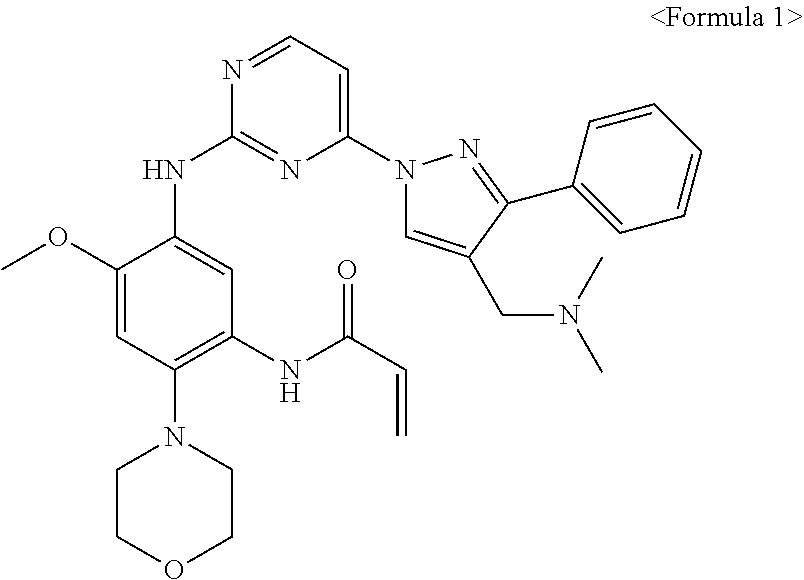
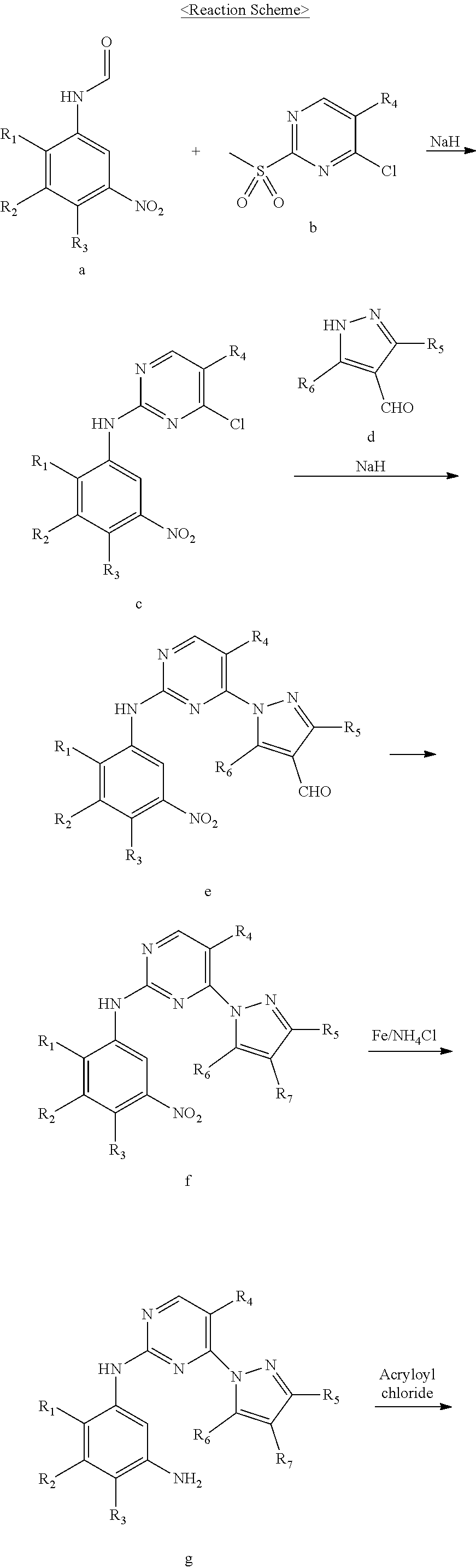
The present invention provides a process for preparing a compound (Formula 1) through new intermediates, which helps to solve prior art problems. This process avoids the use of acryloyl chloride and makes it easy to remove and control impurities. It also solves issues of corrosion and contamination caused by the use of iron in a reactor. This process is suitable for industrial mass production.
Problems solved by technology
However, since sodiumhydride has a high possibility of fire and explosion, there is a problem that it is difficult to use in industrial mass production.
However, the use of iron may cause corrosion and contamination in a reactor, which makes it difficult to be applied to mass production.
Therefore, in order to obtain the final product, the compound of formula (I), having a suitable purity, it is required to perform the purification process by column chromatography which is difficult to apply to mass production.
In addition, since acryloyl chloride used in the final step for preparing the compound of Formula (I) has low stability, it is difficult to handle at the production site.
And also, since various degradation products are produced during the reaction of the compound of formula (g) with acryloyl chloride, it is difficult to prepare the compound of Formula (I) having a suitable purity.
Method used
the structure of the environmentally friendly knitted fabric provided by the present invention; figure 2 Flow chart of the yarn wrapping machine for environmentally friendly knitted fabrics and storage devices; image 3 Is the parameter map of the yarn covering machine
View more
Image
Smart Image Click on the blue labels to locate them in the text.
Viewing Examples
Smart Image
Click on the blue label to locate the original text in one second.
Reading with bidirectional positioning of images and text.
Smart Image
Examples
Experimental program
Comparison scheme
Effect test
example 1
on of 1-(2-chloropyrimidin-4-yl)-3-phenyl-1H-pyrazole-4-carbaldehyde (Compound 13)
[0068]A mixture of 2,4-dichloropyrimidine (30.0 g, 0.201 mol), potassiumcarbonate (55.6 g, 0.402 mol), and dimethylformamide (180.0 mL) was cooled to 0-5° C. and then 3-phenyl-1H-pyrazole-4-carbaldehyde (41.6 g, 0.242 mol) was added thereto. The reaction mixture was stirred for 15 hours and then purified water (1.2 L) was added thereto. The resulting solid was filtered and then dried in vacuo to obtain 48.8 g of the titled compound. (Yield: 85.1%)
on of tert-butyl (4-fluoro-2-methoxy-5-nitrophenyl)carbamate (Compound 8)
[0070]A mixture of 4-fluoro-2-methoxy-5-nitroaniline (60.0 g, 0.322 mol) and dichloromethane (500.0 mL) was cooled to 0-5° C. A solution of dibutyl dicarbonate (91.5 g, 0.419 mol) in dichloromethane (120.0 mL), 4-dimethylaminopyridine (3.9 g, 0.032 mol), and triethylamine (65.2 g, 0.645 mol) were added to the mixture. The reaction mixture was stirred at 20-30° C. for 4 hours and then concentrated under reduced pressure to obtain 92.3 g of the titled compound. (Yield: 100.0%)
on of tert-butyl (2-methoxy-4-morpholino-5-nitrophenyl)carbamate (Compound 7)
[0072]A mixture of tert-butyl (4-fluoro-2-methoxy-5-nitrophenyl)carbamate (92.3 g, 0.322 mol), acetonitrile (600.0 mL), diisopropylethylamine (54.1 g, 0.419 mol), and morpholine (36.5 g, 0.419 mol) was refluxed under stirring for about 3 hours. The reaction mixture was concentrated under reduced pressure to obtain 99.0 g of the titled compound.
the structure of the environmentally friendly knitted fabric provided by the present invention; figure 2 Flow chart of the yarn wrapping machine for environmentally friendly knitted fabrics and storage devices; image 3 Is the parameter map of the yarn covering machine
Login to View More
PUM
Login to View More
Abstract
The present invention provides intermediates useful for the synthesis of an aminopyrimidine derivative or pharmaceutically acceptable salt thereof having a selective inhibitory activity against protein kinases, especially against the protein kinases for mutantepidermal growth factor receptors; and processes for preparing the same. And also, the present invention provides novel intermediates useful for said process and processes for preparing the same.
Description
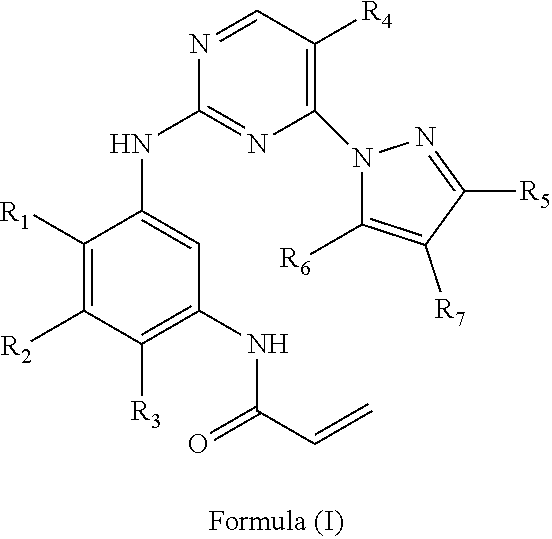
CROSS-REFERENCE TO RELATED APPLICATIONS[0001]This application is the National Stage of International Patent Application No. PCT / KR2018 / 008383 filed Jul. 25, 2018, which claims the benefit of Korean application number 10-2017-0096226, filed Jul. 28, 2017, the entire contents of both of which are incorporated herein by reference.TECHNICAL FIELD[0002]The present invention relates to intermediates useful for the synthesis of an aminopyrimidine derivative or pharmaceutically acceptable salt thereof having a selective inhibitory activity against proteinkinase; and processes for preparing the same.BACKGROUND ART[0003]WO 2016 / 060443 has disclosed an aminopyrimidine derivative or pharmaceutically acceptable salt thereof having a selective inhibitory activity against protein kinases, especially against the protein kinases for mutantepidermal growth factor receptors. Said aminopyrimidine derivative or pharmaceutically acceptable salt thereof can provide an effective and safe therapy against ...
Claims
the structure of the environmentally friendly knitted fabric provided by the present invention; figure 2 Flow chart of the yarn wrapping machine for environmentally friendly knitted fabrics and storage devices; image 3 Is the parameter map of the yarn covering machine
Login to View More
Application Information
Patent Timeline
Application Date:The date an application was filed.
Publication Date:The date a patent or application was officially published.
First Publication Date:The earliest publication date of a patent with the same application number.
Issue Date:Publication date of the patent grant document.
PCT Entry Date:The Entry date of PCT National Phase.
Estimated Expiry Date:The statutory expiry date of a patent right according to the Patent Law, and it is the longest term of protection that the patent right can achieve without the termination of the patent right due to other reasons(Term extension factor has been taken into account ).
Invalid Date:Actual expiry date is based on effective date or publication date of legal transaction data of invalid patent.



 Login to View More
  Login to View More