Manufacturing method of semiconductor device

a manufacturing method and semiconductor technology, applied in the direction of semiconductor devices, electrical devices, transistors, etc., can solve the problems of poor contact, unstable substrate potential, lowered surface concentration of p-type impurity diffusion region, etc., to achieve easy control of implantation energy, suppress diffusion progress, and suppress variation of element concentration profile

US20050106843A1Active Publication Date: 2005-05-19SEMICON COMPONENTS IND LLC
6 Cites 0 Cited by

Patent Information

Authority / Receiving Office
US · United States
Patent Type
Applications(United States)
Current Assignee / Owner
Publication Date
2005-05-19

Smart Images

  • Figure 1
    Figure 1
  • Figure 2
    Figure 2
  • Figure 3
    Figure 3
Patent Text Reader

Abstract

When Ti as a barrier metal layer is brought into contact with a diffusion region of boron provided on a surface of a silicon substrate, there is a problem that boron is absorbed by titanium silicide, and contact resistance is increased. Although there is a method of additionally implanting boron whose amount is equal to the amount of boron absorbed by titanium silicide, there has been a problem that when boron is additionally implanted into, for example, a source region in a p-channel type, the additionally added boron is diffused deeply at the diffusion step, and characteristics are deteriorated. According to the invention, after formation of an element region, boron is additionally implanted into the whole surface at a dosage of about 10% of an element region, and is activated in the vicinity of a surface of a silicon substrate by an alloying process of a barrier metal layer. By this, a specified concentration profile of the element region is kept, and the impurity concentration only in the vicinity of the surface can be raised. Accordingly, even if boron is absorbed by titanium silicide, a specified boron concentration can be kept in the element region, and the increase of contact resistance can be suppressed.
Need to check novelty before this filing date? Find Prior Art

Description

BACKGROUND OF THE INVENTION

[0001] 1. Field of the Invention

[0002] The present invention relates to a manufacturing method of a semiconductor device, and particularly to a manufacturing method of a semiconductor device in which the increase of contact resistance due to the absorption of boron by titanium is suppressed and the characteristics are improved.

[0003] 2. Description of the Related Art

[0004] As the miniaturization of a semiconductor device advances, in the semiconductor device with a silicon substrate, a barrier metal layer made of titanium-based metal (for example, Ti, TiN, TiON, TiW, etc.) is formed before the formation of a wiring layer.

[0005] With reference to FIGS. 15 to 17, a conventional manufacturing method of a semiconductor device will be described while a power MOSFET with a trench structure is used as an example.

[0006] In FIG. 15, a p−-type epitaxial layer is laminated on a p+-type silicon semiconductor substrate 21 to form a drain region 22. After an oxide...

Examples

Embodiment Construction

[0066] Embodiments of the present invention will be described in detail with reference to FIGS. 1 to 14.

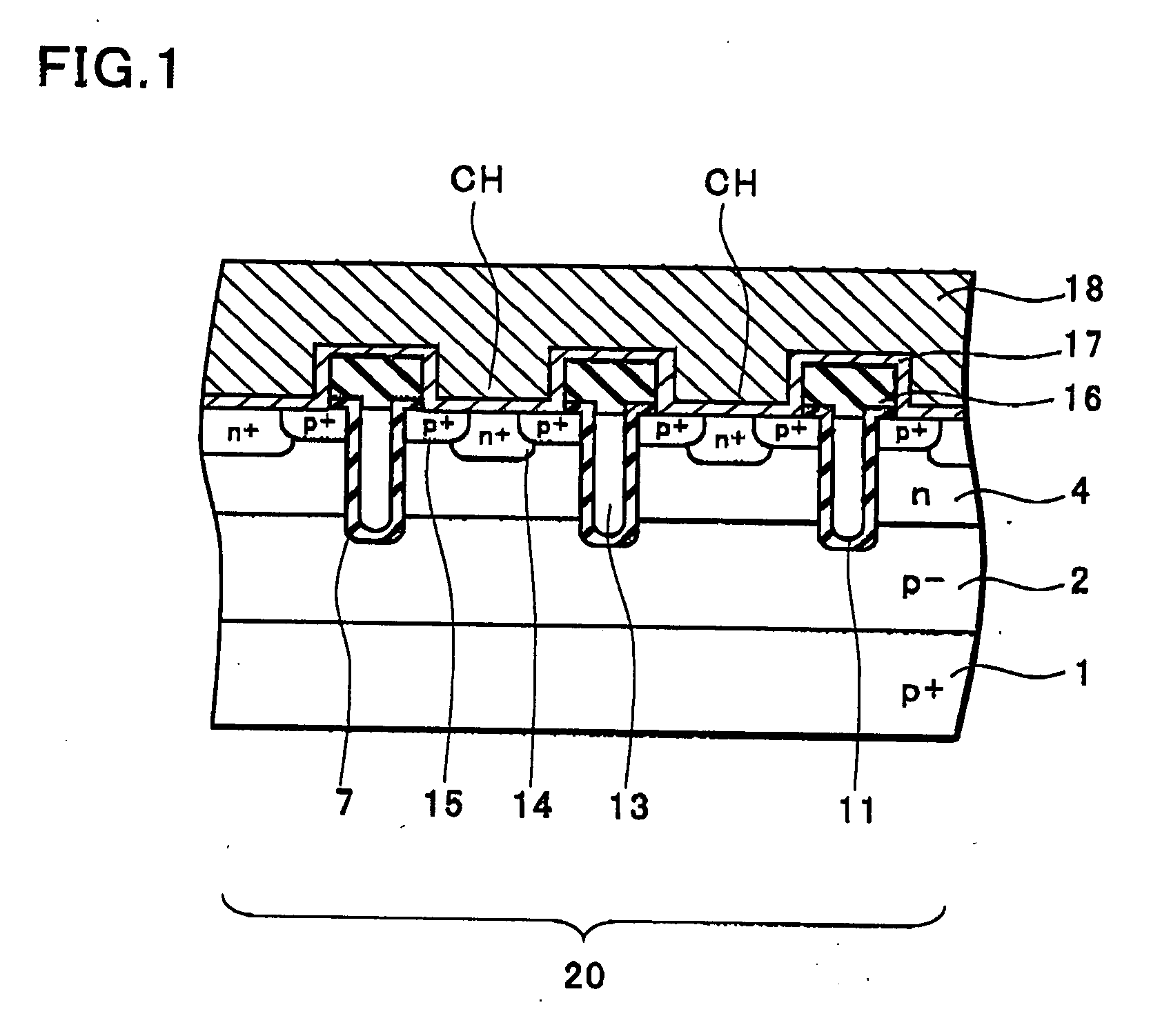
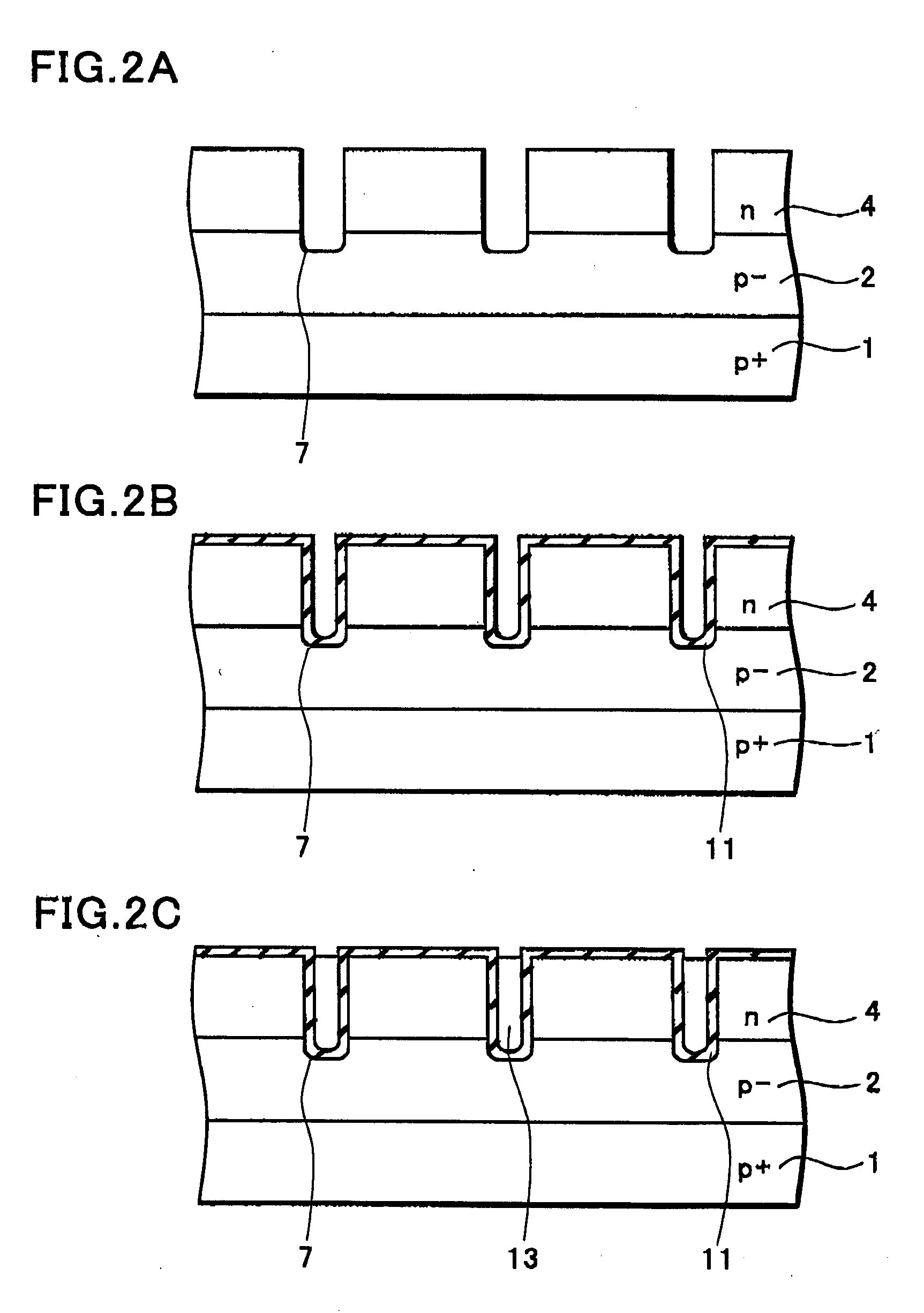
[0067] First, a first embodiment of the invention will be described with reference to FIGS. 1 to 8 while a MOSFET of a p-channel trench structure is used as an example.

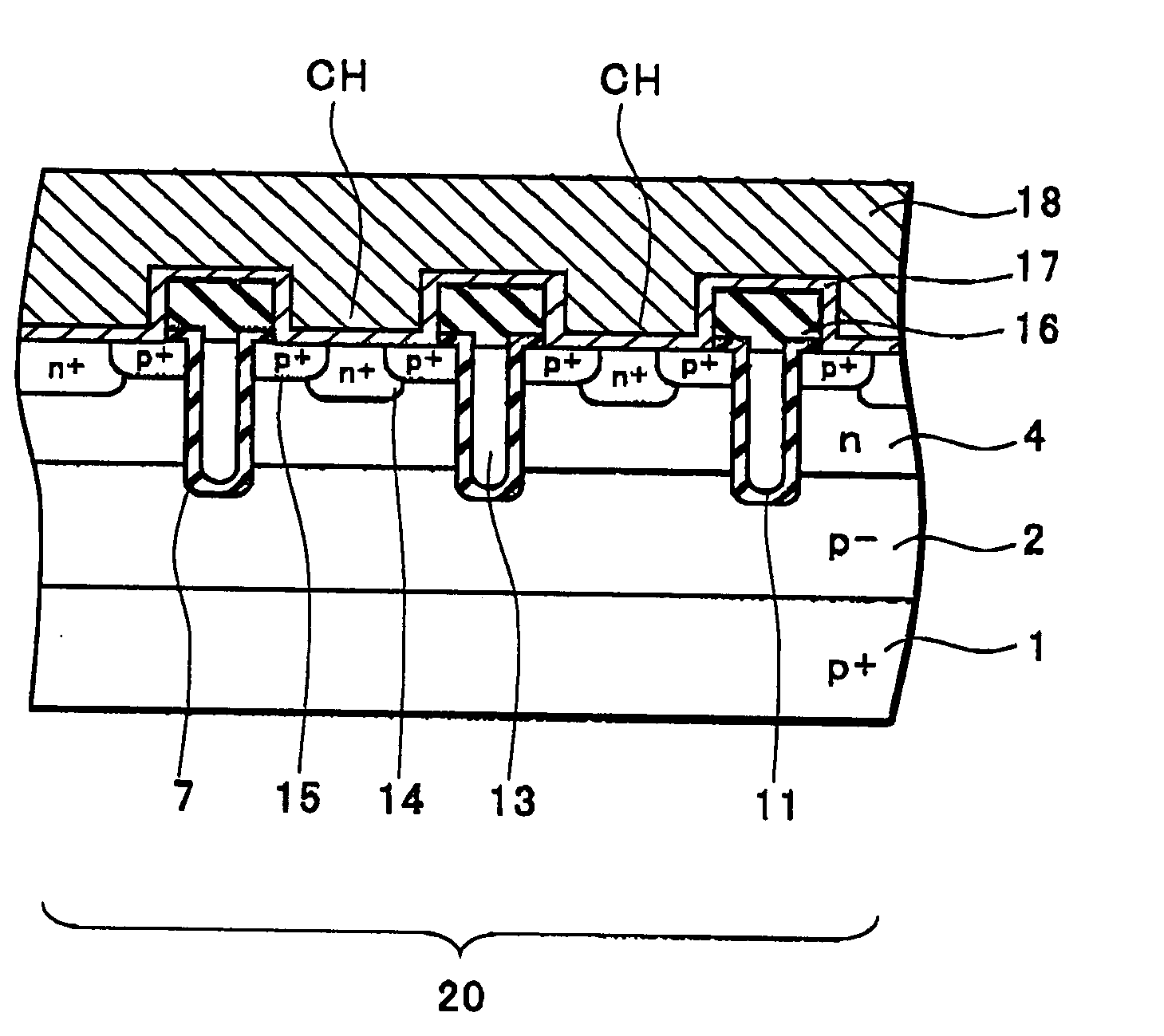
[0068]FIG. 1 shows a structure of the trench type MOSFET of the invention. A drain region 2 made of a p−-type epitaxial layer is provided on a p+-type silicon semiconductor substrate 1, and an n-type channel layer 4 is provided on its surface.

[0069] Trenches 7 are provided to pass through the channel layer 4 and to reach the drain region 2, an inner wall of each of the trenches 7 is coated with a gate oxide film 11, and a gate electrode 13 made of polysilicon filled in the trench 7 is provided.

[0070] P+-type source regions 15 are provided on the surface of the channel layer 4 adjacent to the trench 7, and an n+-type body region 14 is disposed on the surface of the channel layer 4 between the source regions 15 of...