
Lubricant composition for automobile driving system
a technology for automobile driving and lubricant composition, which is applied in the direction of lubricant composition, base materials, additives, etc., can solve the problems of reducing the friction coefficient, facilitating wear, and reducing so as to reduce the viscosity of lubricant and maintain the durability of wear resistance
- Summary
- Abstract
- Description
- Claims
- Application Information
AI Technical Summary
Benefits of technology
Problems solved by technology
Method used
Image

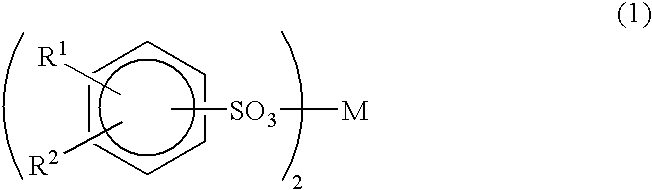
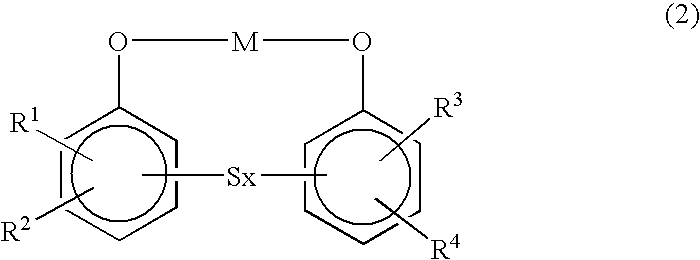
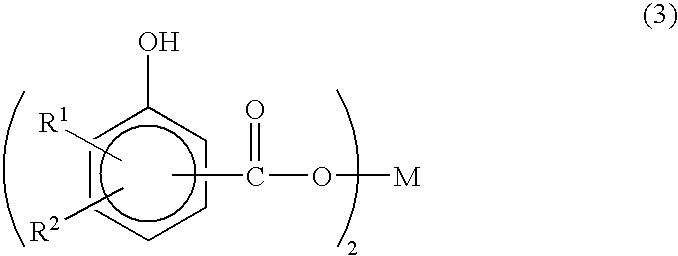
Examples
example 1
[0082] With said refined mineral oil as the base oil, magnesium sulfonate was added at a quantity corresponding to a content of elemental Mg in the oil of 0.15 wt %, and zinc dithiophosphate was added in a quantity corresponding to a content of elemental Zn in the oil of 0.1 wt %, with the ratio of the quantity of elemental Zn in the oil to the quantity of elemental Mg in the oil adjusted to 0.67. In addition, as other additives, the sulfur-phosphorus based (S—P) package was added in a quantity of 7.1 wt %, forming oil sample A with a 40° C. dynamic viscosity of 30 mm2 / s.
[0083] For oil sample A, the friction width measured using the aforementioned wear-resistance evaluation method was found to be 0.74 mm.
example 2
[0084] Oil sample B with a 40° C. dynamic viscosity of 30 mm2 / s was prepared in the same way as in Example 1, except that the magnesium sulfonate was added in a quantity corresponding to a quantity of elemental Mg in the oil of 0.3 wt %, and the zinc dithiophosphate was added in a quantity corresponding to a quantity of elemental Zn in the oil of 0.2 wt %, with the ratio of elemental Zn to elemental Mg in the oil being 0.67.
[0085] For oil sample B, the friction width measured using the aforementioned wear-resistance evaluation method was found to be 0.80 mm.
example 3
[0086] Oil sample C with a 40° C. dynamic viscosity of 30 mm2 / s was prepared in the same way as in Application Example 1, except that the magnesium sulfonate was added in a quantity corresponding to a quantity of elemental Mg in the oil of 0.3 wt %, and the zinc dithiophosphate was added in a quantity corresponding to a quantity of elemental Zn in the oil of 0.1 wt %, with the ratio of elemental Zn to elemental Mg in the oil being 0.33.
[0087] For oil sample C, the friction width measured using the aforementioned wear-resistance evaluation method was found to be 0.80 mm.
PUM
| Property | Measurement | Unit |
|---|---|---|
| friction width | aaaaa | aaaaa |
| friction width | aaaaa | aaaaa |
| friction width | aaaaa | aaaaa |
Abstract
Description
Claims
Application Information
 Login to View More