
Receiver front-end filtering using low pass filtering and equalization
- Summary
- Abstract
- Description
- Claims
- Application Information
AI Technical Summary
Benefits of technology
Problems solved by technology
Method used
Image

Examples
Embodiment Construction
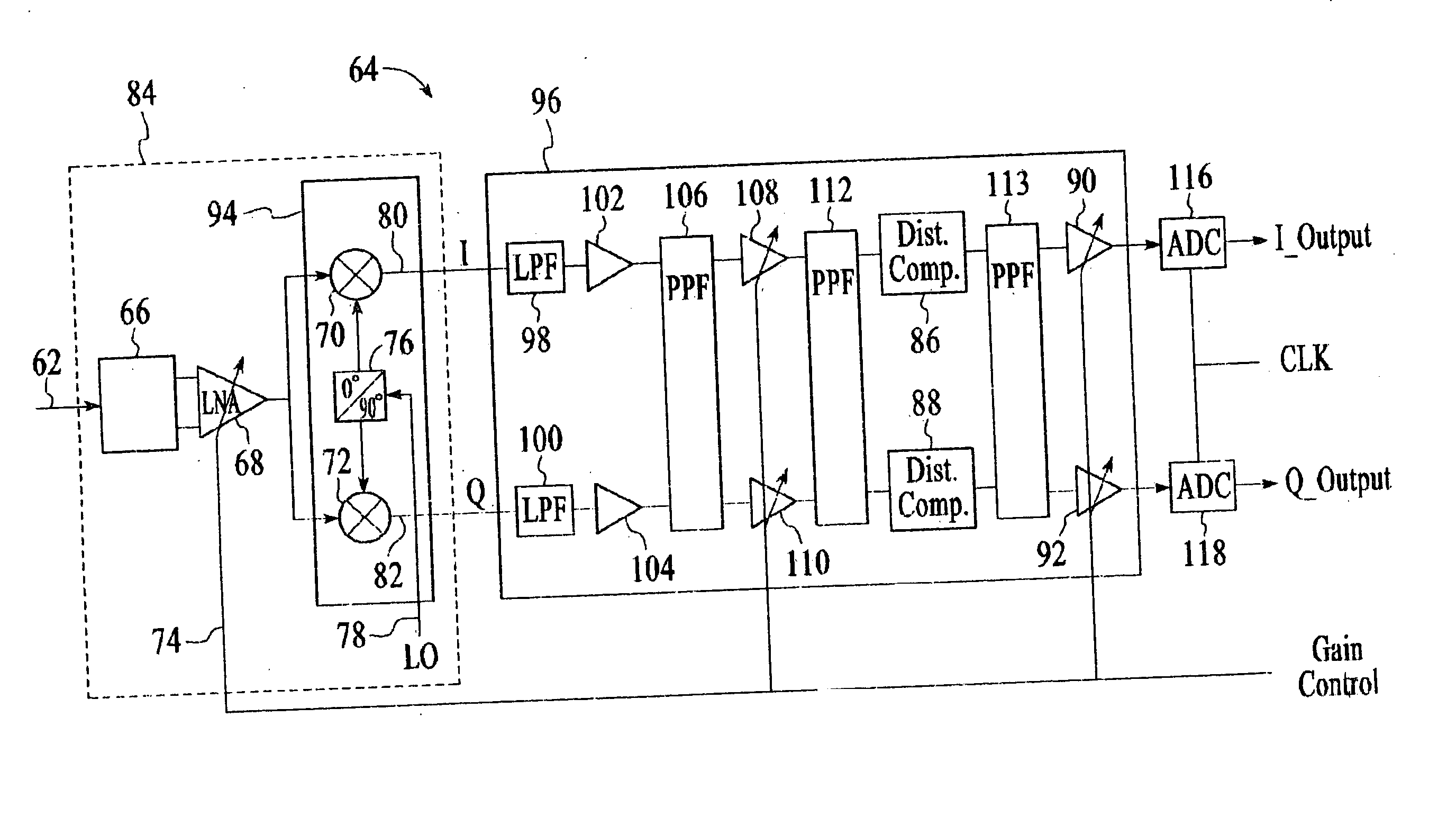
[0025]FIG. 4 illustrates one possible embodiment of the invention. While the signal processing will be described as being implemented with the global system for mobile communication (GSM) standard for wireless communications, a person of ordinary skill in the art will recognize that the invention may be adapted for use in other environments.
[0026] The input line 62 to the receiver 64 may be coupled to an antenna, not shown. The input line is linked to a switching arrangement 66, which may include a SAW filter or equivalent component, since the switching arrangement is not critical to the invention. The switching arrangement provides preliminary RF filtering.
[0027] A variable low noise filter 68 is a conventional component for the front-end of a wireless receiver. Such amplifiers function as band pass filters for initial channel selection. However, the more significant function of the amplifier is to ensure sufficient signal strength for reliable operation of the mixers 70 and 72 t...
PUM
 Login to View More
 Abstract
Description
Claims
Application Information
 Login to View More