

Process for treating ammonia-containing exhaust gases
a technology of exhaust gas and ammonia, which is applied in the direction of chemistry apparatus and processes, separation processes, dispersed particle separation, etc., can solve the problems of reducing atmospheric visibility, reducing process efficiency, and releasing at least some unreacted ammonia, so as to reduce the cost of exemplary systems using the invention and reduce the ammonia emission
- Summary
- Abstract
- Description
- Claims
- Application Information
AI Technical Summary
Benefits of technology
Problems solved by technology
Method used
Image

Examples
Embodiment Construction
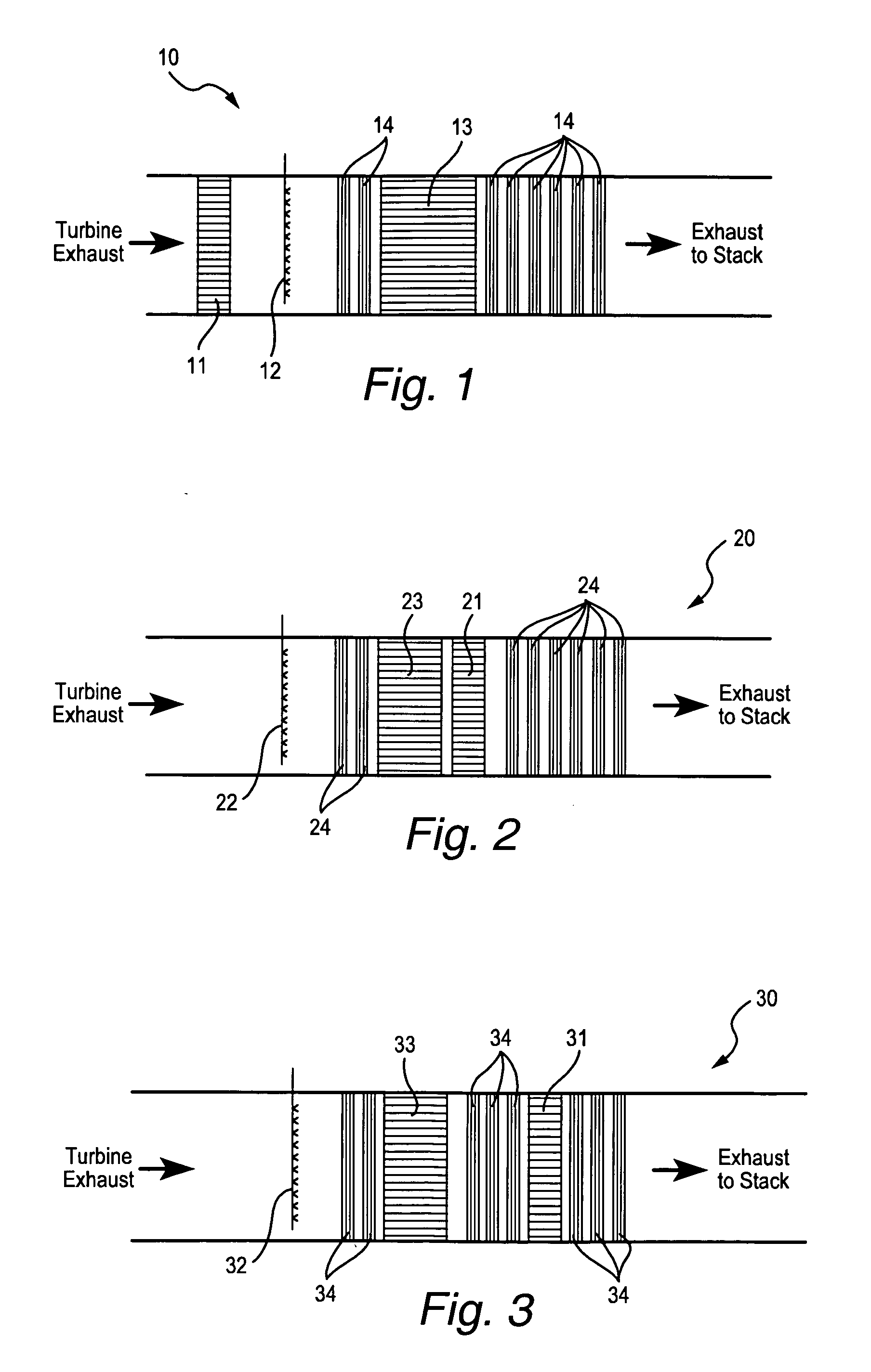
[0011] The present invention substantially reduces the unreacted ammonia slip at the outlet of the SCR system using an oxidation catalyst installed downstream of the SCR system catalyst. For combustion sources that contain at least some oxygen in the exhaust stream, the preferred oxidation catalysts include noble metals that oxidize the ammonia (with the oxidation state “OS” of the nitrogen in the ammonia being −3) to a species of nitrogen having a higher oxidation state, such as elemental nitrogen N2 (OS=0), nitrous oxide N2O(OS=+1), nitric oxide NO(OS=+2), and nitrogen dioxide NO2 (OS=+4). As noted above, it is desirable to maximize the conversion of the ammonia slip to elemental nitrogen and minimize the formation of other nitrogen-containing species. The chemical reactions describing oxidation of the ammonia slip include the following:
4NH3+302→2N2+6H2O
2NH3+202→N2O+3H2O
4NH3+502→4NO+6H2O
4NH3+702→4NO2+6H2O
[0012] As those skilled in the art will appreciate, converting ammonia t...
PUM
| Property | Measurement | Unit |
|---|---|---|
| Temperature | aaaaa | aaaaa |
| Temperature | aaaaa | aaaaa |
| Temperature | aaaaa | aaaaa |
Abstract
Description
Claims
Application Information
 Login to View More