Heat treatment of superalloy components

a superalloy and heat treatment technology, applied in the direction of engine components, mechanical equipment, manufacturing tools, etc., can solve the problem that the heat conduction through the superalloys that is being given a localized heat treatment is unlikely to be sufficient, and achieve the effect of improving the repairability of components and maximizing the lifespan

a superalloy and heat treatment technology, applied in the direction of engine components, mechanical equipment, manufacturing tools, etc., can solve the problem that the heat conduction through the superalloys that is being given a localized heat treatment is unlikely to be sufficient, and achieve the effect of improving the repairability of components and maximizing the lifespan

US20060042729A1Inactive Publication Date: 2006-03-02SIEMENS ENERGY INC

Image

Smart Image Click on the blue labels to locate them in the text.
Viewing Examples
Smart Image
  • Heat treatment of superalloy components
  • Heat treatment of superalloy components
  • Heat treatment of superalloy components

Examples

Experimental program
Comparison scheme
Effect test

Embodiment Construction

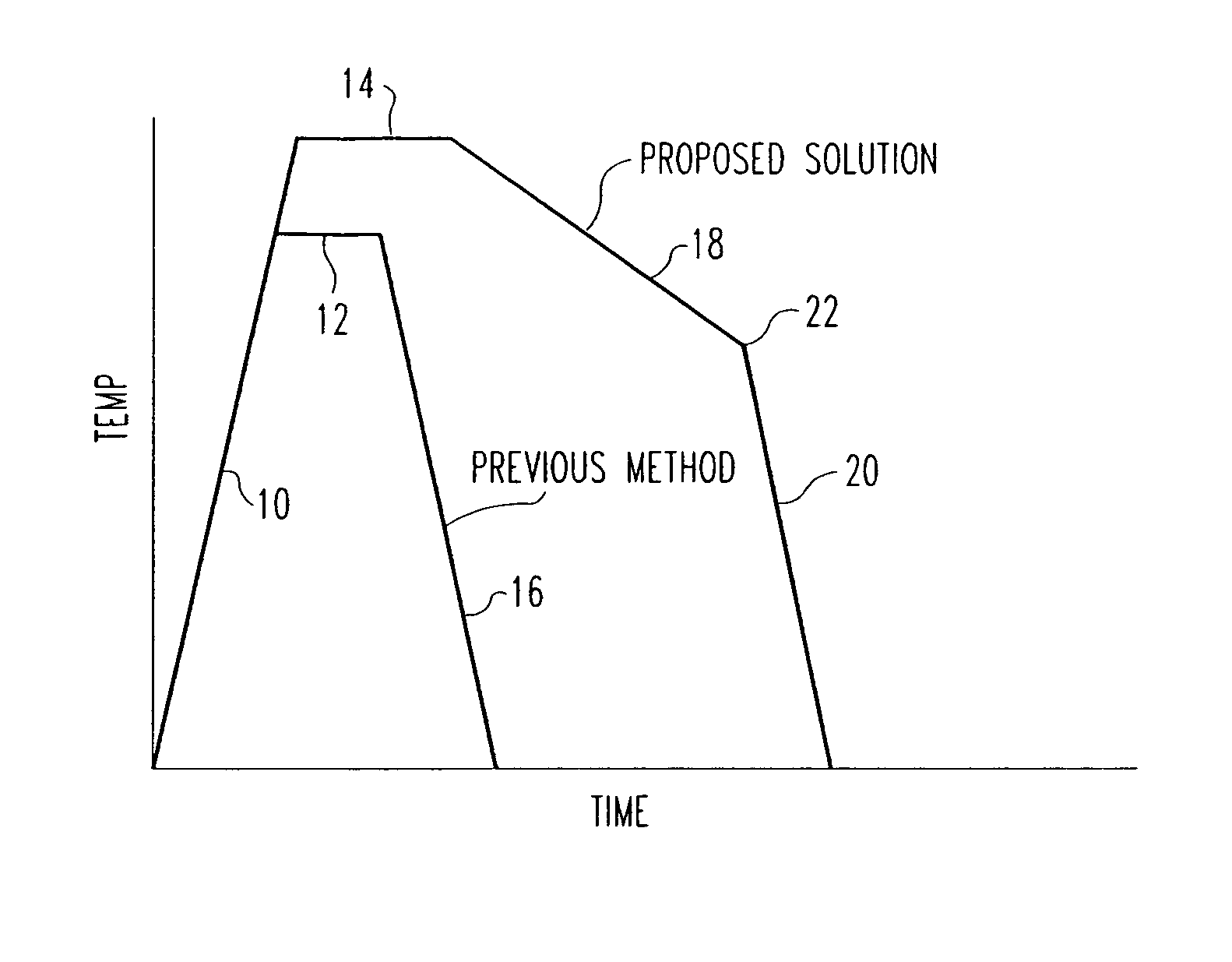
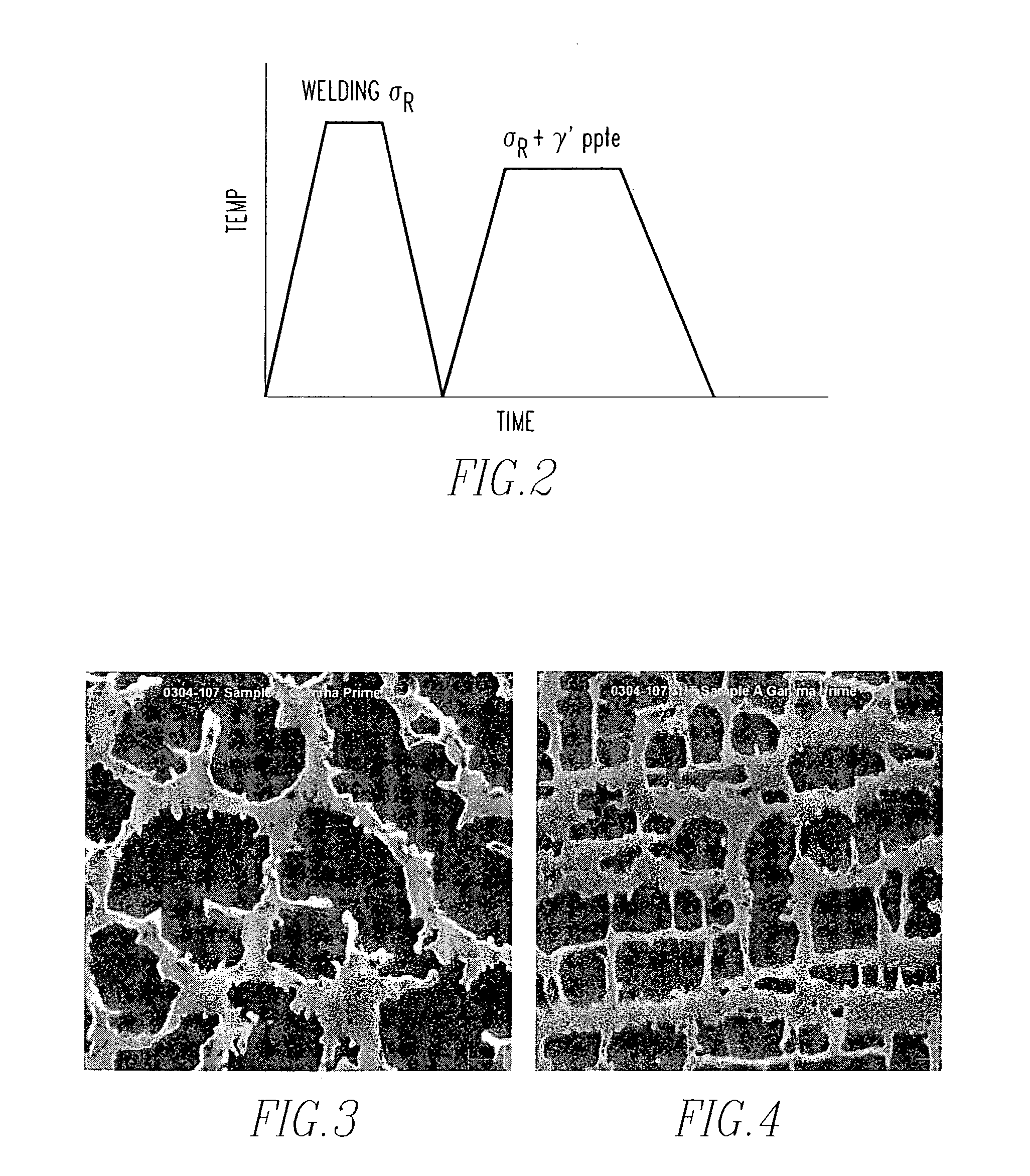
[0028] The present invention provides an improved method of heat treating superalloys, which resists the formation of recrystallized grains in portions of the component not being repaired, and also resists cracking during and after the welding process. Although primarily intended for use prior to welding, the heat treating method may also be advantageously used after welding, to rejuvenate components after extended service, and as a pre-brazing or post-brazing heat treatment.

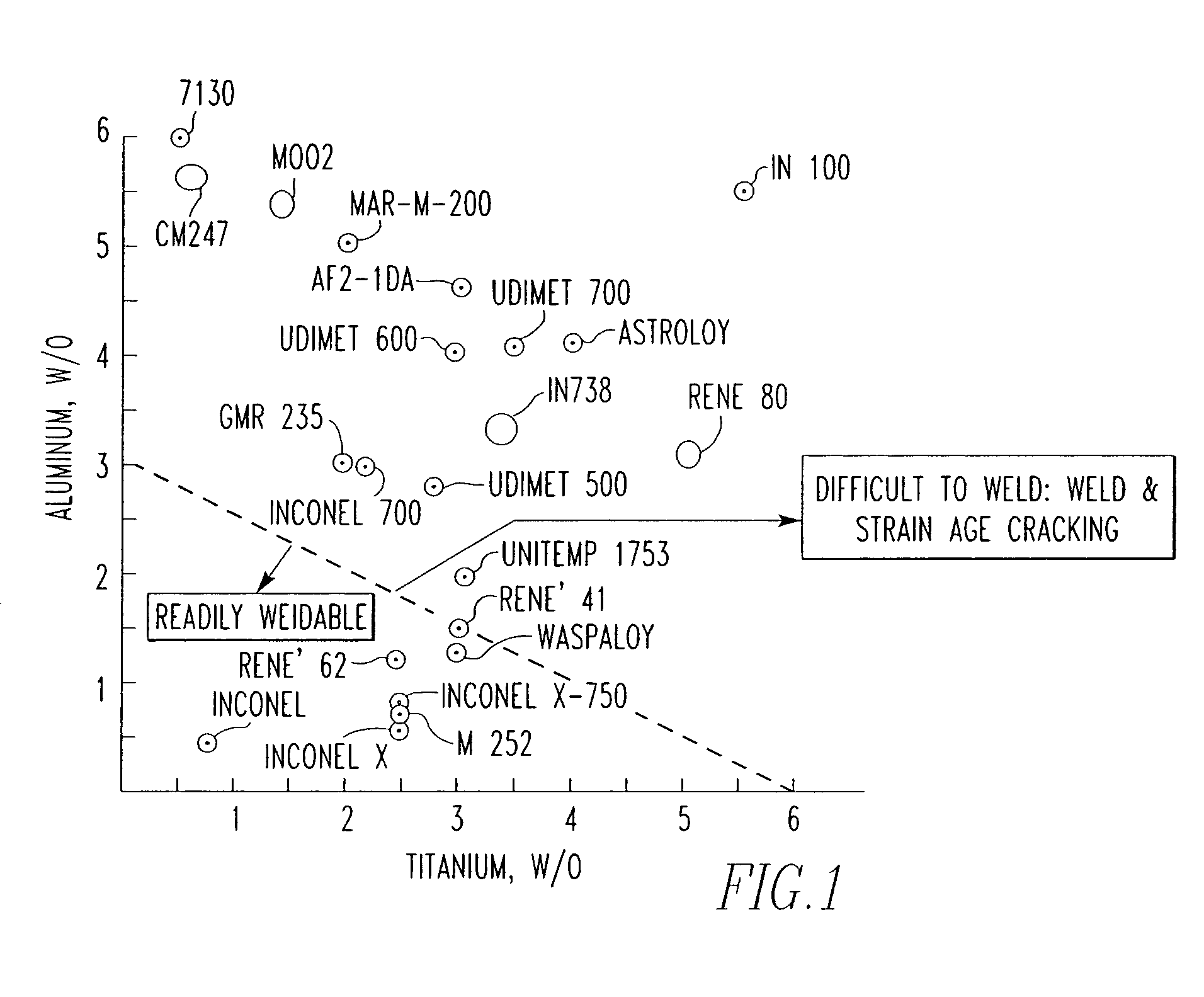
[0029] Referring to FIG. 1, the difficulty in welding various superalloys based on their aluminum and titanium concentrations is illustrated. As shown in FIG. 1, increasing concentrations of both aluminum and / or titanium in nickel based superalloys increases the difficulty of welding these materials. The graph shows that the alloys CM247, MarM002, IN738, and RENE 80 are particularly difficult to weld. All of these alloys are examples of alloys with which the present invention may be used.

[0030] Referring to FI...

the structure of the environmentally friendly knitted fabric provided by the present invention; figure 2 Flow chart of the yarn wrapping machine for environmentally friendly knitted fabrics and storage devices; image 3 Is the parameter map of the yarn covering machine
Login to View More

PUM

PropertyMeasurementUnit
temperatureaaaaaaaaaa
Login to View More

Abstract

An improved method of heat treating superalloys prior to welding includes subjecting only the portion of the component to be repaired to a localized heat treatment, leaving the remainder of the component untreated. The localized heat treatment permits the use of higher hold temperatures that are near, at, or above the Ni3(Al,Ti) solution temperature of the alloy. Such heat treatment prevents strain age cracking and also prevents recrystallization in areas that are not heat treated. Such localized heat treatment can be applied before and / or after welding, for material rejuvenation, pre-brazing, and post-brazing.

Description

BACKGROUND OF THE INVENTION [0001] 1. Field of the Invention [0002] The present invention relates to a method of repairing superalloy components. More specifically, the invention provides a method of local heat treatment of superalloy components prior to welding in a manner that resists recrystallization of the material in locations where repair is not necessary, and also resists cracking in the heat affected zone of the weld and deposited weld metal while preserving the material properties of the remainder of the component. [0003] 2. Description of the Related Art [0004] Components of various types of equipment that are subject to high temperature, high stress environments, for example, components within combustion turbines, are typically made from materials known as superalloys, which are defined herein as nickel based alloys containing aluminum and / or titanium, or cobalt based alloys. Components made from these materials typically include equiaxed materials, directionally solidif...

Claims

the structure of the environmentally friendly knitted fabric provided by the present invention; figure 2 Flow chart of the yarn wrapping machine for environmentally friendly knitted fabrics and storage devices; image 3 Is the parameter map of the yarn covering machine
Login to View More

Application Information

Patent Timeline
02 Mar 2006
Publication
US20060042729A1
IPC
C22F1/10
CPC
Y10T29/49336; C22F1/10
Inventors
KOTTILINGAM, SRIKANTH C.; DITZEL, PETER J.