Semiconductor memory device
a memory device and semiconductor technology, applied in the field of semiconductor memory devices, can solve the problems of becoming difficult to provide flash memory with high-speed data read performance under the condition of a more lowered voltage, becoming difficult to do timing control of read data output operation, and becoming impossible to secure the time period necessary for setting up data
- Summary
- Abstract
- Description
- Claims
- Application Information
AI Technical Summary
Benefits of technology
Problems solved by technology
Method used
Image



Examples
embodiment 1
[0038] [Embodiment 1]
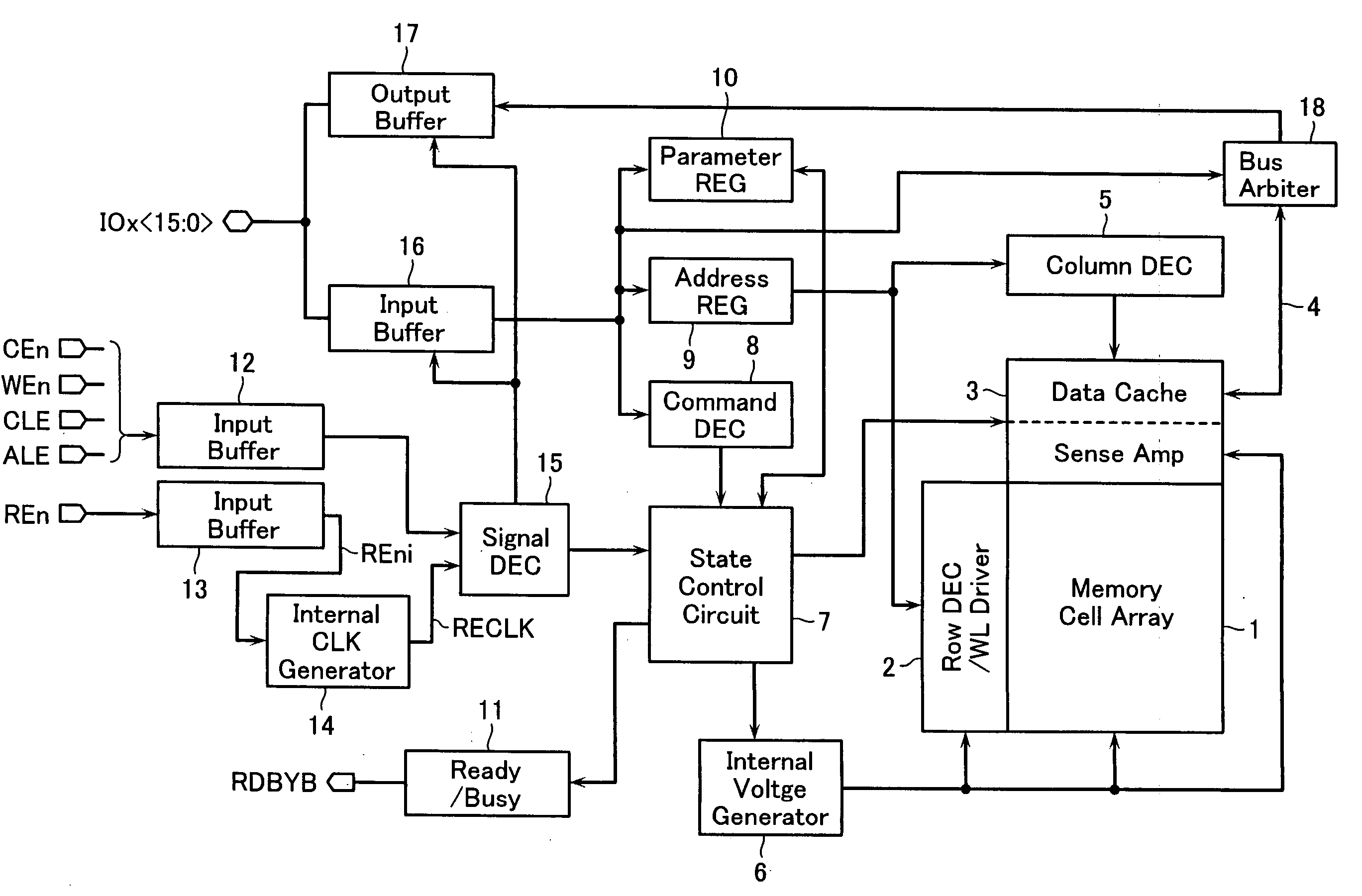
[0039]FIG. 1 shows a functional block diagram of a NAND-type flash memory in accordance with an embodiment. The memory cell array 1 is, as shown in FIGS. 2 and 3, formed of NAND cell units NU arranged in a matrix manner. Each NAND cell unit NU has a plurality of electrically rewritable and non-volatile memory cells (i.e., thirty two cells in the example shown in FIG. 3) M0-M31 connected in series and select gate transistors S1 and S2, which serve for coupling the both ends of the serially connected memory cells to a bit line BL and a common source line CELSRC, respectively.
[0040] A set of NAND cell units sharing a word line constitutes a block, which serves as a unit of data erase. As shown in FIG. 2, plural blocks (BLK0, BLK1, . . . ) are arranged in the direction of the bit line.
[0041] As shown in FIG. 3, each two bit lines BLa and BLb share a sense amplifier PB. The bit lines BLa and BLb are selectively coupled to the sense amplifier PB via bit line select ...
embodiment 2
[0086] [Embodiment 2]
[0087]FIG. 14 shows a functional block diagram of a NAND-type flash memory in accordance with Embodiment 2. The portions corresponding to those in FIG. 1 are denoted by the same reference signs as in FIG. 1, and detailed explanation thereof will be omitted.
[0088] In this Embodiment 2, the parameter register 10, which is usually utilized only in a test mode, is configured to be able to store a control parameter, which is used for adapting the chip to operation circumstances (for example, read configuration), and output it for setting and / or changing operation circumstances corresponding to a host device in response to a specified circumstance setting command.
[0089]FIG. 15 shows input / output relationships of the parameter register 10 in accordance with this embodiment. In case of setting data DIN7:0> in the parameter register 10 together with a test mode signal TESTMODE, the parameter register 10 outputs test-use parameter TESTPAR7:0>. In addition, in this embod...
embodiment 3
[0102] [Embodiment 3]
[0103]FIG. 19 shows a NAND-type flash memory in accordance with another embodiment where not only a data read operation but also a data write operation are taken in for improving operation speed thereof. A detailed explanation will be omitted because the main portions corresponding to those in FIG. 14 are denoted by the same reference signs as in FIG. 14.
[0104] An internal clock generation circuit 14a is disposed at the output node of the input buffer 13a disposed in association with the read enable signal REn. This is the same as above-described Embodiments 1 and 2. In this Embodiment 3, another internal clock generation circuit 14b is disposed at the output node of another input buffer 13b disposed in association with the write enable signal WEn. These internal clock generation circuits 14a and 14b may be formed as similar to that described in Embodiment 1.
[0105] In a data write mode, write command and write address are input as synchronous with the write en...
PUM
 Login to View More
 Abstract
Description
Claims
Application Information
 Login to View More