Magnetic tunnel device and magnetic memory using same

US20060056114A1Active Publication Date: 2006-03-16NEC CORP

Image

Smart Image Click on the blue labels to locate them in the text.
Viewing Examples
Smart Image
  • Magnetic tunnel device and magnetic memory using same
  • Magnetic tunnel device and magnetic memory using same
  • Magnetic tunnel device and magnetic memory using same

Examples

Experimental program
Comparison scheme
Effect test

experiment 1

[0122] The magneto-resistance device of the present invention having the above-mentioned configuration was manufactured by the above-mentioned method. The result of the experiment shows improvement of the thermal stability and the like due to the introduction of the composite magnetic film. That will be described below with reference to FIG. 15.

[0123]FIG. 15 is graphs showing the relation between thermal treatment temperature and MR ratio in the magneto-resistance device. The vertical axis shows the MR ratio (%), and the horizontal axis shows the thermal treatment temperatures (° C.). Here, each of samples will be described below.

(5) Sample 5 (Comparison Example to the Conventional Example)

[0124] Substrate / Ta (3 nm) / Cu (50 nm) / Ta (15 nm) / Co90Fe10 (3 nm) / Pt49Mn51 (30 nm) / Co90Fe10 (9 nm) / Al (2 nm)-Ox / Co90Fe10 (2. nm) / Ni81Fe19 (7.5 nm) / Ta (30 nm) / Cu (300 nm).

[0125] Here, the sample is formed in the order of substrate / lower electrode seed layer / lower electrode layer / buffer layer / an...

experiment 2

[0135] The magneto-resistance device is manufactured by the same method as the experiment example 1 to contain the CoFeAlOx composite magnetic layer 6 in the pinned ferromagnetic layer 20. The film structure will be described below with reference to FIG. 17.

[0136]FIG. 17 is a table showing relation between MR ratio and exchange coupling magnetic field. Here, each of samples is as follows.

experiment 3

[0147] The experimental example 3 of the anti-ferromagnetic coupling film using the composite magnetic layer will be described. The samples were manufactured, in which the Co90Fe10 (6 nm) metal ferromagnetic layer and the CoFeTaOx (5 nm) composite magnetic layer are ferromagnetically or anti-ferromagnetically coupled. The composite magnetic layer CoFeTaOx (6 nm) was formed by the reactive sputtering (the oxygen / argon flow rate ratio=0.13) by using the alloy target of (Co90Fe10)85Ta15 in a mixture atmosphere of argon and oxygen, and was the same film as the experiment example 1. After the film growth, thermal treatment at 300° C. was carried out on the sample in the magnetic field to give the magnetic anisotropy. Those magnetization curves (vibratory magnetometer) are described with reference to FIG. 18.

[0148]FIG. 18 is a graph showing magnetization curve of each of the samples. The vertical axis shows magnetization (emu) and the horizontal axis shows magnetic field (Oe). Here, each...

the structure of the environmentally friendly knitted fabric provided by the present invention; figure 2 Flow chart of the yarn wrapping machine for environmentally friendly knitted fabrics and storage devices; image 3 Is the parameter map of the yarn covering machine
Login to View More

PUM

No PUM Login to View More

Abstract

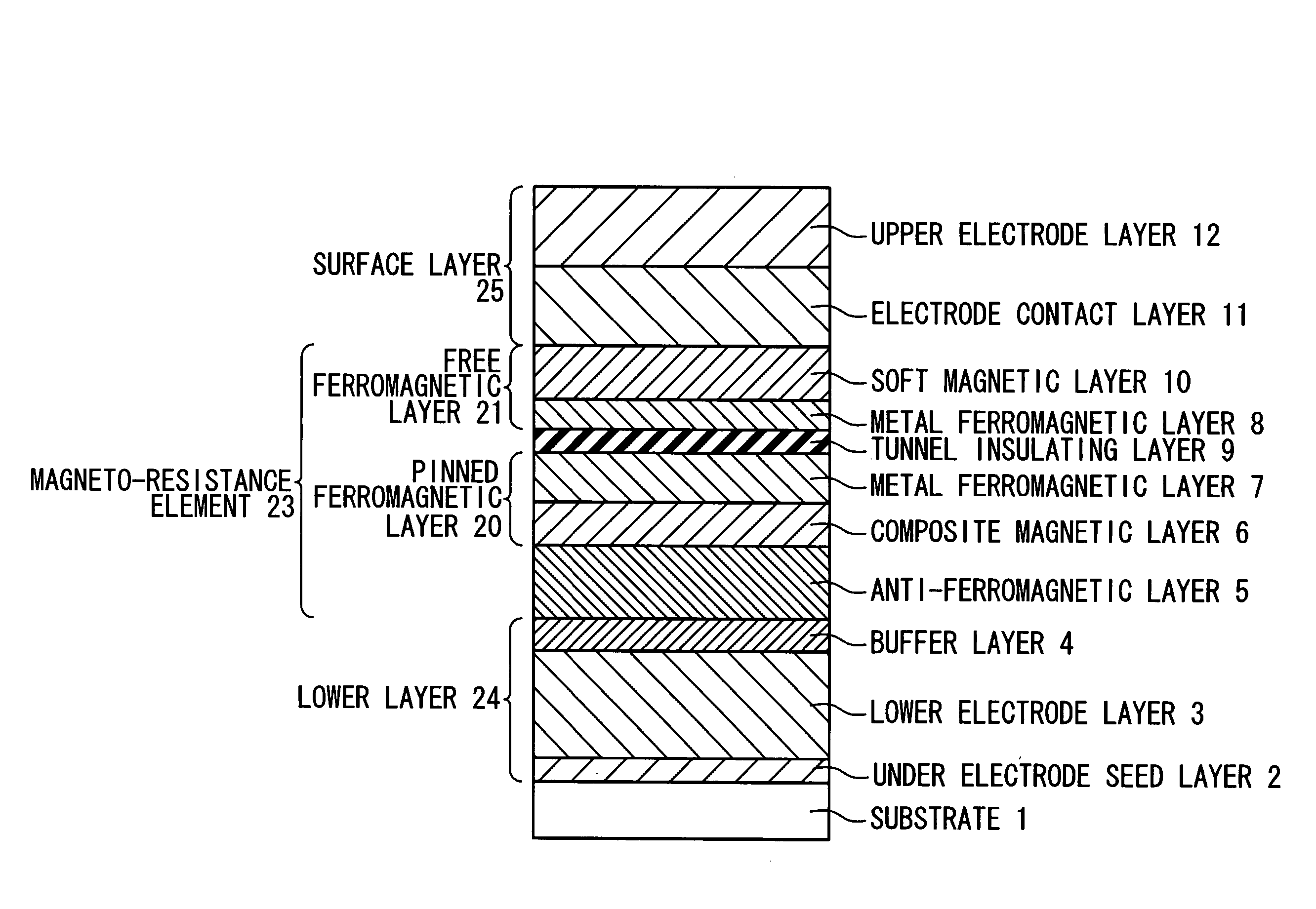
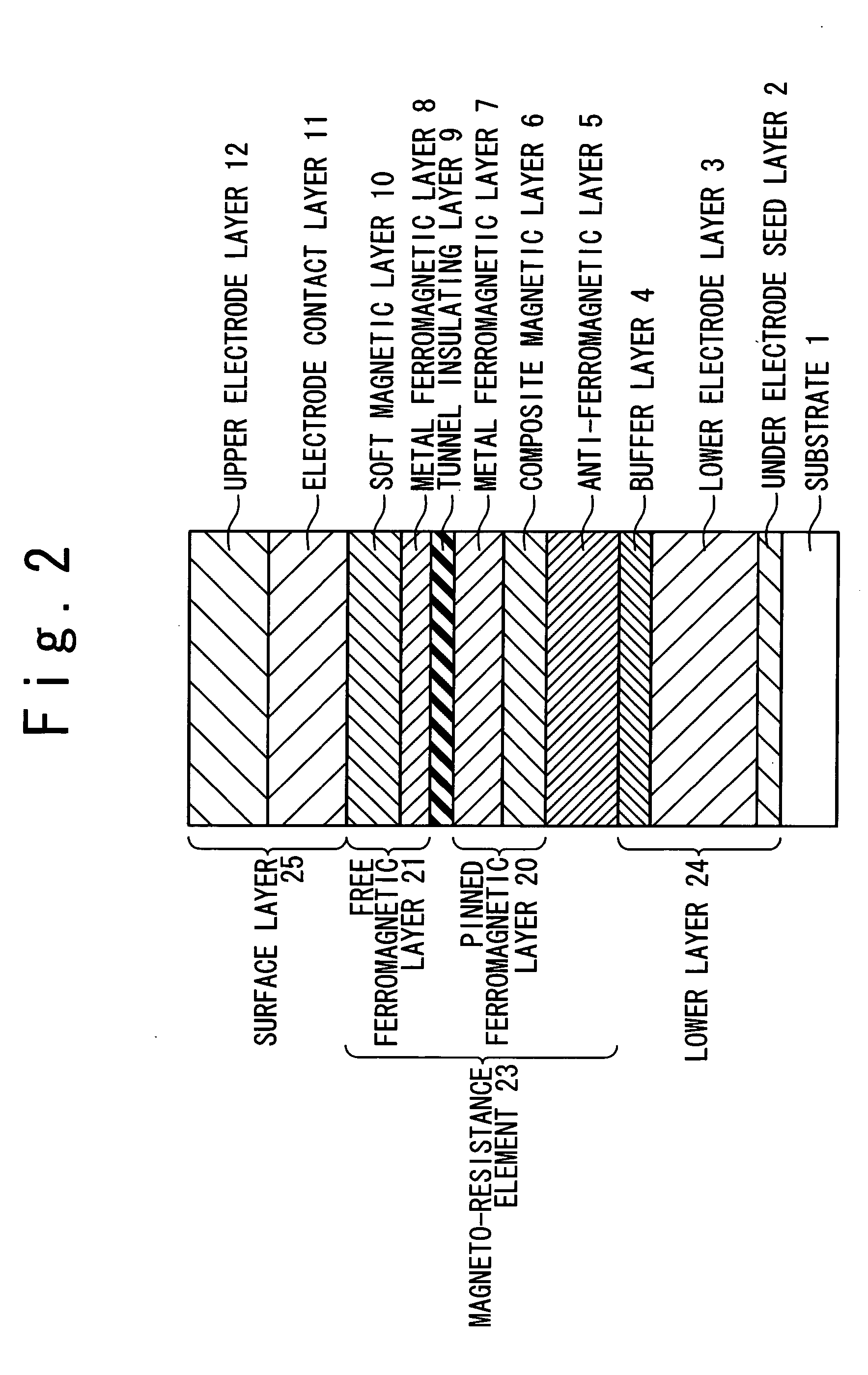
A magneto-resistance device is composed of an anti-ferromagnetic layer (5), a pinned ferromagnetic layer (20), a tunnel insulating layer (9) and a free ferromagnetic layer (21). The pinned ferromagnetic layer (20) is connected to the anti-ferromagnetic layer (5) and has a fixed spontaneous magnetization. The tunnel insulating layer (9) is connected to the pinned ferromagnetic layer (20) and is non-magnetic. The free ferromagnetic layer (21) is connected to the tunnel insulating layer (9) and has a reversible free spontaneous magnetization. The pinned ferromagnetic layer (20) has a first composite magnetic layer (6) to prevent at lest one component of the anti-ferromagnetic layer (5) from diffusing into tunnel insulating layer (9).

Description

TECHNICAL FIELD [0001] The present invention relates to a magnetic tunnel element (a magneto-resistance device) and a manufacturing method of a magneto-resistance device, and more particularly relates to a magnetic tunnel element (a magneto-resistance device) including a magnetic tunnel junction (MTJ) to show a tunnel magneto-resistance (TMR) effect, to the manufacturing method of the same, and to a magnetic memory using the same. BACKGROUND ART [0002] In recent years, a magnetic head and MRAM (magnetoresistive Random Access Memory) using a magneto-resistance element to show GMR (Giant Magneto-Resistance) effect have been developed. The magneto-resistance element used in such devices has a structure called spin valve, and includes an anti-ferromagnetic layer / a ferromagnetic layer / a nonmagnetic layer / a ferromagnetic layer. When the nonmagnetic layer is a conductive layer formed of material such as Cu, the structure is called a spin-valve type GMR, and when the nonmagnetic layer is an...

Claims

the structure of the environmentally friendly knitted fabric provided by the present invention; figure 2 Flow chart of the yarn wrapping machine for environmentally friendly knitted fabrics and storage devices; image 3 Is the parameter map of the yarn covering machine
Login to View More

Application Information

Patent Timeline
16 Mar 2006
Publication
US20060056114A1
IPC
G11B5/33; G11B5/127; G01R33/09; G11B5/39; H01F10/13; H01F10/16; H01F10/32; H01F41/18; H01L27/22; H01L43/08; H01L43/10; H01L43/12
CPC
B82Y25/00; G01R33/093; G01R33/098; H01F10/3295; H01F10/3254; H01L43/08; G11B5/3906; H10N50/10
Inventors
FUKUMOTO, YOSHIYUKI; SHIMURA, KEN-ICHI