
Novel 4-phenyl substituted tetrahydroisoquinolines and therapeutic use thereof
a technology of tetrahydroisoquinoline and 4-phenyl, which is applied in the field of compound, composition and method of the treatment of various disorders, can solve the problems of tics, insomnia and jittery feelings, and subsequent development of anxiety disorders
- Summary
- Abstract
- Description
- Claims
- Application Information
AI Technical Summary
Benefits of technology
Problems solved by technology
Method used
Image

Examples
examples
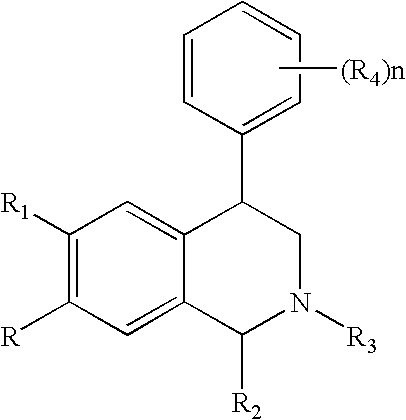
[0059] Compounds listed in Tables I-VIA below (Examples 1-131) were made according to the synthetic schemes set forth hereinabove, and have the melting points as set forth in the Tables; where a compound is an oil or a solid, it is listed as such therein and if it is a solid, the salt form is indicated.
TABLE IEx.RingR4R5R6MP (° C.)Salt1unsat.HHH165-168maleate2sat.HHH 81-833unsat.HMeH240-246hydrochloride4sat.HMeH190-191maleate5unsat.HClHOil, MS6sat.ClHHOil, MS7unsat.HFH242-257hydrochloride8sat.HFHOil, MS9unsat.FHF233-236hydrochloride
[0060]
TABLE IBenantiomerically pure compounds (based on general structure in Table I)Ex.RingR4R5R6MP (° C.)Salt / Isomer10sat.HHH—enantiomer A11sat.HHH121enantiomer B
[0061]
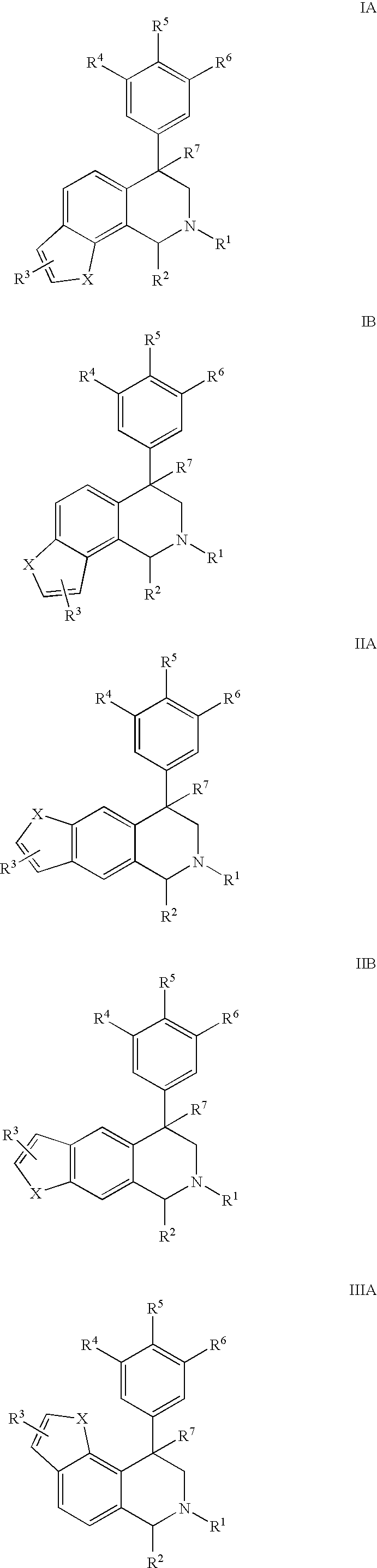
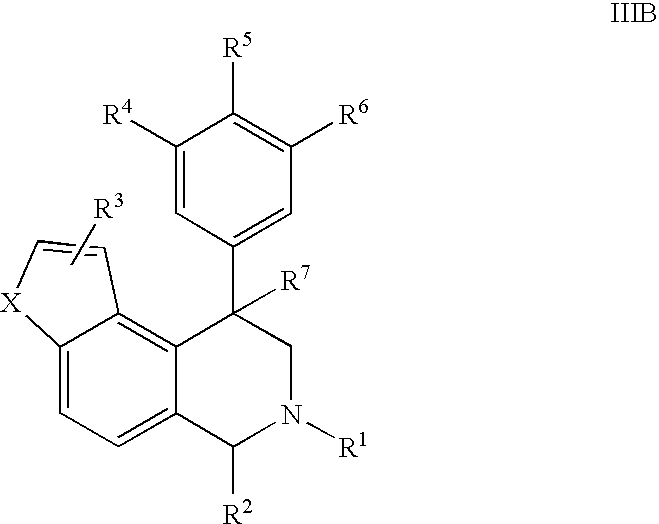
TABLE IIEx.XRingR3R4R5R6R13MP (° C.)Salt12Ounsat.HHHH—199-204maleate13Osat.HHHH—168-169maleate14Ounsat.HFFH—240-243hydrochloride15Osat.HFFH—86-9016Ounsat.HFHF—256-258hydrochloride17Osat.HFHF—107-10918Ounsat.HFHH—156-160fumarate19Osat.HFHF—224-226hydrochloride20Ounsat.HHFH—190-192hydroch...
example 5
[0072] Step A: Benzofuran-7-carboxaldehyde (4.44 g, 30.4 mmol), aqueous methylamine (5.5 mL, 63 mmol) and MeOH (35 mL) were combined in a 25-mL flask under N2. The mixture was cooled to 0° C. under rapid stirring, and NaBH4 (0.61 g, 16 mmol) was added in portions over 5 min. The mixture warmed to room temperature while stirring overnight. The mixture was diluted with water (50 mL), stirred for 15 mm, and extracted (3×) with CH2Cl2. The combined organic extracts were washed (3 ×) with 2 N HCl . These acidic extracts were made basic with solid KOH, additional water, and conc. NH4OH. The basic mixture was extracted (3×) with CH2Cl2. This second set of organic extracts were combined and dried over Na2SO4, filtered, and concentrated in vacuo to provide the methyl amine product (3.51 g, 71%) as a yellow oil: 1H NMR(500 MHz, CDCl3) δ 7.66 (d, J=2.3 Hz, 1 H), 7.53-7.55 (m, 1 H), 7.22-7.29 (m, 2 H), 6.80 (d, J=2.4 Hz, 1 H), 4.10 (s, 2 H), 2.51 (s, 3 H).
[0073] Step B: Methyl amine product fr...
example 6
[0076] Step A: The amine prepared in Example 5, Step A (1.24 g, 7.69 mmol) was dissolved in absolute EtOH (8 mL) in a Parr reactor. 10% Pd / C (0.61 g, 50% by weight) was added, and the mixture was hydrogenated at 30 psi overnight. The slurry was filtered through Celite, and the pad was washed twice with MeOH. The filtrate was concentrated in vacuo to provide dihydrobenzofuran 76 (1.27 g, quantitative) as a yellow oil: 1H NMR (300 MHz; CDCl3) δ 7.07-7.13 (m, 2 H), 6.81 (t, J=7.4 Hz, 1 H), 4.58 (t, J=8.7 Hz, 1 H), 3.78 (s, 2 H), 3.18-3.27 (m, 3H), 6.81 (s, 3 H).
[0077] Step B: The dihydrobenzofuran amine (1.27 g, 7.69 mmol, prepared in Step A), 3′-chlorophenacyl bromide 71 (1.9 g, 8.0 mmol), and CH2Cl2 (15 mL) were combined in a 100-mL flask under N2. The mixture was rapidly stirred while Et3N (1.1 mL, 7.9 mmol) was added. After stirring for 2 h, the mixture was diluted with water and CH2Cl2, and the layers were separated. The aqueous layer was extracted twice with CH2Cl2, and the comb...
PUM
| Property | Measurement | Unit |
|---|---|---|
| temperatures | aaaaa | aaaaa |
| temperatures | aaaaa | aaaaa |
| temperature | aaaaa | aaaaa |
Abstract
Description
Claims
Application Information
 Login to View More