
Application level interface to network analysis tools
a network analysis and application level technology, applied in the field of network analysis, can solve the problems of daunting and often seemingly impossible tasks of driving a conventional network simulator, and achieve the effects of facilitating the creation and/or modification of input, and facilitating the use of application layer parameters and application layer logi
- Summary
- Abstract
- Description
- Claims
- Application Information
AI Technical Summary
Benefits of technology
Problems solved by technology
Method used
Image

Examples
example embodiments
[0056] Example Embodiments
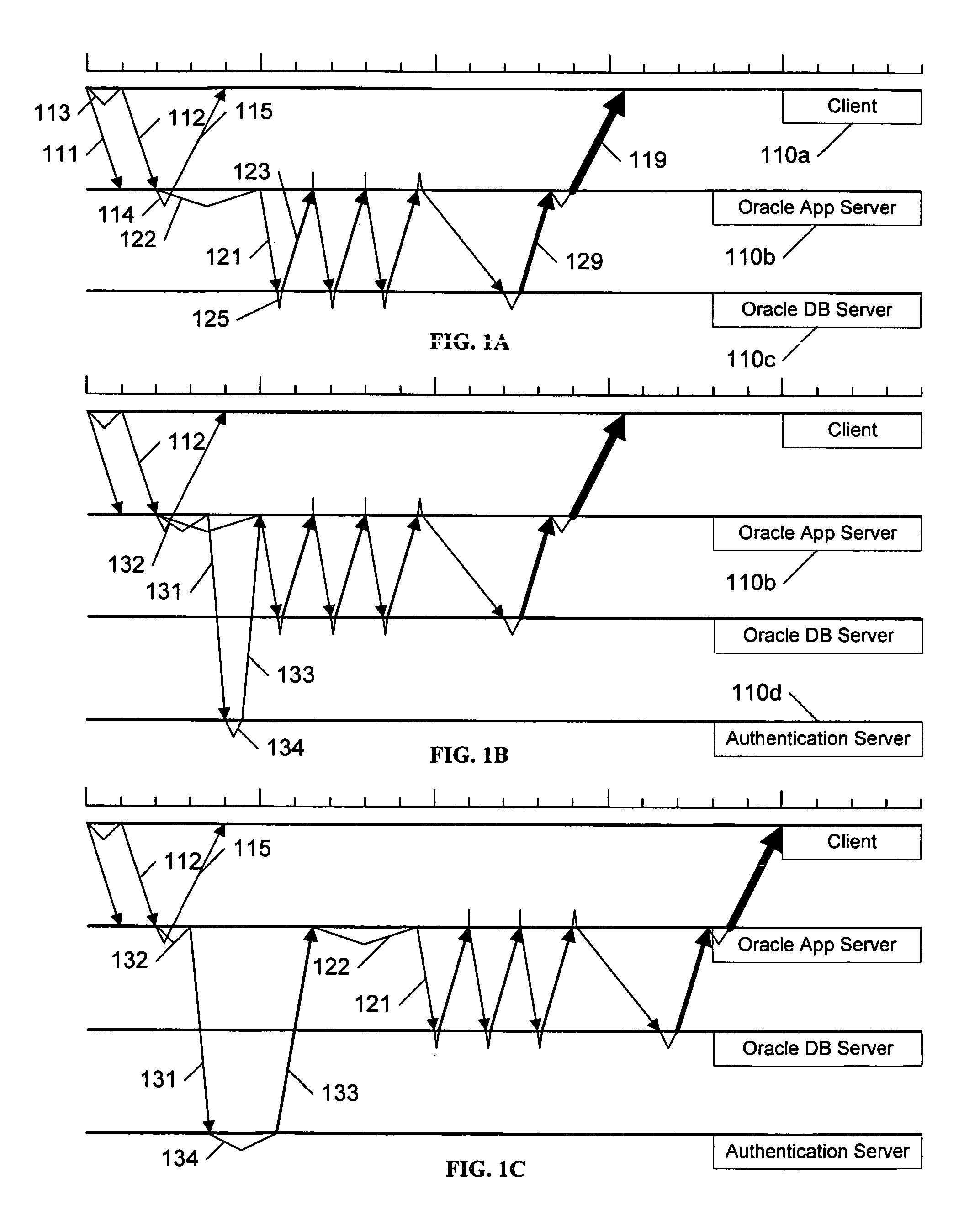
[0057] In FIG. 1A, the three example tiers include a client 110a, an application server 110b, and a database server 110c, and illustrate a series of exchanges, such as might occur when a client 110a requests information from a database 110c, via commands sent to a server 110b. The client 110a initiates the transaction via a series of messages 111, 112 to the server 110b. In response to these messages 111, 112, the server 110b sends a message 115 to the client 110a, acknowledging receipt of the messages 111, 112, and also sends a message 121 to the database server 110c, requesting the data corresponding to the request from the client 110a. Thereafter, the database server 110c exchanges a number of messages 123-129 to effect the data transfer. The application server 110b packages the received data and communicates it to the client 110a via one or more messages 119.
[0058] The illustrated messages 111-129 may have been extracted from a simulation of a network ...
PUM
 Login to View More
 Abstract
Description
Claims
Application Information
 Login to View More