
Inhibitors of the 11-beta-hydroxysteroid dehydrogenase type 1 enzyme
- Summary
- Abstract
- Description
- Claims
- Application Information
AI Technical Summary
Benefits of technology
Problems solved by technology
Method used
Image

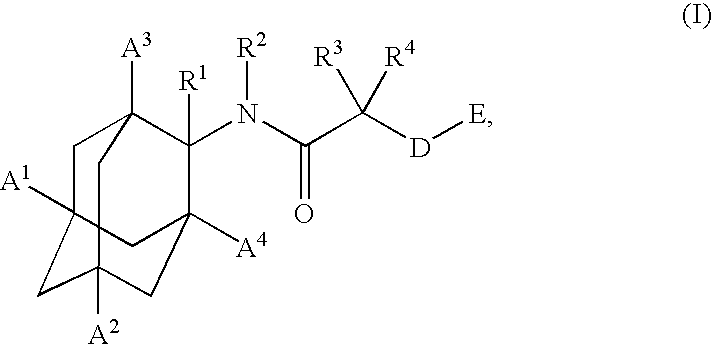
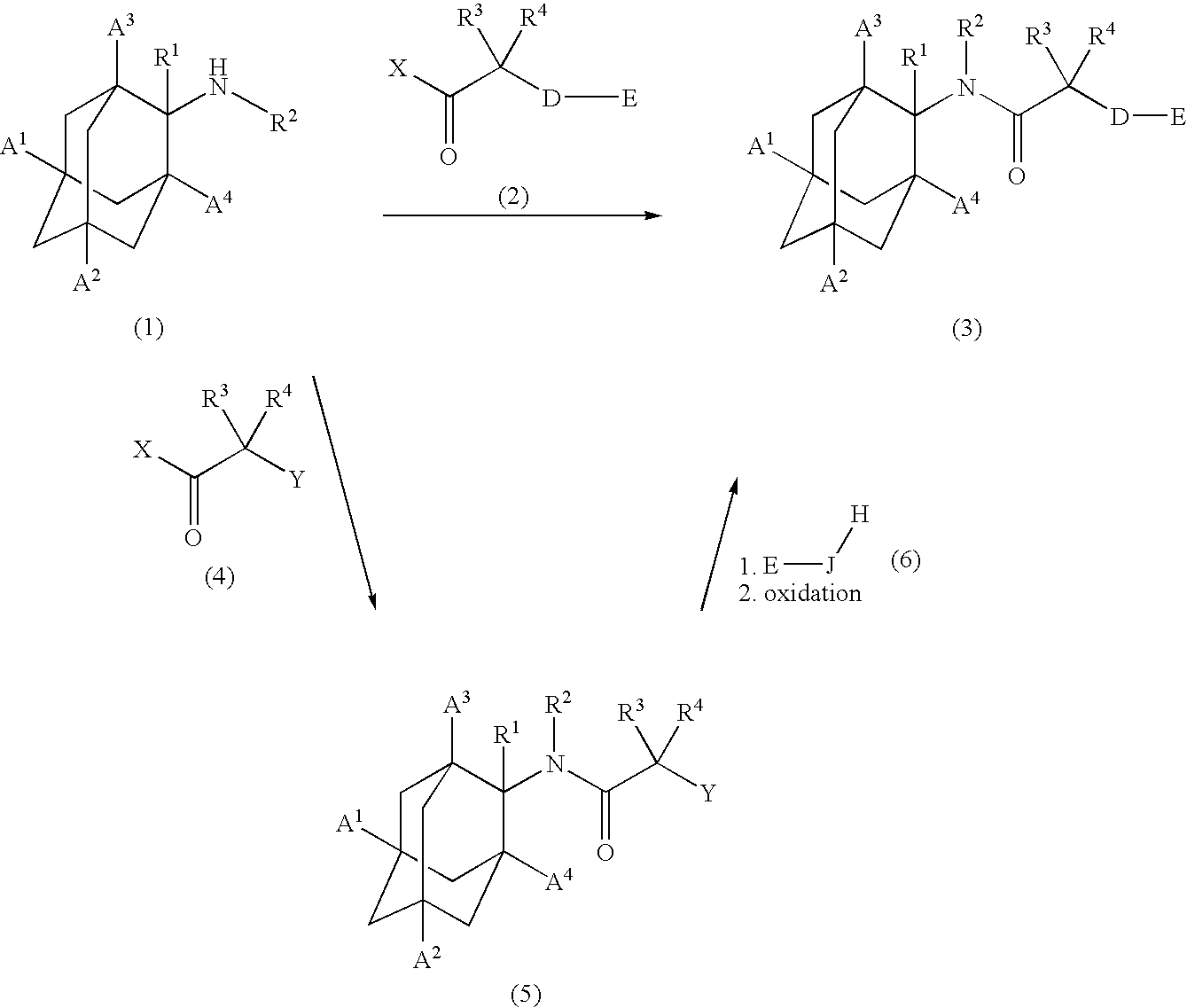
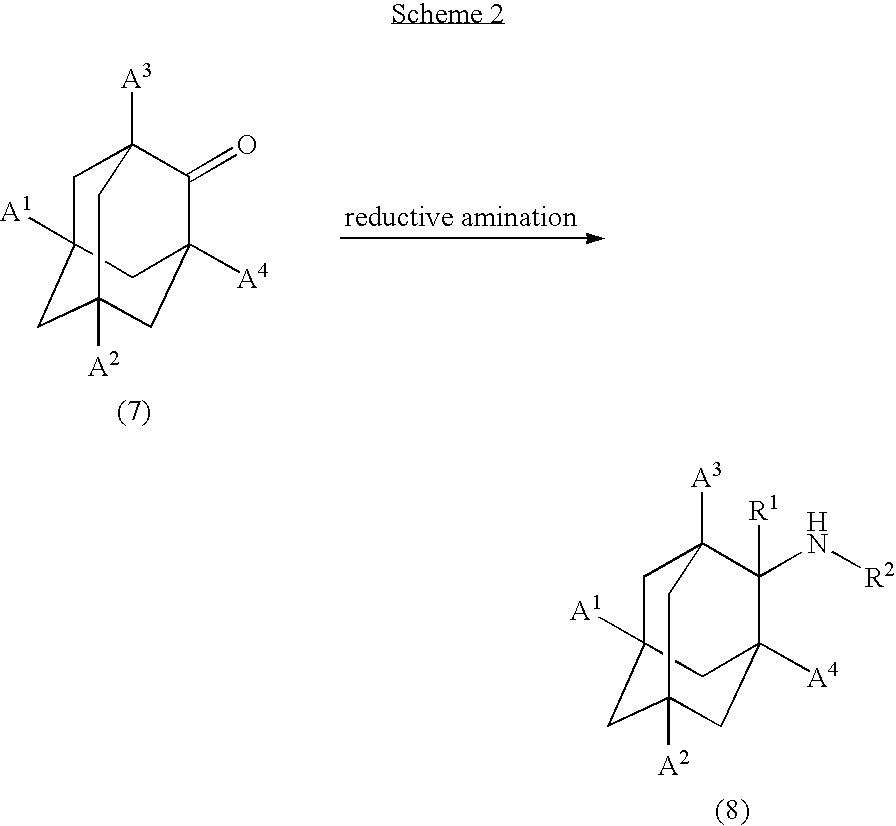
Examples
example 1
E-4-(2-methyl-2-phenoxy-propionylamino)-adamantane-1-carboxylic acid amide
example 1a
E- and Z-5-hydroxy-2-adamantamine
[0463] A solution of 5-hydroxy-2-adamantanone (10 g, 60.161 mmoles) and 4 Å molecular sieves (5 g) in methanolic ammonia (7N, 100 mL) was stirred overnight at room temperature. The mixture was cooled in an ice bath, treated by the portionwise addition of sodium borohydride (9.1 g, 240.64 mmoles) and stirred at room temperature for 2 hours. The mixture was filtered and MeOH was removed under reduced pressure. The mixture was taken into DCM (100 mL), acidified with 1N HCl to pH=3 and the layers separated. The aqueous layer was treated with 2N NaOH solution to pH=12 and extracted three times with 4:1 THF:DCM. The combined organic extracts were dried (MgSO4) and filtered. The filtrate was concentrated under reduced pressure to provide the title compound as a white solid (9.84 g, 97.9%).
example 1b
E-2-bromo-N-(5-hydroxy-adamantan-2-yl)-2-methyl-propionamide
[0464] A solution of E- and Z-5-hydroxy-2-adamantamine (0.868 g, 5.2 mmoles) in DCM (15.0 mL) and DIPEA (2.5 mL) was cooled in an ice bath and treated with 2-bromoisobutyryl bromide (0.72 mL, 5.8 mmoles) in DCM (2.5 mL). The mixture was stirred for 2 hours at room temperature and DCM was removed under reduced pressure. The residue was partitioned between water and ethyl acetate. The organic layer was washed with saturated sodium bicarbonate, water, dried (MgSO4) and filtered. The filtrate was concentrated under reduced pressure to provide the title compound as dark beige solid (1.17 g, 71%). The isomers were separated by column chromatography (silica gel, 5-35% acetone in hexane) to furnish 0.78 g of E-2-bromo-N-(5-hydroxy-adamantan-2-yl)-2-methyl-propionamide and 0.39 g of Z-2-bromo-N-(5 -hydroxy-adamantan-2-yl)-2-methyl-propionamide.
PUM
| Property | Measurement | Unit |
|---|---|---|
| Molar density | aaaaa | aaaaa |
| Molar density | aaaaa | aaaaa |
| Molar density | aaaaa | aaaaa |
Abstract
Description
Claims
Application Information
 Login to View More