Unlock instant, AI-driven research and patent intelligence for your innovation.

Thermoresponsive polymer and production method thereof

a thermoresponsive polymer and polymer technology, applied in the field of thermoresponsive polymer, can solve the problems of difficult to express critical solution temperature, apt change of critical solution temperature, etc., and achieve the effects of good thermoresponse, excellent effect, and small variation width of critical solution temperatur

Active Publication Date: 2007-08-30
JNC CORP
View PDF2 Cites 5 Cited by
  • Summary
  • Abstract
  • Description
  • Claims
  • Application Information

AI Technical Summary

Benefits of technology

The present invention provides a specific monomer component with a functional group that can regulate thermoresponse. This monomer can be polymerized to create a thermoresponsive polymer with good thermoresponse and stability in aqueous solutions containing buffer or salt. The polymer can be used in various applications without selecting a specific solution for separation. The technical effect of this invention is the creation of a versatile thermoresponsive polymer that can be used in various applications.

Problems solved by technology

However, a polymer having a critical solution temperature has a problem in that the critical solution temperature is apt to change greatly caused by the interfusion of a salt or increase of pH, and the critical solution temperature therefore becomes difficult to be expressed.

Method used

the structure of the environmentally friendly knitted fabric provided by the present invention; figure 2 Flow chart of the yarn wrapping machine for environmentally friendly knitted fabrics and storage devices; image 3 Is the parameter map of the yarn covering machine
View more

Image

Smart Image Click on the blue labels to locate them in the text.
Viewing Examples
Smart Image
  • Thermoresponsive polymer and production method thereof
  • Thermoresponsive polymer and production method thereof
  • Thermoresponsive polymer and production method thereof

Examples

Experimental program
Comparison scheme
Effect test

example 1

Synthesis of N-acryloylasparagineamide

[0054]A 5 ml portion of acrylic acid chloride and 200 ml of diethyl ether were put into a 500 ml capacity eggplant type flask and stirred on an ice bath. Next, 1.84 g of asparagineamide hydrochloride (mfd. by Kokusan Kagaku) was dissolved in 40 ml of deionized water, and 3 g of potassium carbonate was dissolved in 20 ml of deionized water. The asparagineamide aqueous solution was mixed with the potassium carbonate aqueous solution. The mixed liquid was added dropwise into the eggplant type flask spending 10 minutes while stirring constantly, and the mixture after completion of the dropwise addition was stirred for 24 hours. Diethyl ether layer in the thus obtained reaction liquid was discarded, and the water layer was concentrated at 25° C. under a reduced pressure. One liter of acetone was added to the thus obtained residue and stirred for 1 hour. The insoluble solids were removed by suction filtration. By recrystallizing from the acetone layer...

example 2

Synthesis of N-acryloylglutamineamide

[0058]A 5 ml portion of acrylic acid chloride and 200 ml of diethyl ether were put into a 500 ml capacity eggplant type flask and stirred on an ice bath. Next, 2 g of glutamineamide hydrochloride (mfd. by Kokusan Kagaku) was dissolved in 25 ml of deionized water, and 3 g of potassium carbonate was dissolved in 25 ml of deionized water. The glutamineamide aqueous solution was mixed with the potassium carbonate aqueous solution. The mixed liquid was added dropwise into the eggplant type flask spending 10 minutes while stirring constantly, and the mixture after completion of the dropwise addition was stirred for 24 hours. Diethyl ether layer in the thus obtained reaction liquid was discarded, and the water layer was concentrated at 25° C. under a reduced pressure. A 500 ml portion of acetone was added to the thus obtained residue and stirred for 1 hour. The insoluble solids were removed by suction filtration. By recrystallizing from the acetone laye...

example 3

Synthesis of N-methacryloylasparagineamide

[0062]A 11.3 ml portion of methacrylic acid chloride, 1 g of asparagineamide hydrochloride (mfd. by Kokusan Kagaku) and 50 ml of diethyl ether were put into a 300 ml capacity eggplant type flask and stirred on an ice bath. Next, 20 ml of saturated potassium carbonate aqueous solution was added dropwise thereto. Thereafter, this was stirred on an ice bath for 30 minutes and then at room temperature for 12 hours. Diethyl ether layer in the thus obtained reaction liquid was discarded, and the water layer was dissolved in 100 ml of methanol. After filtration, the filtrate was concentrated under a reduced pressure and fractionated by a silica gel column using methanol as the developing solvent. The thus obtained amide compound fraction was purified using an ion exchange resin (“Dynaion (trade name) PA 412” mfd. by Mitsubishi Kagaku) After concentration under a reduced pressure and subsequent drying under a reduced pressure, 0.43 g of colorless cr...

the structure of the environmentally friendly knitted fabric provided by the present invention; figure 2 Flow chart of the yarn wrapping machine for environmentally friendly knitted fabrics and storage devices; image 3 Is the parameter map of the yarn covering machine
Login to View More

PUM

PropertyMeasurementUnit
temperatureaaaaaaaaaa
Login to View More

Abstract

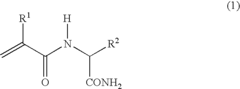
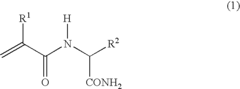
A material which expresses its critical solution temperature even in an aqueous solution containing a buffer or salt, and at the same time, shows small variation width of the critical solution temperature even when concentration of salt or the like contained in water, a buffer liquid or the like is different, interacts with a substance such as a component in the living body and can therefore be used efficiently in the isolation of substances, is provided. A monomer represented by a formula (1) and a thermoresponsive polymer which contains said monomer as a polymerization component.

Description

BACKGROUND OF THE INVENTION[0001]1. Field of the Invention[0002]This invention relates to a thermoresponsive polymer, which can change and regulate its polarity and hydrogen bonding performance by changing temperature, and a production method thereof.[0003]2. Background Art[0004]In a compound in which its structure is changed by temperature, pH, light or the like stimulus, its hydrophilic property, hydrophobic property and the like polarities are changed accompanied by its structural changes. A thermoresponsive polymer is known as a compound which causes a structural change by temperature. Illustratively, poly(N-acryloylglycineamide) can be exemplified. This polymer is characterized in that the polymer is dissolved in an aqueous solution when its temperature becomes 38 to 39° C. or more, and the polymer is in-solubilized at 35 to 36° C. or less. This means that it has an upper critical solution temperature (e.g., see Non-patent Reference 1).[0005][Non-patent Reference 1] Howard C. H...

Claims

the structure of the environmentally friendly knitted fabric provided by the present invention; figure 2 Flow chart of the yarn wrapping machine for environmentally friendly knitted fabrics and storage devices; image 3 Is the parameter map of the yarn covering machine
Login to View More

Application Information

Patent Timeline
no application Login to View More
Patent Type & Authority Applications(United States)
IPC IPC(8): C08F26/00
CPCC08F220/60C07C237/22C08F220/603C08F220/56C08F222/38
Inventor NAGAOKA, HIROKAZUOHNISHI, NORIYUKIEGUCHI, MASARU
Owner JNC CORP