
Lipid therapy
a lipid therapy and carrier potential technology, applied in the field of lipid therapy, can solve the problems of incomplete protection, achieve the effect of improving the carrier potential of nascent hdl to, and improving the reverse cholesterol transpor
- Summary
- Abstract
- Description
- Claims
- Application Information
AI Technical Summary
Benefits of technology
Problems solved by technology
Method used
Image

Examples
Embodiment Construction
[0032]The following embodiments describe techniques and devices directed, in one aspect, at improving reverse cholesterol transport by the aqueous diffusion pathway or the microsolubilization parthway.
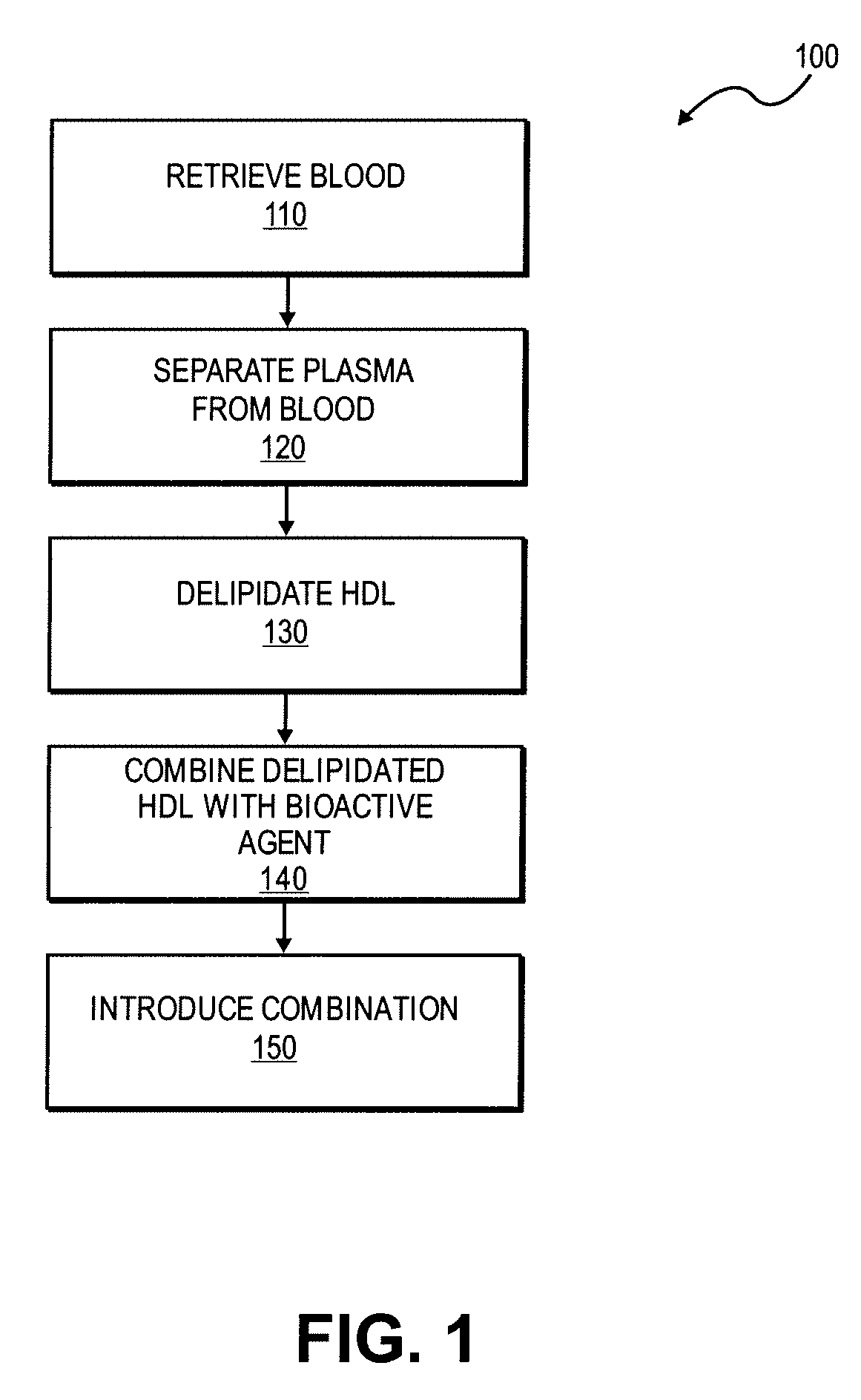
[0033]FIG. 1 shows a process scheme for delipidating HDL (e.g., α-HDL) from blood plasma and introducing the delipidated HDL into the blood with or without an adjuvant, such as Apo A1 or a mutant or mimic thereof. The technique, in one embodiment, enhances the carrier potential of nascent HDL available to accept cholesterol, particularly cholesterol translocated from intracellular sites by way of the microsolubilization pathway. Referring to FIG. 1, process 100 describes a method of retrieving blood from a patient (block 110) and then separating plasma from the blood (block 120). The plasma may be separated from the blood by known techniques, such as filtration or centrifugation. The separated plasma will typically contain LDL and HDL.
[0034]Following separating plasma from the blood, t...
PUM
| Property | Measurement | Unit |
|---|---|---|
| Density | aaaaa | aaaaa |
| Solubility (mass) | aaaaa | aaaaa |
| Area | aaaaa | aaaaa |
Abstract
Description
Claims
Application Information
 Login to View More