First, the container is repeatedly opened over an extended period of time, thereby repeatedly exposing the control solution to contaminants in the air and on surfaces, such as the user's fingers, which carry contaminants.
In addition, because the users of such control solutions often have poor dexterity (such as diabetics), the user frequently fumbles the cap and may drop the cap, which may further contaminate the solution.
If it is determined that the control solution has become contaminated the entirety of the control solution must be thrown away, and a new container opened, which can become costly.
Moreover, when this happens, a new container of control solution may not be readily available to the user, possibly leaving him or her in a medically risky situation.
Furthermore, such prior art control solution containers are problematic in that, because such a relatively large volume of the control solution is provided, the
efficacy of the control solution may expire well before a majority of the control solution is used, which also adds to the cost of treating the patient.
The shelf-life of the control solution sealed within its original containment is usually about 1 to 2 years, but once the user opens the solution container, the shelf-life quickly drops to only a few months due to the
contamination problem mentioned above.
Also, the user may forget to replace the cap on the container causing the control solution to evaporate thereby changing the
analyte concentration which results in erroneous values.
Additionally, it is difficult to precisely and accurately dispense the requisite volume of the control solution from within such prior art containers.
The volume dispensed is highly user dependent in that the user may apply too much control solution by over-squeezing the container or may apply too little solution by not squeezing enough.
There is yet another drawback of prior art control solution dispensers: while advancements are rapidly being made in the development of systems and devices for measuring
analyte concentrations, there has been limited advancement in the area of control solution containment and dispensing for use with these advanced systems and devices.
While the prior art control solution dispensers can be used in this case to evaluate the
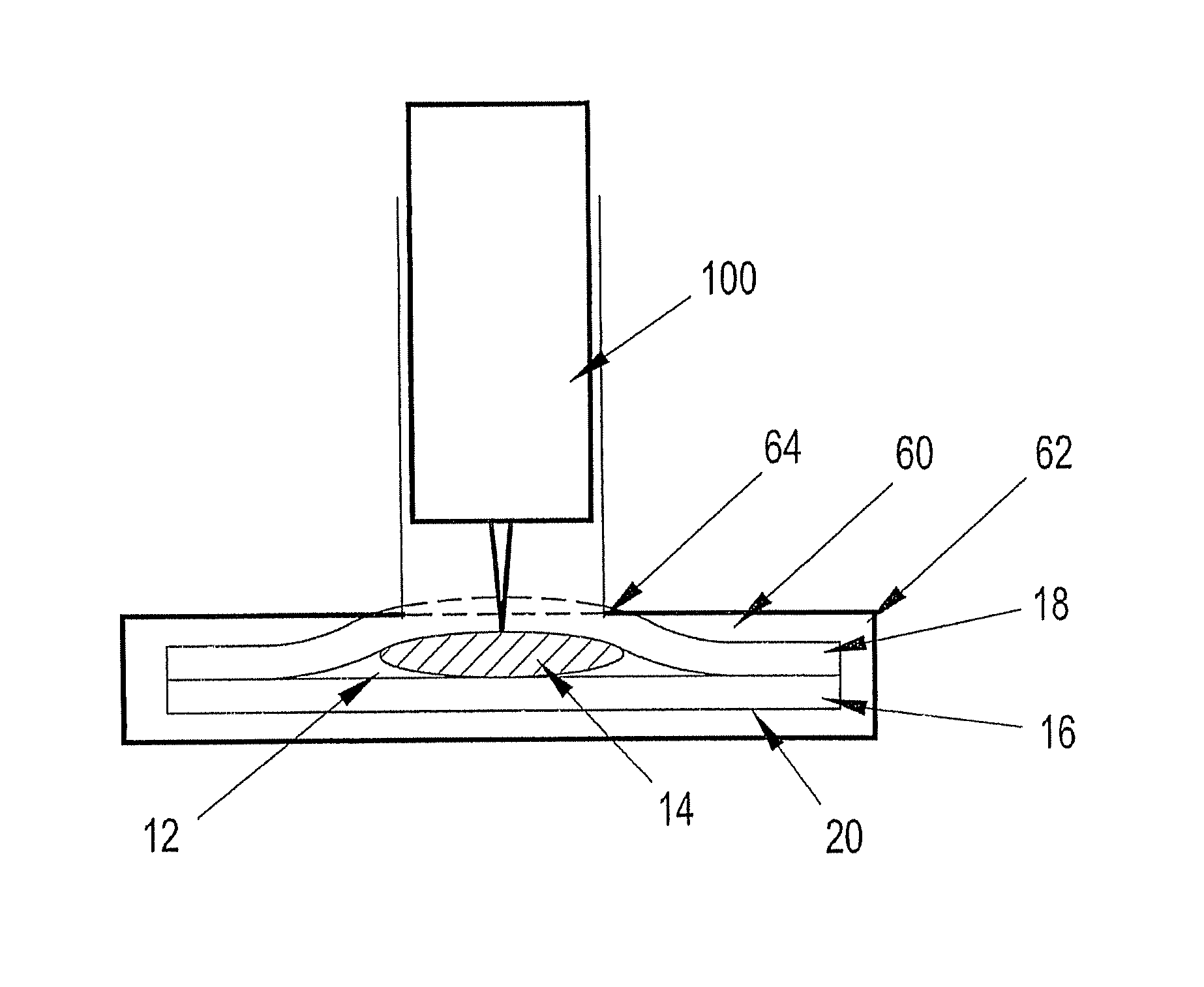
test strips by dispensing a droplet of control solution on to the designated sensor area of the test strip as mentioned above, there is no provision for evaluating the effectiveness of the integrated microneedle.
One could deposit a droplet of control solution onto a sterilized substrate and position the microneedle tip within the droplet to evaluate the effectiveness of the
capillary channel; however, such requires an additional component and additional steps with a very high risk of
contamination of the control solution if the substrate is not adequately sterilized.
Even if a sterile substrate can be ensured, there is no means to truly mimic operating conditions wherein the needle is dispensed in a manner to penetrate the
skin surface and wick accessed fluid there beneath.
More specifically, factors like the needle's ability to penetrate
skin at the speed, angle and depth as occurs under actual operating conditions, the needle's tip strength, and the needle's ability to provide suitable
capillary action to fluid from within a
solid medium, are unable to be evaluated.



 Login to View More
  Login to View More