[0003]To avoid damaging the wafer during the transport process, various wafer
pickup devices have been developed. The particular application or environment from which the wafer is lifted often determines the most effective type of
pickup device. One class of pickup devices, known as Bernoulli wands, is especially well suited for transporting very hot wafers. Bernoulli wands formed of
quartz are especially advantageous for transporting wafers between high temperature chambers since
metal designs cannot withstand such high temperatures and / or can contaminate wafers at such elevated temperatures. The
advantage provided by the Bernoulli wand is that the hot wafer generally does not contact the pickup wand, except perhaps at one or more small locators positioned outside the wafer edge on the underside of the wand, thereby minimizing contact damage to the wafer caused by the wand. Bernoulli wands for high temperature wafer handling are disclosed in U.S. Pat. No. 5,080,549 to Goodwin et al. and in U.S. Pat. No. 6,242,718 to Ferro et al., the entire disclosures of which are hereby incorporated herein by reference. The Bernoulli wand is typically mounted at the front end of a
robot or wafer handling arm.
[0004]In particular, when positioned above the wafer, the Bernoulli wand uses jets of gas to create a gas flow pattern above the wafer that causes the pressure immediately above the wafer to be less than the pressure immediately below the wafer. Consequently, the pressure imbalance causes the wafer to experience an upward “lift” force. Moreover, as the wafer is drawn upward toward the wand, the same jets that produce the lift force produce an increasingly larger repulsive force that prevents the wafer from contacting the Bernoulli wand. As a result, it is possible to suspend the wafer below the wand in a substantially non-contacting manner.
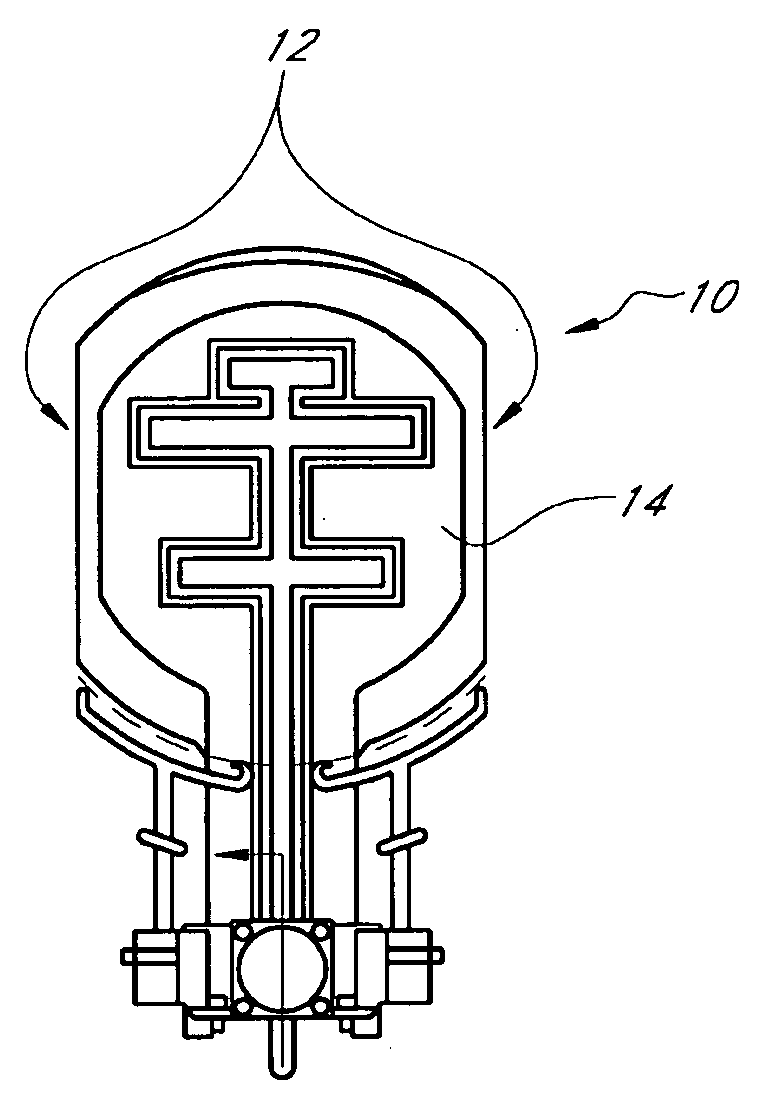
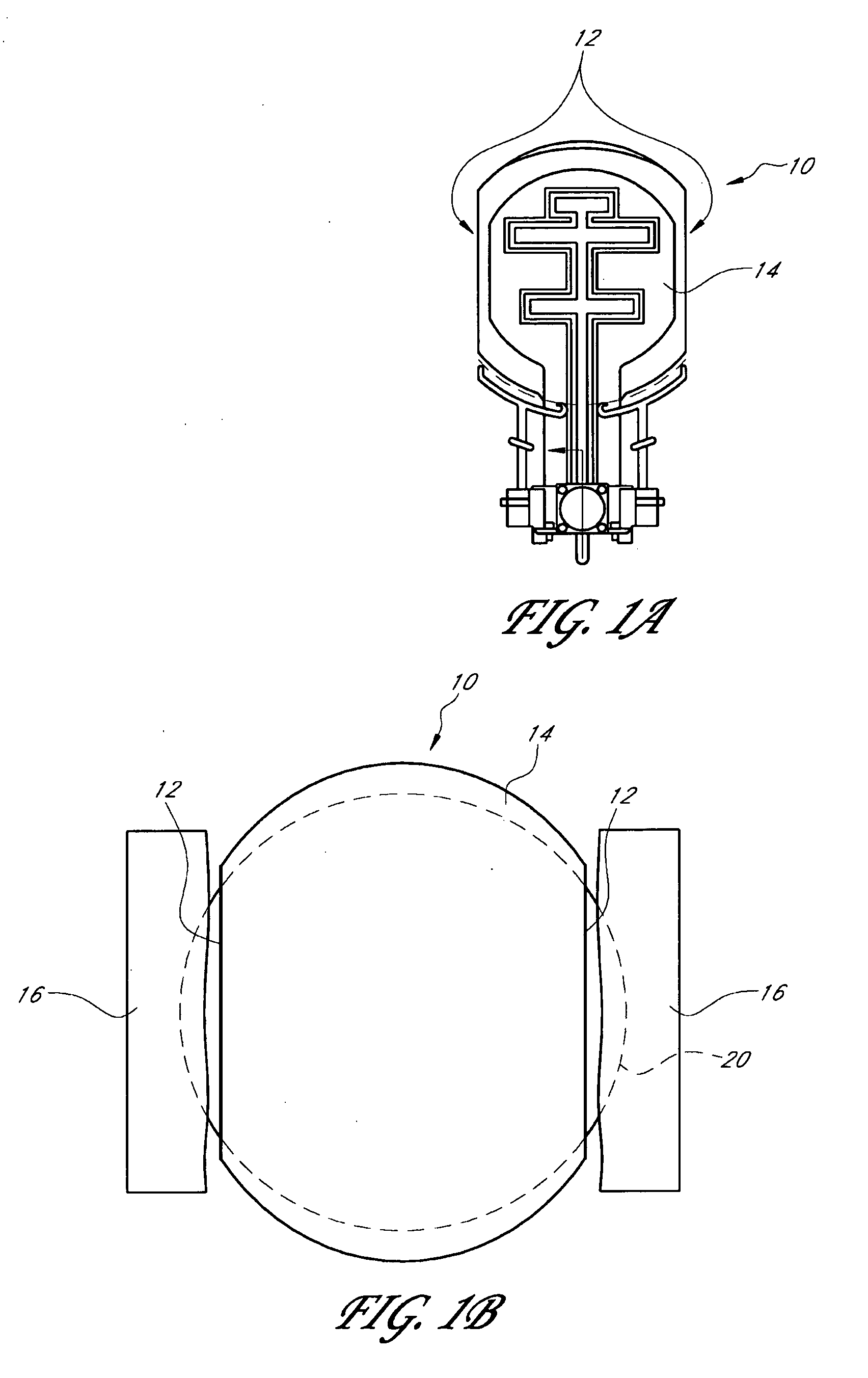
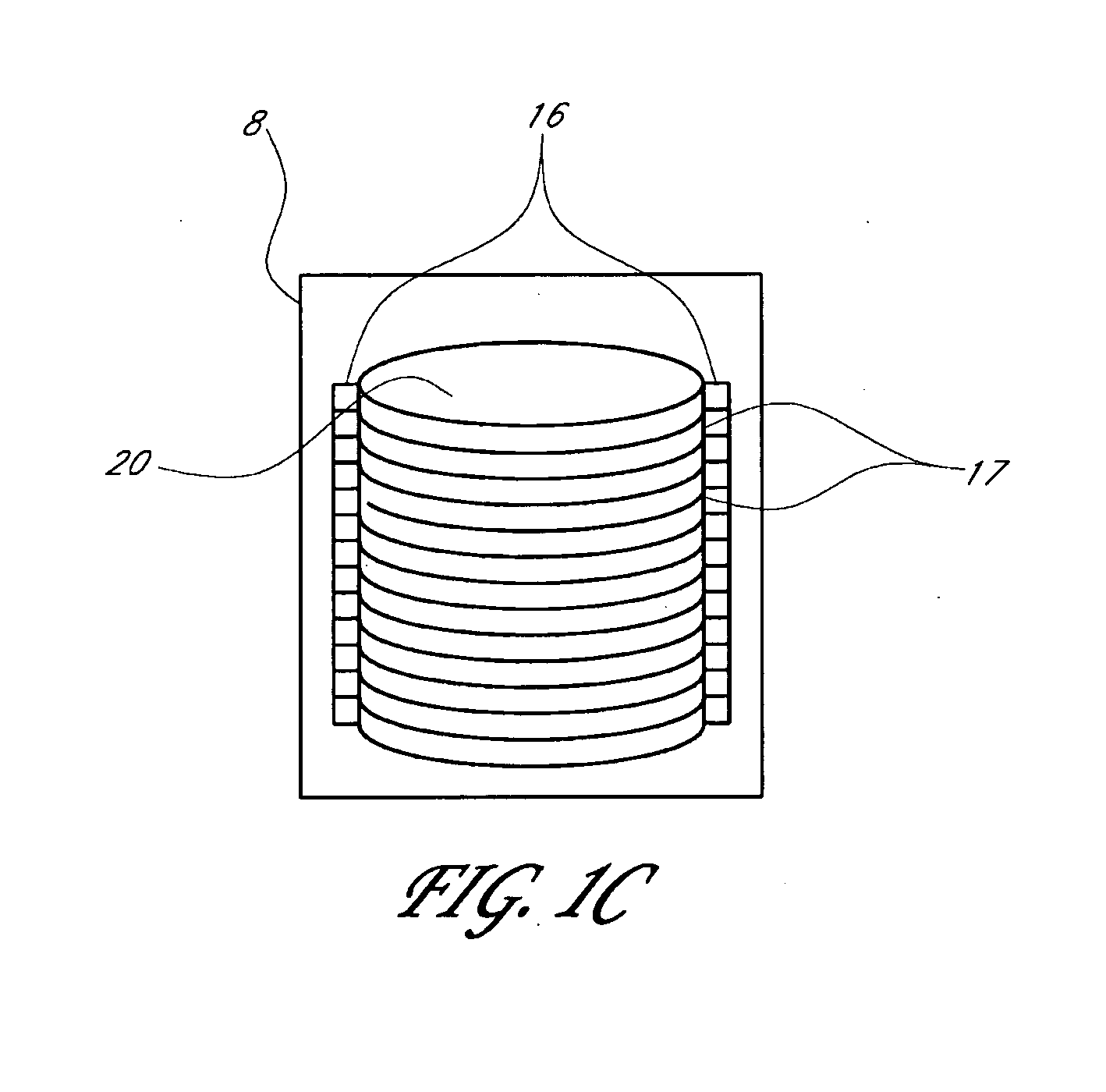
[0006]FIG. 1B is a plan view of the flat head portion 14 of the Bernoulli wand 10 between shelves 16 of a cassette rack. A typical cassette rack 8 with individual slots 17 is shown in FIG. 1C. Each slot 17 is capable of holding a wafer 20. Typically, these cassette racks 16 hold about 26 200 mm wafers in a vertical column. As shown in FIG. 1B, the truncated sides 12 allow the Bernoulli wand 10 to be inserted between the shelves 16 of a cassette rack. When loaded into a slot 17 (FIG. 1C) of the cassette rack 8, opposite
peripheral edges (which are left “uncovered” by the truncated sides 12) of a wafer 20, shown by dotted line 20 in FIG. 1B, are horizontally supported by the shelves 16 of the cassette rack 8 while the Bernoulli wand 10 is inserted between the shelves 16. The Bernoulli wand 10 having the truncated sides 12 is configured such that it can fit between the shelves 16, thereby allowing for a fairly densely stacked cassette rack 8.
[0007]During loading into a hot process chamber, and especially onto the hot surface of a
susceptor, a wafer will typically become distorted because the lower part of the wafer heats up more quickly than the upper part, as is well known in the art. This uneven heating creates a temporary
distortion of the wafer referred to as “curl” or “
curling”. Curl is particularly problematic in a process chamber having a temperature over 400 degrees Celsius. This curl effect can occur very rapidly when a
room temperature wafer is being placed on a hot substrate holder, such as a
susceptor. If rapid enough, the effect can make the wafer jump on contact and can move the wafer away from its desired position on the
susceptor.
[0009]The design shown in FIGS. 1A-1C has been found particularly problematic. Due to the open sides that facilitate use with cassettes, it has been found that the front side of a
curling wafer, where
active devices are formed, can be scratched by the truncated sides 12 of the Bernoulli wand 10 if the wafer curl is severe enough to cause contact between the wafer and wand 10. It has also been determined that the truncated sides 12 of the wand 10 also promote the degree of curl by increasing the temperature differential across the wafer as a result of allowing the wafer area under the truncated portion to have
direct radiation applied to it. The portions of the wafer under the non-truncated portion of the Bernoulli wand 10 act to filter some of the
radiation to the wafer.



 Login to View More
  Login to View More